Place of Publication: Libbysville, Port Clarence, Russian America (Nos. 1-10, 1866-1867), and Camp Libby, Plover Bay, East Siberia (Nos. 11 and 12, 1867)
Size and Format: 52 pages; manuscript and printed editions
Editor/Publisher: John J. Harrington, editor; Turnbull and Smith (San Francisco), publisher of printed numbers
Title Changes and Continuation: None
General Description & Notes:
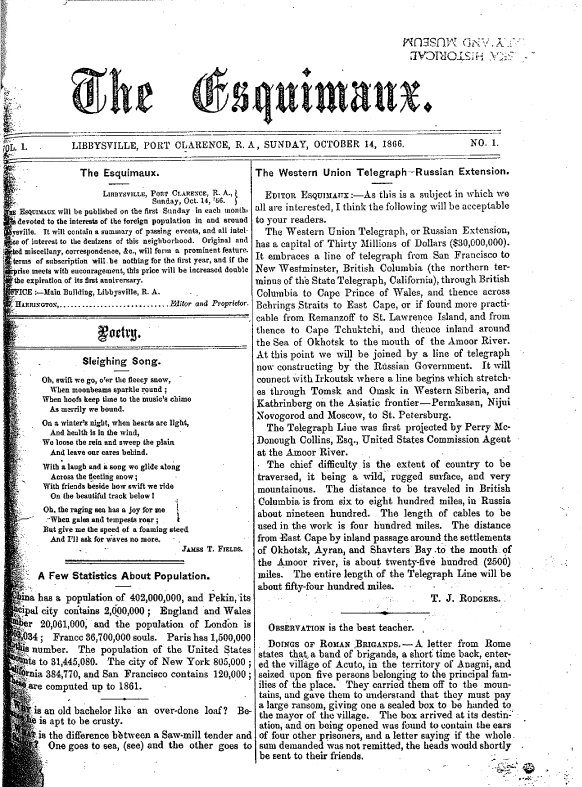
The Esquimeaux (AK, 1866-1867)
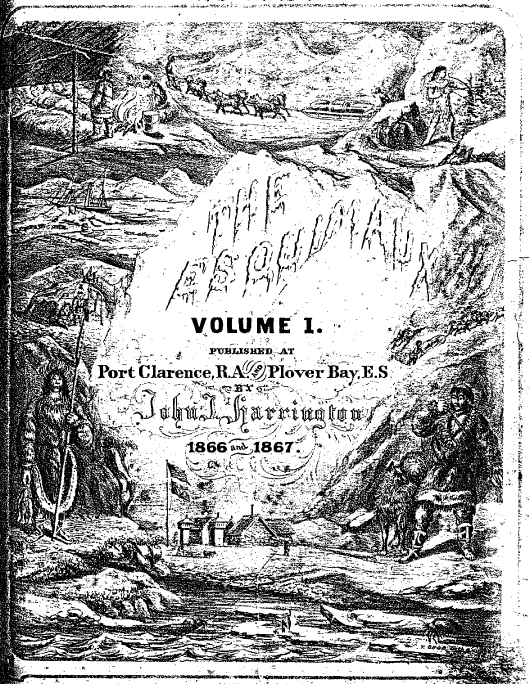
According to Wickersham, this monthly publication, of which Nos. 1 to 10 inclusive were published in Libbysville, Port Clarence, Russian America, and Nos. 11 and 12 in Camp Libby, Plover Bay, Eastern Siberia, appeared in both manuscript and later print.
The paper provided information of the workers building the Western Union Telegraph Expedition line planned from the United States in Seattle on Puget Sound, via the Fraser and Yukon rivers, to Port Clarence and then across the Bering Strait to Plover Bay and on to points in Asia and Europe.
After the abandonment of the project, because of the success of the Trans-Atlantic cable in 1866, and the U.S. purchase of Russian Alaska in March 1867 for $7 million, the manuscript was taken to San Francisco and printed there by the editor. The editor’s preface is dated Oct. 31, 1867.
The Esquimeaux (AK, 1866-1867)
Information Sources:
Bibliography: James Wickersham, A Bibliography of Alaska Literature, 1724-1924 (Cordova, Ak.: Cordova Daily Times Print, 1927), 258
Citations: Daily Evening Bulletin (San Francisco, California), Monday, December 02, 1867; Issue [47]
Place of Publication: Cape Prince of Wales, A.M.A. Mission School, Alaska (1893, 1902)
Frequency: Annual? “Only Yearly in the World”
Volume and Issue Data: March 24, 1893-Vol. 5, May, 1902?
Size and Format: 7 1/4 x 10 3/4 inches; some handwritten and mimeographed, some printed
Editor/Publisher: W.T. Lopp (1894-1902); Oo-ten-na, Eskimo engraver; Kiok, I-ya-tunk-uk and Ad-loo-at, compositors; American Missionary Association Mission School
Title Changes and Continuation: None
General Description & Notes:
See image
Information Sources:
Bibliography: James Wickersham, A Bibliography of Alaska Literature, 1724-1924 (Cordova, Ak.: Cordova Daily Times Print, 1927), 258
Place of Publication: “Editor’s office, Starboard Front Cabin, ‘Thames City,'” en route from Gravesend, England to Vancouver Island, British Columbia, Canada
Frequency: Weekly (“read aloud each Saturday night, the day of publication, by the commanding officer, Capt. H.R. Luard, R.E.”)
Volume and Issue Data: 17 numbers issued: No. 1, Nov. 6, 1858 to No. 17, April 2, 1859; not published during three week layover at Falkland Islands
Size and Format: 10.75 x 18 inches; pre-printed title/masthead; pen and ink
Editor/Publisher: Second Corporal Charles Sinnett, R.E., assisted by Lt. H.S. Palmer, R.E.
Title Changes and Continuation: None
General Description & Notes:
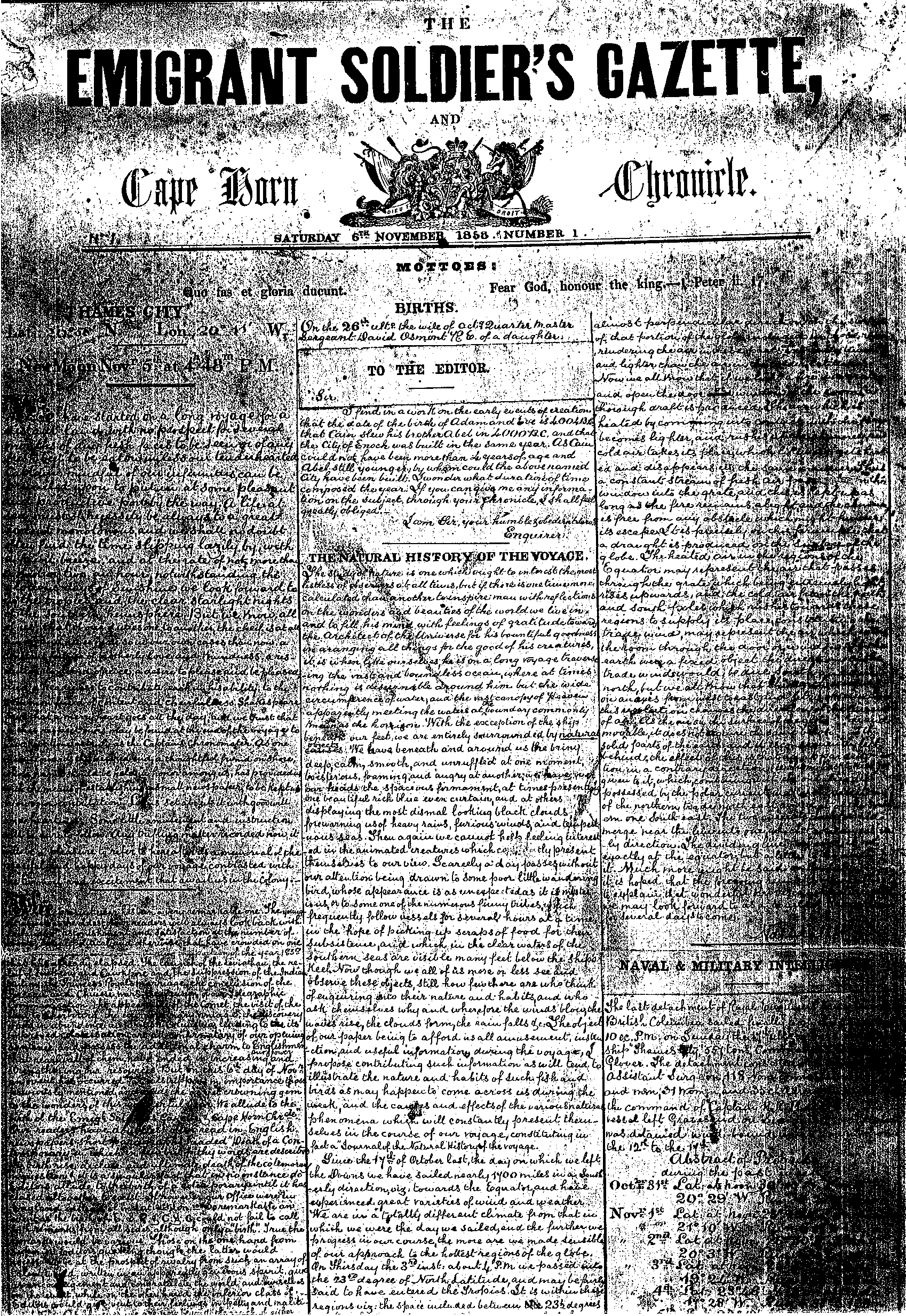
Contains a news section, natural history of the voyage, correspondence, conundrums, naval and military intelligence, songs, poetry, jokes, advertisements, foreign intelligence and market intelligence.
The Emigrant Soldiers Gazette and Cape Horn Chronicle was published originally in manuscript form on board the ship “Thames City,” which sailed from Gravesend, England, on October 10, 1858 and reached Esquimalt, Vancouver Island, British Columbia on April 12, 1859. Aboard the ship was a detachment of Royal Engineers selected for service in B.C.
The paper was edited by Second Corporal Charles Sinnett, R.E., and assisted by Lt. H.S. Palmer, R.E. Each Saturday night, the day of publication, the paper was read aloud by the ship’s commanding officer, Captain H.R. Luard, R.E.
The first issue explained that as one of the ways to avoid monotony and “keep a merry heart,”
[A] thoughtful friend on shore, whose name should be held in honour among us, has provided us with the means of establishing a small Newspaper, to be kept up by our own contributions. Let us set about it with good will and heartiness. Some little amusement and instruction will be sure to follow. Any trifling matter recorded now will be a pleasure to refer to hereafter as a memorial of the peaceful and happy days of our voyage.
The first issue also published a notice “To Correspondents,” as a guide to contributors:
1. In future, contributions of Leading Articles on any subject are requested to send them in to the Editor by noon every Thursday, and all other contributions should be sent in by 8 o’clock the same evening, to give ample time for publishing the paper.
2. Any person willing to answer letter addressed “To the Editor,” are invited to do so, addressing their answers in the same manner.
3. The answers to Charades and Conundrums will be published the Saturday after they appear, and any person guessing an answer, may learn on application to the Editor or Sub-Editor if he is right or wrong. But is hoped correct guessers will keep their secret.
The paper maintained a regular front page news section and other regular sections, such as “Natural History of the Voyage,” “Correspondence,” “Conundrums,” “Naval and Military Intelligence,” “Songs and Poetry,” “Jokes,” “Foreign Intelligence,” “Market Intelligence,” and “Advertisements.”
The printed edition of the paper included a map detailing the ship’s route and marking its locations on the dates of publication.
After the arrival of the Thames City at New Westminster, B.C., the men aboard the ship paid to have the paper printed as a souvenir of their voyage. The “British Columbian” newspaper in New Westminster printed the paper from the manuscript originals.
In Volume One–”To the correspondents 1. In the future, contributors of Lending Articles on any subject are requested to send them in to the editor by noon every Thursday, and al other contributions should be sent in by eight o’clock the same evening, to give ample time for publishing the paper. 2. Any person willing to answer letters addressed “To the Editor,” are invited to do so, addressing their answers in the same manner. 3. The answers to the Charades and Conundrums will be published the Saturday after they appear, and any person guessing an answer may learn on application to the Editor or Sub-Editor if he is right or wrong. But it is hoped correct guessers will keep their secret.”
Preface to the published collection: [Printed by R. Wolfenden, 1907]
“The ESGCHC was published originally in manuscript form, on board the ship “Thomas City,” which was sailed from Gravesend on the 10th of October, 1858, and reached Esquimalt, V. I. on the 12th April, 1859, having on board a Detachment of Royal Engineers selected for service in B.C. The paper was edited by Second-Corporal, Charles Sinnett, R.G., assisted by Lt. H. S. Palmer, R.G. and was read aloud each Saturday night, the day of publication, by the commanding officer, Captain H.R. Luard, R.G. After the arrival of the Detachment of the camp, New Westminster, it was thought advisable to have this most interesting journal printed for distribution amongst the members of the Detachment. This was done, at the men’s expense, at the office of the “British Columbia,” New Westminster, by the late John Robson.
From No. 1 [11/6/58]–p.1 “As one means towards this desired end [to avoid monotony and keep a merry heart], a thoughtful friend on shore, whose name should be held in honour among us, has provided us with a means of establishing a small Newspaper, to be kept up by our own contributors Let us set about it with good will and heartiness. Some little amusement and instruction will be sure to follow. Any trifling matter recorded now will be a pleasure to refer to hereafter as a memorial of the peaceful and happy days of our voyage.
Information Sources:
Bibliography: Emigrant Soldiers Gazette and Cape Horn Chronicle (Printed by R. Wolfenden, 1907); Roy Atwood, “Shipboard News: Nineteenth Century Handwritten Periodicals at Sea,” Paper Presentation to the History Division of the Association for Education in Journalism and Mass Communication Annual Convention, Chicago, IL, 1997; Reprint, New York Public Library.
Locations: British Columbia Archives and Records Services, Victoria, British Columbia; (printed edition) The Bancroft Library, University of California, Berkeley, California; New York Public Library, New York.
Place of Publication: Shipboard Alhambra en route to California gold fields (1849)
Frequency: Weekly; irregular
Volume and Issue Data: The Alhambra departed New Orleans in the fall, 1849; only four numbers issued; known dates: No. 3, Sept. 5; No. 4, Sept. 20, 1849
Size and Format: “Two sheets of foolscap, closely written out in full”
Editor/Publisher: “Mr. Moss”
Title Changes and Continuation: None
General Description & Notes:
The Emigrant was published aboard the Alhambra, a ship which embarked for California from New Orleans in the fall of 1849. The ship’s paper was supposed to be published weekly during the voyage, but lasted only four numbers.
The Ship Alhambra
The Alhambra’s master, Captain George Coffin, filled more than half of each issue with his own compositions of rhyme and verse. In his privately printed memoirs, Captain Coffin noted, “On Saturday, August 23rd, appeared the first number of ‘The Emigrant.’ It consisted of two sheets of foolscap closely written out in full by Mr. Moss.”
Coffin claimed the paper “was well received, the reading matter was various, to please all tastes, and the croakers were silenced.” He also claims audience response was so enthusiastic that when the second installment was ready on August 30, measures had to be taken to preserve order among the passengers. “So great was the desire to get hold of it that it was voted that one of the passengers should read it aloud to the rest.” A freshly minted medical school graduate, Dr. Clark, was selected to read the poem. Captain Coffin noted the doctor “placed himself on the capstan, and the rest of the company gathered round, some standing, others seated about on spare spars, water casks, or whatever else they could find.” The Captain-author, however, found that his work was not read with proper fire and feeling. This lack of force and ability, according to Coffin, explained why the young doctor had no doubt failed in his chosen profession.
The Emigrant’s third issue, published Sept. 5, 1849, featured another of Captain Coffin’s poems, “Simon Spriggin’s Soliloquy.” The issue also contained an advertisement:
WANTED: A few degrees of south latitude. Any person being able to furnish them shall be installed an honorary member of the Committee on Navigation. Apply at the Surgeon’s office.
The Committee on Navigation was the title ironically given a group of the Alhambra’s passengers who were in the habit of offering the ship’s officers unsolicited advice on how to improve the operation of the vessel.
The Alhambra’s newspaper struggled through one more issue, then died. Captain Coffin noted its passing: “From this time ‘The Emigrant’ languished for want of sustenance; it did not appear the next Saturday. It made one more effort on Saturday, September 20th, and then gave up the ghost. The editorial valedictory had some reference to ‘casting pearls before swine . . .'” (p. 50). Simon Spriggins bowed himself out with a final poem, the inspirational character of which may be gathered from this stanza:
“Your saddle bags shall yet be filled
With Sacramento’s glittering ore.
Your doubts and fears shall all be still’d
And troubles come not near you more.” (p. 51)
Lewis notes that The Emigrant and other shipboard newspapers (see, e.g., BAROMETER, THE PETREL, and SHARK) “lacked the formality of print but more nearly approached conventional journalism” than the various travel journals and diaries kept during the voyages.
According to Captain Coffin’s accounts published after the voyage, (41) On Saturday, August 23, appeared the first number of “The Emigrant.” It consisted of two sheets of foolscap closely written out in fully by Mister Moss (Mr. Sam Moss, Jr. “ super Cargo) [p.12].
(43) The first number of “The Emigrant” was well received, the reading matter was various, and the croakers were silenced.
(45) Saturday, August 30–The second number of “The Emigrant” appeared promptly by this morning. So great was the desire to get hold of it, that it was voted that one of the passengers should read it aloud to the rest. The selected Doctor Clark as the reader. . . . He placed himself on the capstan, and the rest of the company gathered round, some standing, others seated about on spare spars, water casks, or whatever else they could find.
(49) September 6–The third number of “the Emigrant” appeared this day
Information Sources:
Bibliography: George Coffin, A Pioneer Voyage to California and Round the World, 1849-1852, Ship Alhambra (Chicago: privately printed, 1908); Oscar Lewis, Sea Routes to the Gold Fields: The Migration by Water to California in 1849-1852 (New York: A.A. Knopf, 1949), pp. 89-92; Roy Atwood, “Shipboard News: Nineteenth Century Handwritten Periodicals at Sea,” Paper Presentation to the History Division of the Association for Education in Journalism and Mass Communication Annual Convention, Chicago, IL, 1997.
According to Wikipedia , “the first publication in Elkhorn was a handwritten news bulletin reproduced on cyclostyle. Founded by F. Greenstreet in 1886, the Elkhorn Breeze was applauded by the Manitoba Free Press as ‘a credit to that prosperous young city.’ In spite of such praise The Breeze had ceased publication by the end of 1887.”
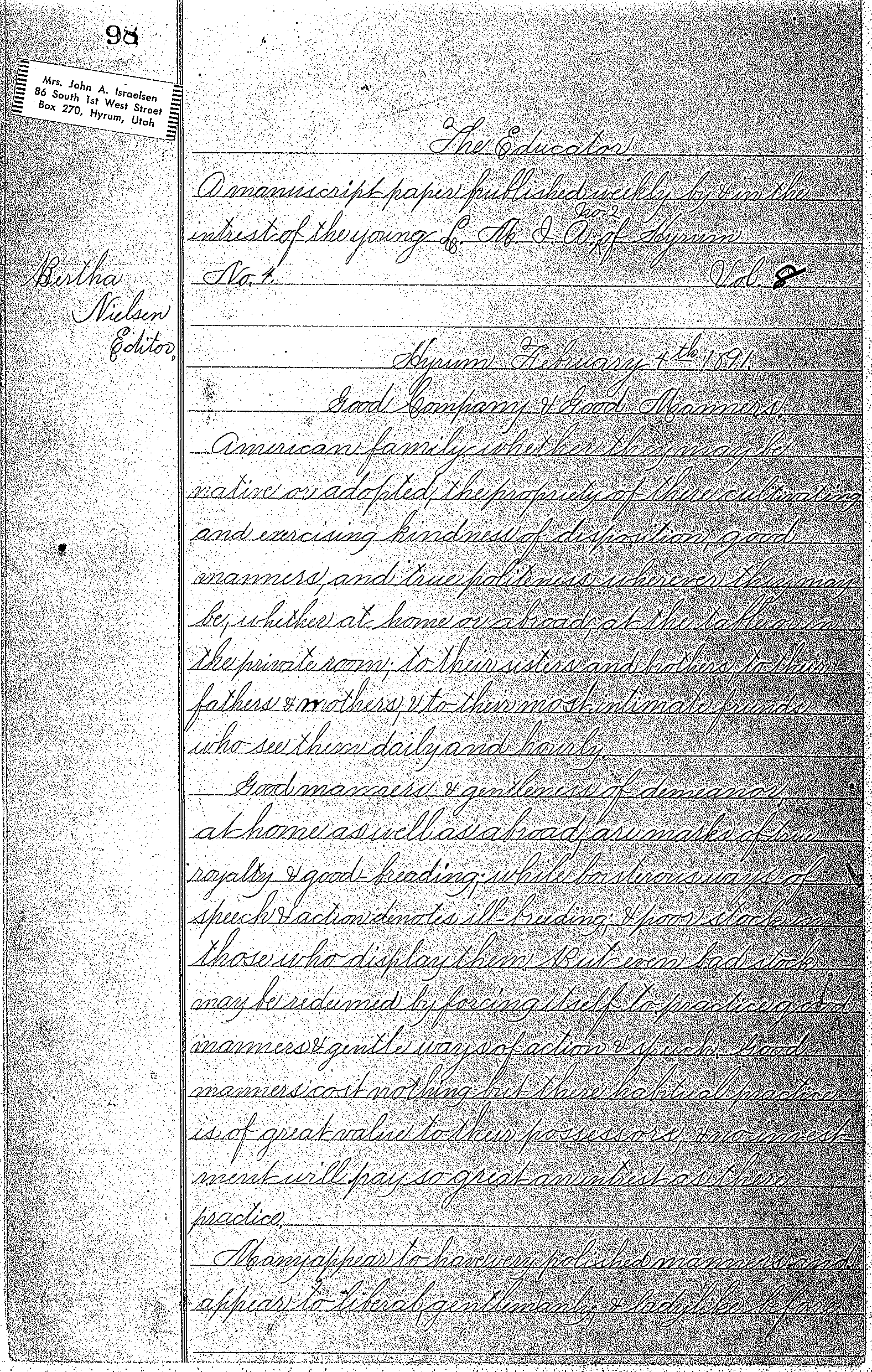
Volume and Issue Data: Vol. 8, No. 4, February 4, 1891
Size and Format: 7 3/4 x 13 inches, ledger book paper, single column
Editor/Publisher: Bertha Nielsen, editor; “A manuscript paper published weekly by & in the interest (sic) of the young L.M.I.A. No. 2 of Hyrum” (i.e., Young Ladies’ Mutual Improvement Assn.)
Title Changes and Continuation: Unknown
General Description & Notes
According to Alter, the Young Men’s and Young Ladies’ Mutual Improvement Associations in and around Hyrum, Utah published weekly literary journals largely in the interests and for the entertainment of their members during the late 1880s. The publications carried news, religious items and weather reports.
The Educator, along with “THE KNOWLEDGE SEEKER,” “THE YOUNG LADIES THOUGHTS,” “A MANUSCRIPT PAPER” and “THE EVENING STAR” were published by Mormon Mutual Improvement Associations under various editors, since officers in these organizations changed hands regularly.
Utah State University Special Collections and Archives has 25 file folders containing these various Mutual Improvement Association newspapers. They do not have a complete run of any of them, however.
Information Sources:
Bibliography: J. Cecil Alter, Early Utah Journalism (Salt Lake City: Utah State Historical Society, 1938), 90; Lorraine T. Washburn, “Culture in Dixie,” Utah Historical Quarterly, 29 (July 1961), 259-260; Mark A. Pendleton, “The Orderville United Order of Zion,” Utah Historical Quarterly, 7 (October 1939), 151.
Locations: John A. Israelson’s papers, Special Collections and Archives, Utah State University, Logan, UT
According to Lingenfelter and Gash, editor J.A. Talbott, a former printer from Calaveras, came to Potosi following a silver discovery in 1860 without printing equipment. Talbott justified publishing the East of the Nevada in its first issue: “The manifold wants of our community rendering it necessary, owing to our isolated position, shut out from those sources of information and instruction that is as familiar as ‘household words’ in a settled community, renders it necessary to have a vehicle of thought amongst us by which an interchange of intelligence should be disseminated, questions discussed, wit circulated, and those precious gems preserved, without which ‘this world would be a void.’ For this end, and under our peculiar circumstances, our sheet is issued.” The paper included a description of the principal mines of the district, a notice of the construction a theater and other local news. The paper probably ran only a few issues, since the silver boom in Potosi was exhausted by October 1860, and Talbott joined the rush to Holcomb Valley.
The short life of the Miner’s Voice included competition with another local handwritten newspaper, the Potosi Nix Cum Rouscht, edited by Capt. J.E. Stevens, president of the Colorado Mining Company and founder of Potosi.
Information Sources:
Bibliography: Robert F. Karolevitz, Newspapering in the Old West: A Pictorial History of Journalism and Printing on the Frontier (New York: Bonanza Books, 1969), p. 119; Richard E. Lingenfelter, The Newspapers of Nevada (San Francisco: John Howell-Books, 1964), 66-67; Richard E. Lingenfelter and Karen R. Gash, The Newspapers of Nevada (Reno: University of Nevada Press, 1984), pp. 170-171.
Index Sources: None
Locations: No issues located, but Feb. 19, 1861 issue (Vol. 1, No. 1) quoted in Los Angeles Star, March 9, 1861.
Volume and Issue Data: Vol. 1, No. 6, Oct. 8, 1898; only a few issues published
Size and Format: 8 x 10 inches; two pages; pen and ink
Editor/Publisher: Charles C. Carruthers, editor; F.L. Lowell, assistant
Title Changes and Continuation: None
General Description and Notes:
According to the McLean, the Tribune was an independent newspaper that provided community news and editorials on the differences between Canadian and American mining laws, customs and tariffs. The Tribune’s motto was “He that runs may read.” No price appears.
The Oct. 8, 1898 issue includes five advertisements and criticisms of Canadian officials and “their coadjutors, the B.C. press.” The paper was clearly unhappy with Canadian treatment of Americans in the eastern Alaska/Yukon mining region. Tribune editor Carruthers displayed a tendency to editorialize in almost every article. At the same time, he also records the names of many of the early arrivals in the country, pictures the difficulties between Canadians and Americans, and indicates the difficulties and dissatisfactions between labor and management.
Information Sources:
Bibliography: Dora E. McLean, Early Newspapers on the Upper Yukon Watershed: 1894-1907, unpublished M.A. thesis, University of Alaska, 1963, 38-43; James Wickersham, A Bibliography of Alaska Literature, 1724-1924 (Cordova, Ak.: Cordova Daily Times Print, 1927), 258; Melody Webb, Yukon: The Last Frontier (University of British Columbia Press/University of Nebraska Press, 1985/1993), p. 137; John McPhee, Coming into the Country (Bantam Books, 1979), p. 340.
Link: Melody Webb, Yukon: The Last Frontier (University of British Columbia Press/University of Nebraska Press, 1985-1993), p. 137
Place of Publication: Washington, Iowa; Sigourney, Iowa (1844)
Frequency: Quarterly?
Volume and Issue Data: Vol. 1, No. 1, April 1, 1844; at least three issues
Size and Format: Four pages, 13″x21″; three columns per page
Editor/Publisher: S.A. James
Title Changes and Continuation: None
General Description and Notes:
According to Littler, the first issue of the Domestic Quarterly Review was “without doubt the first document published in the county that at all approximated in dignity of appearance, manner and matter of regular newspaper issue.” Littler says the Review was a “12 column sheet, 3 wide columns to the page, and the pages were in size 13 by 21 inches” and “contained “probably as much matter in it as are found in regularly printed newspaper sheets of the same size.”
James described the Review as “a complete family, Young Lady or Gentleman’s newspaper” devoted “to Literature, Amusement and Particular Intelligence.” The Review was “written and published at the low price of $1.00 a year, invariably in advance, and will be mailed to subscribers so as to reach them on the first day of each quarter in any part of the United States.” James included a request that “Editors will confer a favor by giving the above notice (with this notice) an insertion.”
The editor of another local handwritten paper, the Quarterly Visitor, notes in that publication’s summer 1844 issue that “the printing office, publishing the ‘Quarterly Review,’ has removed to Sigourney in Keokuk Co.” The Keokuk County History of 1880, which made liberal use of interviews with James, says that he issued three numbers of his handwritten newspaper. The county history also notes that James lived in a small log cabin with his family for sometime after his move, so it seems doubtful that the “printing office” involved much more than the writing skills of James and perhaps his wife, Sarah.
Information Sources:
Bibliography: Nathan Littler, History of Washington County, (Iowa), 1835-1875, ed. by Edna Jones (Washington, Iowa: Jonathan Clark, 1977), 221-222; The History of Keokuk County, Iowa (Des Moines: Union Historical Company, 1880), 459-460; Roy Alden Atwood, “Handwritten Newspapers on the Iowa Frontier, 1844-1854,” Journalism History, 7:2 (Summer 1980), 56-59, 66-67.
Locations: No extant issues located, but quoted in Littler (1977).
Place of Publication: Denial Bay Township, Australia (west side of Eyre Peninsula, 500 miles from Adelaide)
Frequency: “Weekly”
Volume and Issue Data: November 14, 1908 (first issue) through 1909
Size and Format: Early editions were three columns. After the New Year, 1909, it went to two columns.
Editor/Publisher: Dr. C.T. Abbott (with Mrs. Abbott, assistant production officer and general press hand”) [Alan Finch, Pens & Ems]
Title Changes and Continuation: None
General Description and Notes:
In his history of Australian journalism, Alan Finch describes The Denial Bay Starter as “produced in a violent mauve ink on a hectograph in atrocious handwriting.” According to Finch, the first editorial, or leading article, explained the anonymous editor’s goals for the publication:
“Dear friends, this obscene sheet is only started with the intention of amusing you and gathering for your perusal any little items of news that may be brought to our notice. We do not wish to enter into the arguments that arise from burning questions of the hour, but will try to plainly set before you both the good and the bad points of any discussion. We should be willing to inscribe any letter or correspondence that the public may forward to us . . . we do not wish to hurt anyone’s feelings but if we inadvertently do so please tell us and we will strive to make atonement in every possible way.”
The editor went on to explain the title of the new paper: “. . . this is a starter and we hope to see in the near future a type printed paper which will bring the West Coast more prominently before the public than it has been hitherto.”
The paper was issued each Saturday, but the editor remained anonymous until shortly after the New Year 1909, when the editor’s name was included at the top of the paper: Dr. C.T. Abbott, a medical doctor and relative newcomer to the area.
Number 20 was produced with the aid of a typewriter and duplicating stencil.
In the January 29, 1910 edition, the editor announced the paper’s retirement:
“The time has come, when the Starter will retire from the arena, and cease to exist. But we hope that this year old infant, has been able to bring other thought and ideas to your minds, than you had previously, that it had been able to sow on rich ground, a few seeds which in the future will spring up. “
The editor, Dr. Abbott, brought the paper to an end because he moved to a new position at Pine Creek.
Information Sources:
Bibliography: Alan Finch, Pens & Ems in Australia: Stories of Australian Newspapers (Adelaide, 1965), pp. 12-18.
Locations: Public Library, Adelaide, Australia; National Library, Canberra, Australia
Frequency: Title says “daily” but actual frequency unknown; first printed editions were daily except Sundays
Volume and Issue Data: Vol. 1, No. 1, 1870-1882 (year of first printed edition)
Size and Format: Unknown
Editor/Publisher: Henry M. Whitney, J. W. Robertson
Title Changes and Continuation: The Daily Bulletin (1882-1895), Evening Bulletin (1895-1912)
General Description and Notes:
According the University of Hawai’i, the Daily Marine Bulletin edited by Henry M. Whitney began in 1870. He started the paper after he was forced to sell the Pacific Commercial Advertiser–the forerunner of the Honolulu Advertiser–amid criticism for his condemnation of the government’s role in importing labor from Asia. Soon after the sale, Whitney began posting this hand-written, single-sheet daily news sheet, the Daily Marine Bulletin, from his stationary and book business.
According to the university, the Daily Marine Bulletin included news and information on ship arrivals and mail dispatches but was reviled by the Advertiser’s editors as a gossip sheet“The title of ‘Marine’ Bulletin appears to us a misnomer, seeing that gossip and criticism is [sic] freely and rather recklessly indulged in, as to matters that are not the least marine in their nature.” The two papers apparently maintained a long rivalry.
The university also notes that “in 1878, James W. Robertson bought Whitney’s firm and continued publishing Whitney’s daily under various titles including the Daily Commercial Bulletin and J.W. Robertson’s Daily Bulletin. Although the lack of any holdings for this period make it difficult to find accurate information about the paper’s form and content, the first printed edition of the Daily Bulletin, launched on February 1, 1882, suggests that the new paper was a continuation of the hand-written sheet Robertson had taken over from Whitney five years earlier: ‘With this issue commences a new edition of our mornings [sic] Bulletin. After this it will appear in printed form, and will be delivered every morning free […] and if it is received as well as our written ones were, we will be satisfied.’”
Information Sources:
Bibliography: None
Locations: University of Hawai’i at Manoa Library, Honolulu, HI (printed editions only)
Gazette-Extr., Philadelphia, 1846; attributed to Herman Melville; courtesy of Prof. Roger Stritmatter, Dept. of Humanities, Coppin State University, Baltimore, MD, USA








 The Handwritten Newspapers Project