Volume and Issue Data: Vol. 4, No. 2, October 24, 1884, Vol. 4, No. 2, October 24, 1884
Size and Format: Ledger (7 3/4 x 12+)
Editor/Publisher: H.S. Allen (Vol. 4, No. 2); multiple authors, editors from the Young Men’s Mutual Improvement Association of Hyrum
Title Changes and Continuation: See related publications, THE EDUCATOR, THE EVENING STAR, A MANUSCRIPT PAPER and YOUNG LADIES THOUGHTS; among the many papers published by the Young Men and Young Ladies Mutual Improvement Societies in Utah
General Description and Notes:
According to Alter, the Young Men’s and Young Ladies’ Mutual Improvement Associations of Hyrum published weekly literary journals largely in the interests and for the entertainment of their members during the late 1880s. The publications carried news, religious items and weather reports.
“The Knowledge Seeker” was published by the Young Men; “The Young Ladies Thoughts” and “The Evening Star” were published by the Young Ladies. These papers appeared under various editors, since officers in these organizations changed regularly.
Information Sources:
Bibliography: J. Cecil Alter, Early Utah Journalism (Salt Lake City: Utah State Historical Society, 1938), 90; Lorraine T. Washburn, “Culture in Dixie,” Utah Historical Quarterly, 29 (July 1961), 259-260; Mark A. Pendleton, “The Orderville United Order of Zion,” Utah Historical Quarterly, 7 (October 1939), 151.
Locations: John A. Israelsen’s (1886-1965) papers, Special Collections and Archives, Utah State University, Logan, U; Mormon Archives, Salt Lake City, UT
Place of Publication: Kamloops, British Columbia, Canada
Frequency: Irregular
Volume and Issue Data: Vol. 1, May 2, 1891-Vol.14, No. 1, 1905; Nos. 1-213
Size and Format: Text largely in shorthand of Chinook jargon; three columns; small format; copies mimeographed
Editor/Publisher: Father LeJeune
Title Changes and Continuation: None
General Description and Notes:
Kamloops Wawa (BC, 1891-1905 )
This newspaper was published in Kamloops, British Columbia between 1891 and 1905 in a Chinook script developed by Father LeJeune. The paper was handwritten then mimeographed.
The first page’s three columns are each written in a different script. The first transliterates the Chinookan script of column two and column three translates both into English. Column three reads:
“This paper is named Kamloops Wawa. It is born just now. It wants to appear and speak every week, to all who want to learn to write fast. No matter if they be white men.”
[Note: The box containing the Kamloops Wawa includes separately paged inserts in various languages with duplicate numbering. Also includes: The Kamloops phonographer, no. 4 (Oct. 1892); circular (2 pp.): Coldwater, Aug. 24, 1892; printed letter dated April 1, 1892 in French. Five unidentified fragments; 2 pp. leaflet, at head of paper, the Kamloops Wawa symbols, on back, “the Duployan phonetic alphabet complete”; 2 copies (4 pp.) of the Chinook shorthand; pp. 49-80 ith chapter headings, “Stations of the Cross”, “Preparation for confession”, “Act of miracle,” “Monseigneur Laurence”, “Fruitless temptation,” etc.]
Kamloops Wawa (BC, 1891-1905)
Information Sources:
Bibliography: James C. Pillings, Bibliography of the Chinookan Languages, Bulletin 15 (Washington, D.C.: Smithsonian Institution, Bureau of Ethnology, 1893), pp. 46-47; Pillings, Bibliography of the Salishan Language, Bulletin 16 (Washington, D.C.: Smithsonian Institution, Bureau of Ethnology, 1893), p. 38.
Locations: McFarlin Library, Special Collections, University of Tulsa
Place of Publication: Ishinomaki, Miyagi Prefecture, Japan
Frequency: Six days while the newspaper could not be printed after massive earthquake, tsunami and nuclear power disasters affected the region
Volume and Issue Data: March 12-17, 2011
Size and Format: Poster-sized paper
Editor/Publisher: Hiroyuki Takeuchi, chief reporter, and the Hibi Shimbun staff
Title Changes and Continuation: None
General Description & Notes:
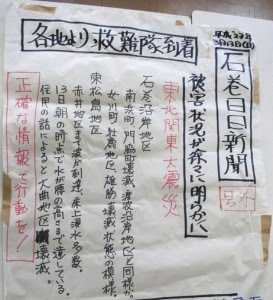
In the aftermath of the Japanese earthquake and tsunami in March 2011, the Ishinomaki Hibi Shimbun newspaper was published for six days in handwritten form. According to the Washington Post,
Unable to operate its 20th-century printing press — never mind its computers, Web site or 3G mobile phones — the town’s only newspaper, the Ishinomaki Hibi Shimbun, wrote its articles by hand with black felt-tip pens on big sheets of white paper.
But unlike modern media, the method worked.
“People who suffer a tragedy like this need food, water and, also, information,” said Hiroyuki Takeuchi, chief reporter at the Hibi Shimbun, an afternoon daily. “People used to get their news from television and the Internet. But when there is no light and no electricity, the only thing they have is our newspaper.”
While recent political ferment across the Arab world has trumpeted the power of new media, the misery in Japan, one of the world’s most wired nations, has rolled back the clock. For a few days at least, the printed and handwritten word were in the ascendant.
After writing and editing articles, Takeuchi and others on staff copied their work onto sheets by hand for distribution to emergency relief centers housing survivors of Japan’s worst-ever earthquake and deadly tsunami that followed.
“They were desperate for information,” said Takeuchi, who has slept in the office for the 10 days since the tsunami flooded the ground floor of his house.
With electricity now restored to about a third of the northeast town’s 160,000 residents, Takeuchi’s newspaper has put away its pens and started printing. Internet access is still not available. Monday’s printed front page cheered a “miraculous rescue drama” — the story of an 80-year-old woman and her 16-year-old grandson plucked from their ruined Ishinomaki home Sunday.
Down the coast in Sendai, a once-thriving city of more than 1 million, the digital juggernaut has also come to a halt. “In conditions like these, nothing has power like paper,” said Masahiko Ichiriki, president and owner of Kahoku Shimpo, the city’s main newspaper. With most shops shut, people can’t buy batteries to power radios.
The Newseum (a museum dedicated free press and news reporting, which closed in 2019) purchased copies of the handwritten papers, which are now on display at the Washington, D.C. museum. According to the Newseum website (now also closed):
“The Newseum became aware of the Hibi Shimbun‘s heroic efforts from a March 21, 2011, story on the earthquake in The Washington Post. That morning, Brian Nishimura Lee, the Newseum’s senior administrator for database and financial systems, emailed editors at the Hibi Shimbun and requested copies of the handwritten editions for the museum’s collection.”
The Newseum website (closed) provided additional details that did not appear in the original Washington Post story:
“Ishinomaki, with a population of about 160,000 people, was one of the hardest hit in Japan. Approximately 80 percent of the homes were destroyed. About 1,300 people have died, and more than 2,700 are still missing.
“The first handwritten newspaper on March 12 was an “Extra” edition that informed residents that the earthquake was “the biggest in the history of Japan.” The next day’s edition told about “rescue teams arriving in some areas.” On March 16, the paper said, “Let’s overcome the hardship with mutual support.” By March 17, the paper wrote about the lights coming back on.
“The first printed edition of the newspaper since the power outage was published on March 18. Editions have been distributed free to refugee sites each day.”
Information Sources:
Bibliography: Andrew Higgins, “In Ishinomaki, news comes old-fashioned way: Via paper,” Washington Post (web edition), March 21, 2011
Links: Newseum video of Japanese handwritten newspapers (no longer active on the closed Newseum site, but still available through the Freedom Forum on YouTube)
Locations: Newseum, 555 Pennsylvania Ave., N.W., Washington, DC
Place of Publication: On board H.M.S. Resolute, Captain Horatio T. Austin, C.B., in search of the expedition under Sir John Franklin looking for the “Northwest Passage”
Frequency: Five issues; frequency unknown
Volume and Issue Data: October 1850-March 1851
Size and Format: 44.5 x 27 cm.; printed facsimile is folio, 12 x 19 inches, 57 pp
Editor/Publisher: Sherard Osborn and George F. McDougall?
Title Changes and Continuation: None
General Description and Notes:
Illustrated Arctic News (printed) (AK, 1850-1851)
Printed and published after the H.M.S. Resolute expedition returned home, from the five numbers originally issued in manuscript, October 1850-March 1851, on shipboard during the wintering of the H.M.S. Resolute in Barrow Strait.
The H.M.S. Terror, captained by Sir Franklin (and its companion ship, the H.M.S. Erebus), which the Resolute’s crew and other expeditions searched for over a period of 11 years, was finally found at the bottom of the Arctic Ocean above the Arctic Circle in September 2016, according the The Guardian (Sept. 12, 2016). The H.M.S. Terror was located 168 years after it went missing off King William Island in eastern Queen Maud Gulf in the Canadian Arctic Archipelago in Nunavut, Canada (see map below). The H.M.S. Erebus had been found several years earlier just to the south of where the Terror was later located.
Map: The H.M.S. Resolute wintered on the Barrow Strait in search of the Sir Franklin expedition. The H.M.S. Terror and its companion ship the H.M.S. Erebus were found, more than 160 years after they went missing, off King William Island in Queen Maud Gulf.
The H.M.S. Resolute, on which these handwritten newspapers were produced, became famous in politics and popular culture long after its retirement. Wood from the ship was later made into two desks, one of which the English crown gave as a gift to the United States President Rutherford B. Hayes in 1880. That desk still sits today in the Oval Office of the White House. That desk was also featured (as was its origin from the H.M.S. Resolute) in the popular film, National Treasure: Book of Secrets (2007), starring Nicholas Cage.
Information Sources:
Bibliography: Sherard Osborn and George F. McDougall, eds., Facsimile of the Illustrated Arctic News, Published on Board H.M.S. Resolute, Captain Horatio T. Austin, C.B., In Search of the Expedition Under Sir John Franklin (London: Ackerman, 1852)
Size and Format: 10 pp. Ledger-size lined paper, written in cursive ink
Editor/Publisher: Annie Miller
Title Changes and Continuation: None
General Description and Notes:
“Devoted to Art, Wit, Poetry, and Science” (cover page)
Motto: “Onward and Upward.”
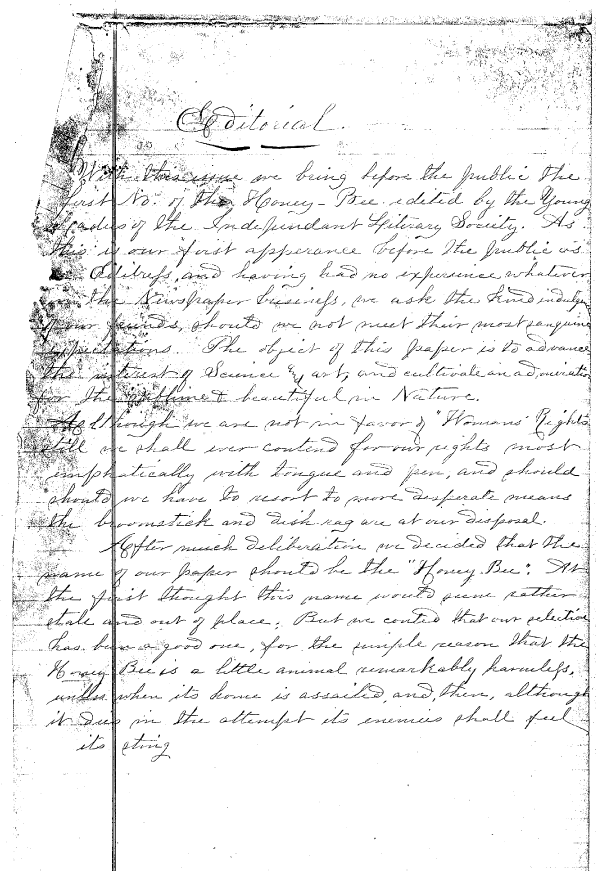
From the “Editorial” on page 2 (see image below): “With this issue we bring before the public the first No. of the Honey-Bee, edited by the Young Ladies of the Independant (sic) Literary Society. ” The editor continues, ” . . . having had no experience whatever in the Newspaper business, we ask the kind indulgence of our friends, should we not meet their most sanguine expectations.”
Honey Bee (OR, 1874)
Bibliography: None
Locations: Special Collections, University of Oregon Library, Eugene, OR
Place of Publication: Hazelton (Caledonia?), British Columbia, Canada
Frequency: Unknown
Volume and Issue Data: 1880-1881
Size and Format: Unknown (see image)
Editor/Publisher: Unknown
Title Changes and Continuation: Unknown
General Description and Notes:
A typewritten memo with the Queek in the BC Archives by Mrs. H.K. Andrews (or “Miss Woods”, whose name is scratched out) reads,
“In the year 1880, I went North with my brother to stay with our people the Tomlinsons. My brother to assist in farm and agricultural work which Mr. Tomlinson the missionary was starting, to help the Indians improve their mode of life. And had settled a little place called Ankihtlast–about 150 miles from the Coast and 20 miles from Hazelton, near the head of Navigation on the Skeena. I went to try and help my sister with the children (four in number). In the year of 80 & 81 Bp. and Mrs. Ridley having been sent by the C.F.S. to be head of the Missions were living at what we called ‘The Forks’ (the junction of the Bulkley and Skeena), now I believe called Old Hazelton. Wishing to do all possible to help the whites, Mrs. Ridley started what she called pleasant evenings on every Tuesday and her house was open house specially for the men who came out from Omineca. An evening of readings, music and general social intercourse. This social evening developed into a desire for a weekly paper, both the Bp. and Mrs. R. were talented & had taken many sketches locally. Mrs. R. and I going out together, sketching up the Haguilket Valley. There was no news coming in for the winter months from the outside world, we were absolutely cut off till spring would come. So everyone was expected to help in gathering items of interest, a riddle, a story, anything. My brother sent weather readings from our mission station. I contributed a few sketches, for our paper was an illustrated one, and we looked forward to receiving it on Saturday. The Bp. wrote out and transferred it on a gelatine press, sufficient numbers for the regular customers–about 10 or 12 I suppose; the Hankins, ourselves, & the miners. “
Information Sources:
Bibliography: None
Locations: British Columbia Archives and Records Services, Victoria, British Columbia, Canada
Volume and Issue Data: Vol. 1, No. 1, April 1, 1906; “whenever we feel like it”
Size and Format: 11 x 14 in.; 4 pp.
Editor/Publisher: Wm. Henry Bruno
Title Changes and Continuations: NA
General Description and Notes:
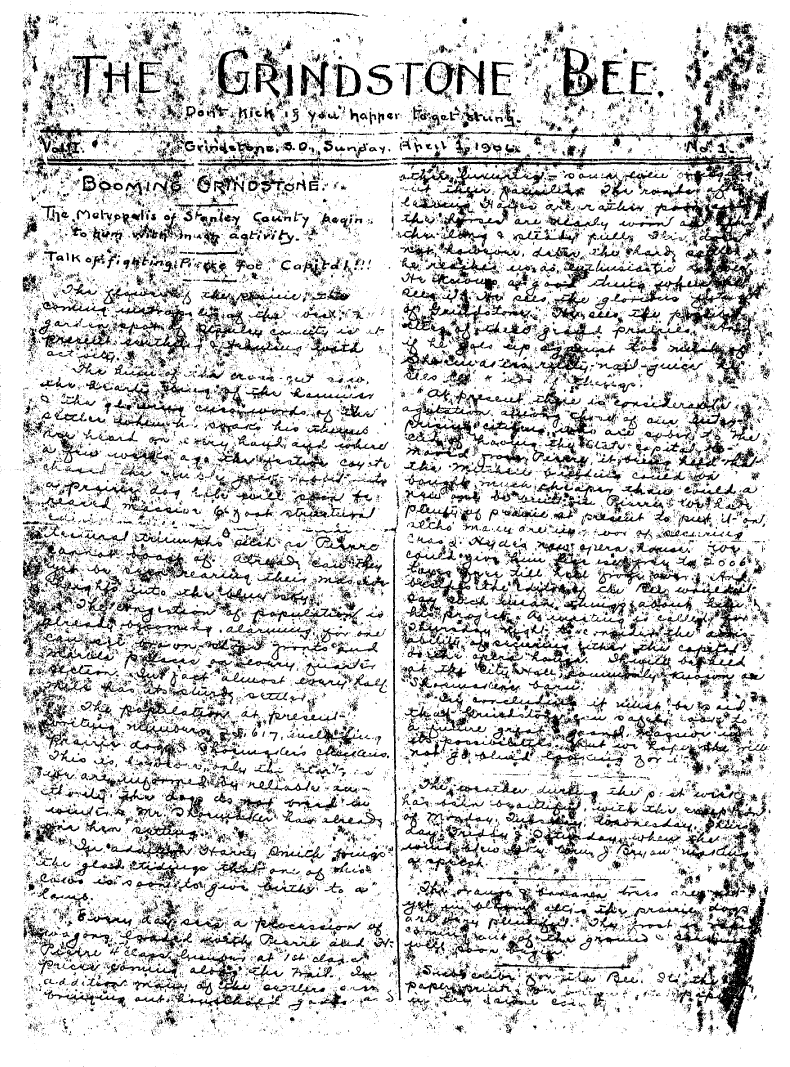
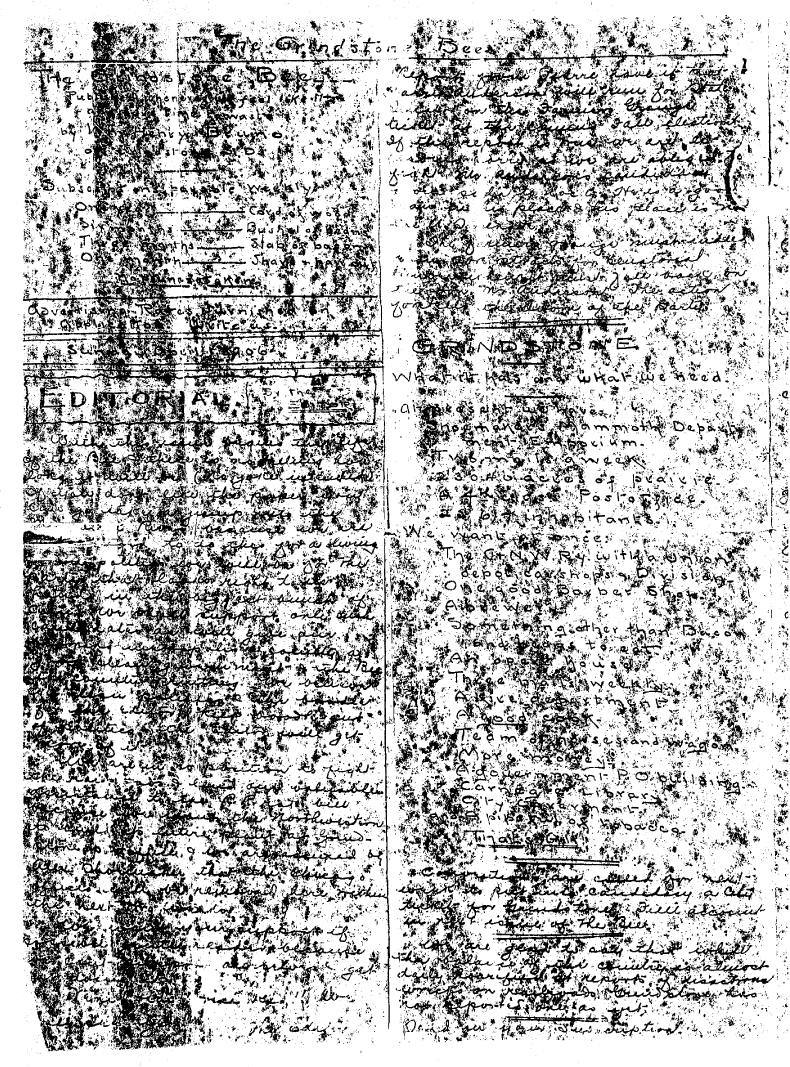
Grindstone Bee (SD, 1906)
The date hints that it may be a spoof. Other indicators, such as the subscription rates on page 3 (“One year: cord of wood; six months: bushel of beans; three months: slab of bacon; one month: shave & hair cut”) and the motto,” Don’t kick if you happen to get stung,” also point toward an “April Fool’s” edition paper.
Place of Publication: Granite (seven miles west of Schurz in present-day Mineral County), Nevada
Frequency: Weekly?
Volume and Issue Data: March 20, 1908-May 1, 1908
Size and Format: Two-page, three columns; graphite pencil and blue pencil headlines, or black ink in longhand, with occasional shading and coloring with crayon
Editor/Publisher: Frank Eugene Bugbee (elected to Nevada Assembly 1931, 1933, and 1937) (1908)
Title Changes and Continuation: Richard E. Lingenfelter, The Newspapers of Nevada (San Francisco: John Howell-Books, 1964), 131, identifies paper as the Granite News.
General Description & Notes:
The Granite Times, according to its 1908 Easter edition, was “Devoted to the Mining and Material Interests of Granite and the Mountain View District.” According to Highton, the paper was regularly sold for $1, while the special the Easter edition was $5. The paper included general local news, editorials and poetry. Stories addressed such events as the completion of an automobile road between Granite and Schurz. The Rawhide Rustler, April 18, 1908, reproduced a portion of the Granite Times: “We reproduce . . . a section of the Times, a paper printed in lead pencil in the new town of Granite . . . . It shows the usual progressiveness of new mining camps in Nevada.” Lingenfelter and Gash speculate that the Times suspended publication with its seventh number on May 1, 1908.
Earl and Moody report that editor Bugbee was an Ohio native who taught school in Kansas before arriving in Nevada at the turn of the century. He visited several mining towns before joining the rush to Granite and starting the Times. Bugbee reported in one issue that he had ordered a carload of type to print his paper, but through an error he received a mess of tripe. He offered “a bar of soap and a pound of tripe” to those who solicited others for new subscriptions to the Times. Noted the editor, “Do not get discouraged because have not the tools and equipment you should have to run your lease. The editor has only three lead pencils, but he gets out a paper every week.”
The two extant issue of the Granite Times at the Nevada Historical Society were donated by Bugbee in 1909.
Information Sources:
Bibliography: Phillip I. Earl and Eric Moody, “Type, Tripe and the Granite Times,” Nevada Magazine, (May-June 1982), 17-18; Jake Highton, Nevada Newspaper Days: A History of Journalism in the Silver State (Stockton, Calif.: Heritage West Books, 1990), pp. 97; Richard E. Lingenfelter, The Newspapers of Nevada (San Francisco: John Howell-Books, 1964), 131 (identifies paper as the Granite News); Richard E. Lingenfelter and Karen R. Gash, The Newspapers of Nevada (Reno: University of Nevada Press, 1984), 110.
Locations: April 17, May 1, 1908: NvHi (also on microfilm)
Place of Publication: Extant issue states: Philadelphia, PA, USA
Frequency: Unknown
Volume and Issue Data: Extant issue dated April 11, 1846
Size and Format: 15 x 11 in. (40 x 25 cm.), one sheet, two pages
Editor/Publisher: Attributed to Herman Melville (see notes below)
Title Changes and Continuation: Unknown
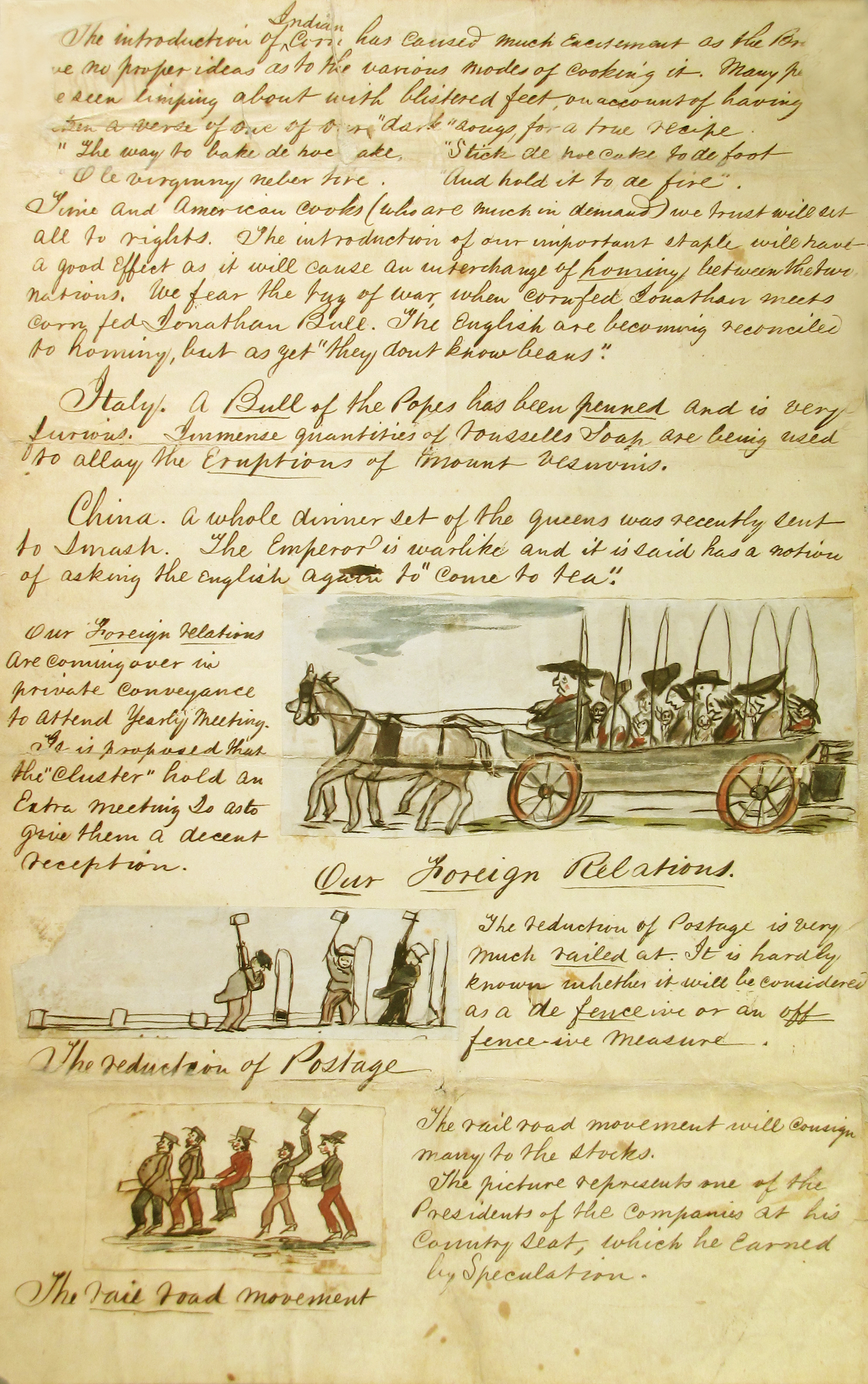
[The] Gazette-Extr[a], PA, 1846, front page
General Description and Notes:
According to one scholar who has analyzed the paper, it is “an April 1846 satirical newspaper, The PHILADal GAZETTE – EXTR, with seven pen and ink drawings accompanying a 437 word handwritten commentary on U.S. and world news.”
[The] Gazette-Extr[a], PA, 1846, back page
The Gazette-Extra was introduced to the Handwritten Newspaper Project by Professor Roger Stritmatter of Coppin State University, Baltimore, MD, USA. He described how he came upon the manuscript and pursued its authorship:
“. . . I purchased [the document] from a New Jersey antique dealer in 2009 . . . . Since the acquisition I have had four published articles, three by experts from the University of Buffalo’s Cedar-Fox Center for Excellence for Document Analysis and Recognition, who are state-of-the-art experts in forensic handwriting, which identify the writer (and therefore the artist) as Herman Melville. . . . I thought I would send it along to you, with appreciation for your website and my permission to publish the images as part of your archive, should you be so inclined” (Roger Stritmatter, PhD, personal email correspondence to the HNP Editor, dated Feb. 6, 2022).
Sargur N. Srihari, with the Cedar-Fox Center for Excellence for Document Analysis and Recognition, presented “Determining Writership of Historical Manuscripts using Computational Methods” at workshop on Automatic Pattern Recognition and Historical Handwriting Analysis in Erlangen, Germany in June 2013. In his presentation, citing Stritmatter’s work, he writes:
“A case for determining authorship of a historical manuscript is the Hydrachos manuscript (H.)1 . It is an April 1846 satirical newspaper, The PHILADal GAZETTE – EXTR, with seven pen and ink drawings accompanying a 437 word handwritten commentary on U.S. and world news. “Hydrachos” is the document’s misspelling of the name of a notorious paleontological curiosity of the 1840s, the Hydrarchos Sillimani, also called Basilosaurus and eventually renamed Zeuglodon cetoides. As summarized in the words of a contemporary novelist it was the “skeleton of an extinct monster, found in the year 1842, on the plantation of Judge Creagh, in Alabama.”[10]. The Alabama doctors declared it a huge reptile, and bestowed upon it the name of Basilosaurus. But some specimen bones of it being taken across the sea to Owen, the English Anatomist, it turned out that this alleged reptile was a whale, though of a departed species. In 1846 the remains of the Hydrarchos, having previously appeared in 1845 in New York at the Apollo Saloon, were on display at the Philadelphia Natural Museum housed in the Masonic Hall on Chestnut Street[13, 115] which is so conspicuously alluded to in the H. document’s opening lines. Measuring 40 x 25 cm, the document contains satirical news content, primarily from the United States, Great Britain, Italy, and China, on both the recto (Figure 1(b)) and verso sides (Figure 1(a)). Lexical, grammatical, thematic, visual, content, and situational analysis[17] all support the hypothesis that the manuscript’s author is the New England author Herman Melville whose description of the controversy surrounding the “extinct monster” unearthed in Alabama from Moby Dick (Chapter 104, “The Fossil Whale”). This synoptic report, drawing a more complete unpublished analysis by Stritmatter [17], summarizes some reasons for hypothesizing this attribution, surprising as it might seem to contemporary Melville scholars. Although Melville does not use the word Hydrachos, many other phrases and allusions in the manuscript can be traced to his published writings. A striking example is the document’s leading conceit of the sea monster capable of carrying mail between America and England. Melville’s fall 1847 satirical squib to Yankee Doodle, appearing in print eighteen months after the date on the Hydrachos manuscript, similarly views the sea monster not as an extinct pile of bones but as a living asset to the communications industry. The satire offers a reward of one thousand dollars to anyone able to ”procure a private interview with the Sea-serpent, of Nahant notoriety,” for the purpose of concluding a negotiation with the Postmaster General to license the beast ”for the transmission of European mails from Boston to Halifax” (Hayford 429). The satire also advertises for a ”smart jockey” to ”superintend” the shipment. The situation of Melville’s satire directly echoes the Hydrachos visual depiction of a sea monster mounted by a ”rider,” equipped like a horse jockey with a bridle and a riding hat, ferrying mail between Boston and Liverpool. Like so much else in Melville’s writing, the motif of the sea monster transporting international mail from the Eastern United States to Europe can be directly traced to Melville’s own circumstances. In April 1846 he was engaged in an intense transatlantic correspondence with his brother Gansevoort, the secretary to the American legation in London, who was concluding negotiations for the publication of Herman’s first book, Typee. The book was published in England by John Murray and in the United States by Wiley & Putnam in March, 1846; throughout March Gansevoort was sending Herman British newspapers containing Typee reviews. The H. document, which has been folded five times vertically and once horizontally, to form an envelope-sized packet, 9×12 cm, preserves traces of evidence that it was at one time sent through the mail as a part of such a correspondence. More specifically, the April 11 date is of particular interest given that Gansevoort sent to Herman by the March 18 ”Unicorn” a number of papers, ”principally Examiners & Critics contg notices of Herman’s Marquesas Islands” (Parker, ”London Journal,” 53). It is proposed that this is the shipment alluded to in the H. manuscripts statement that ”our file of foreign papers was delivered at the cluster office” – the latter perhaps referring to Alan Melville’s Wall Street law office in Manhattan, where international correspondence for the family was typically routed. Qualitative stylistic analysis supports the attribution. In the 437 word document, Stritmatter[17] was able to trace 59 words and phrases many of an apparently particularistic nature, found in the Melville canon . . . .”
According to an article published in the Baltimore Sun (2018), the handwritten paper’s stories “purport to relate news events that occurred in Boston, England, China and Italy. Stritmatter thinks that a piece of commentary datelined Cape May, N.J., is an inside-joke referring to a family event. ‘These satiric mock newspapers were very popular in the 19th century,’ Stritmatter said. ‘They originated aboard ships and were a way that people entertained themselves and each other.’”
Mary Carole McCauley, “Finding a white whale: Coppin State professor might have confirmed lost Herman Melville manuscript,” Baltimore Sun, Oct 17, 2018 (online).
Place of Publication: Near Amherstburgh, Ontario, Canada
Frequency: “After due notice given to subscribers”
Volume and Issue Data: Wednesday evening, May 14, 1856
Size and Format: 3 column pages, 4 pages
Editor/Publisher: (looks like three names–can’t decifer)
Title Changes and Continuation: None
General Description and Notes:
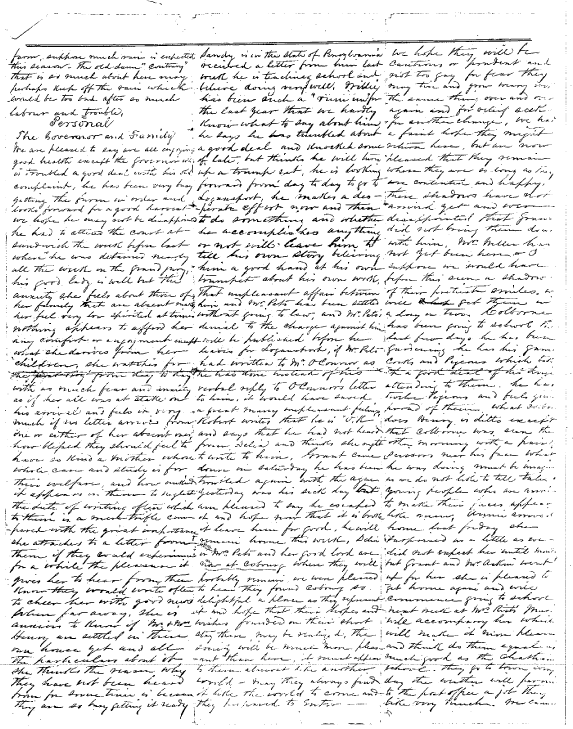
Forest Grove Observer (ON, 1856)
Located in a miscellaneous file along with
various other dated items in the John Macintosh Duff Collection, 1822-1870. Seems to be completely tongue-in-cheek with business notices with heading “Miss Tallstory,” Miss Crusty,” etc. and including stories about chickens, cows, and pigs. One heading under “Personal” is about the Governor and Family which is quite lengthy.
Forest Grove Observer (ON, 1856)
Information Sources:
Bibliography: None
Locations: Archives, Call No. XR1 MS A210158, Archival and Special Collections, University of Guelph Library, Guelph, Ontario, Canada
Place of Publication: St. John’s, Newfoundland, Canada (1892)
Frequency: Only one or two issues produced after the 1892 St.John’s fire destroyed printing press
Volume and Issue Data: No. 1, July 11, 1892
Size and Format: 8.5 x 11 inches
Editor/Publisher: M.A. Devine
Title Changes and Continuation: None
General Description & Notes
The Fire Fly was written as an emergency, interim publication following the fire 1892 in St. John’s. The paper was handwritten because the printing press the editor normally used to publish his paper perished in the flames. Editor Devine published information useful to fire survivors, such as locations of necessary goods and services, and reports on people, property and events during and following the fire.
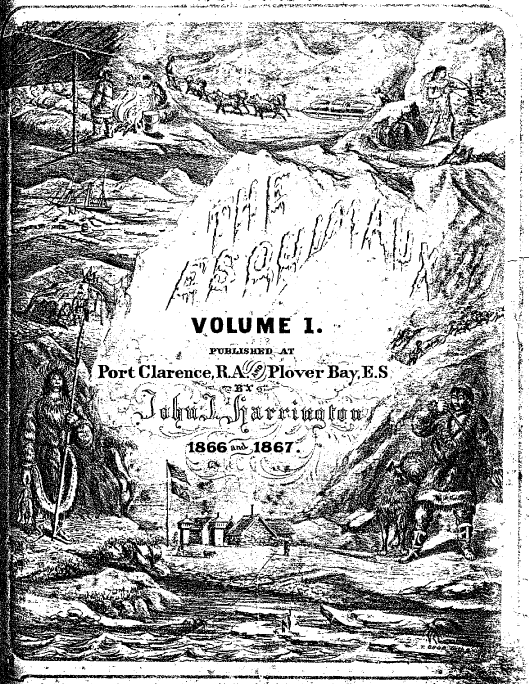
Place of Publication: Libbysville, Port Clarence, Russian America (Nos. 1-10, 1866-1867), and Camp Libby, Plover Bay, East Siberia (Nos. 11 and 12, 1867)
Size and Format: 52 pages; manuscript and printed editions
Editor/Publisher: John J. Harrington, editor; Turnbull and Smith (San Francisco), publisher of printed numbers
Title Changes and Continuation: None
General Description & Notes:
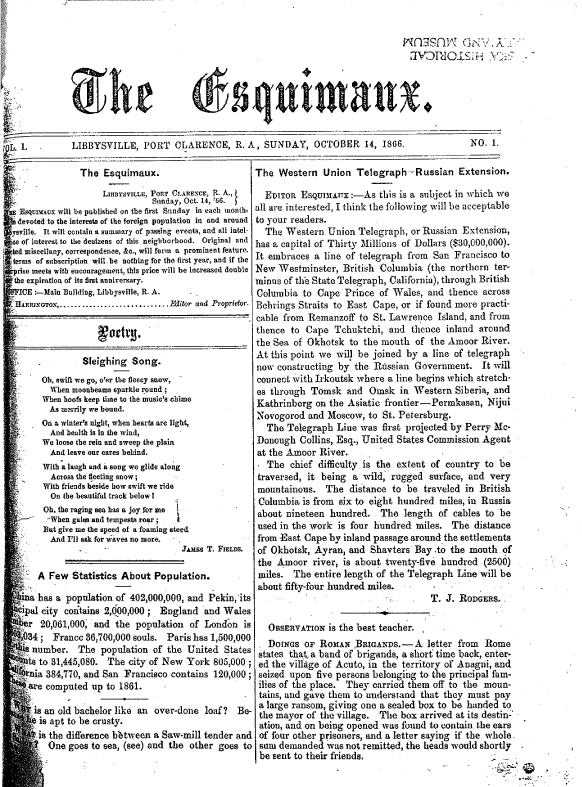
The Esquimeaux (AK, 1866-1867)
According to Wickersham, this monthly publication, of which Nos. 1 to 10 inclusive were published in Libbysville, Port Clarence, Russian America, and Nos. 11 and 12 in Camp Libby, Plover Bay, Eastern Siberia, appeared in both manuscript and later print.
The paper provided information of the workers building the Western Union Telegraph Expedition line planned from the United States in Seattle on Puget Sound, via the Fraser and Yukon rivers, to Port Clarence and then across the Bering Strait to Plover Bay and on to points in Asia and Europe.
After the abandonment of the project, because of the success of the Trans-Atlantic cable in 1866, and the U.S. purchase of Russian Alaska in March 1867 for $7 million, the manuscript was taken to San Francisco and printed there by the editor. The editor’s preface is dated Oct. 31, 1867.
The Esquimeaux (AK, 1866-1867)
Information Sources:
Bibliography: James Wickersham, A Bibliography of Alaska Literature, 1724-1924 (Cordova, Ak.: Cordova Daily Times Print, 1927), 258
Citations: Daily Evening Bulletin (San Francisco, California), Monday, December 02, 1867; Issue [47]
Place of Publication: Cape Prince of Wales, A.M.A. Mission School, Alaska (1893, 1902)
Frequency: Annual? “Only Yearly in the World”
Volume and Issue Data: March 24, 1893-Vol. 5, May, 1902?
Size and Format: 7 1/4 x 10 3/4 inches; some handwritten and mimeographed, some printed
Editor/Publisher: W.T. Lopp (1894-1902); Oo-ten-na, Eskimo engraver; Kiok, I-ya-tunk-uk and Ad-loo-at, compositors; American Missionary Association Mission School
Title Changes and Continuation: None
General Description & Notes:
See image
Information Sources:
Bibliography: James Wickersham, A Bibliography of Alaska Literature, 1724-1924 (Cordova, Ak.: Cordova Daily Times Print, 1927), 258
Place of Publication: “Editor’s office, Starboard Front Cabin, ‘Thames City,'” en route from Gravesend, England to Vancouver Island, British Columbia, Canada
Frequency: Weekly (“read aloud each Saturday night, the day of publication, by the commanding officer, Capt. H.R. Luard, R.E.”)
Volume and Issue Data: 17 numbers issued: No. 1, Nov. 6, 1858 to No. 17, April 2, 1859; not published during three week layover at Falkland Islands
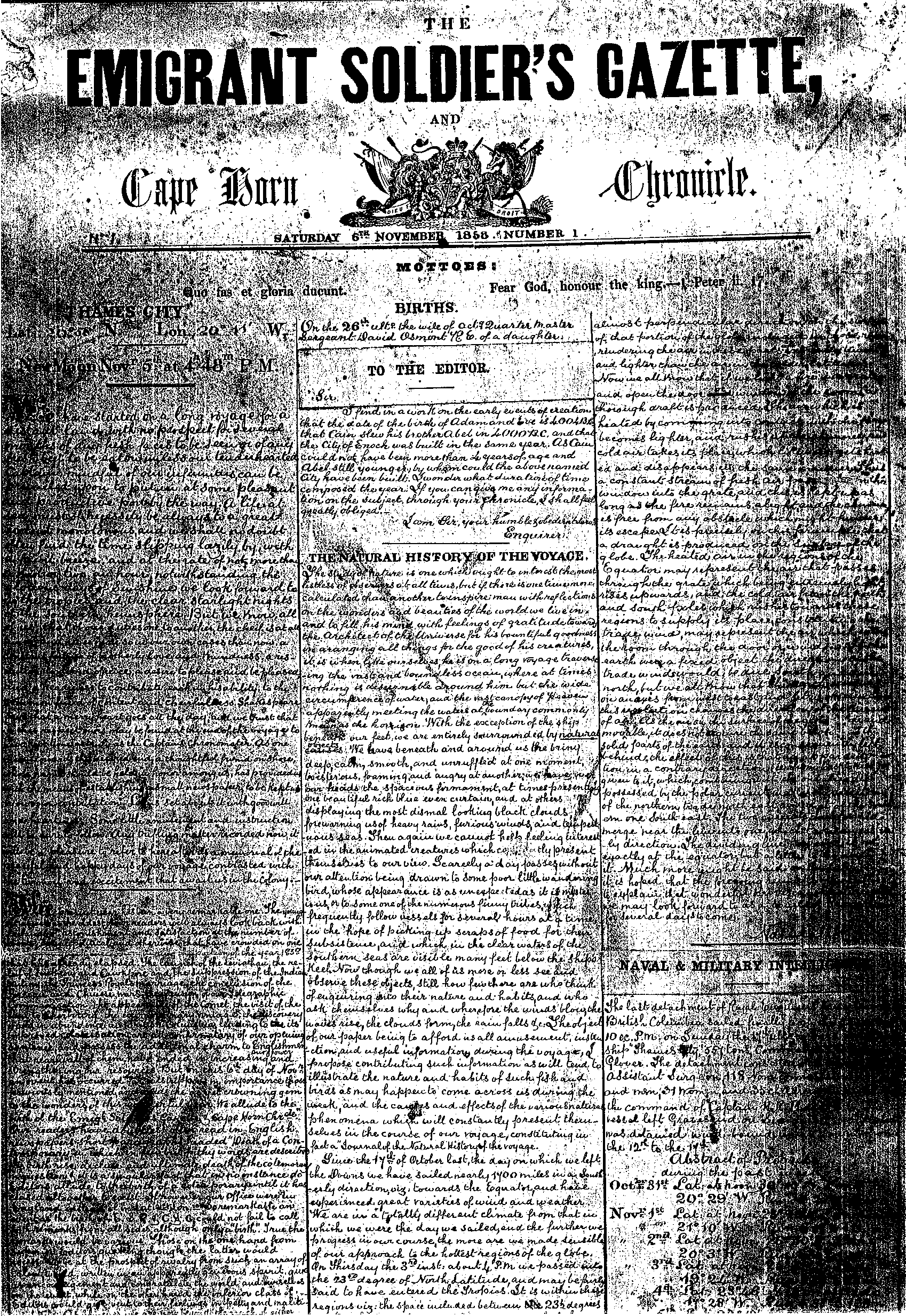
Size and Format: 10.75 x 18 inches; pre-printed title/masthead; pen and ink
Editor/Publisher: Second Corporal Charles Sinnett, R.E., assisted by Lt. H.S. Palmer, R.E.
Title Changes and Continuation: None
General Description & Notes:
Contains a news section, natural history of the voyage, correspondence, conundrums, naval and military intelligence, songs, poetry, jokes, advertisements, foreign intelligence and market intelligence.
The Emigrant Soldiers Gazette and Cape Horn Chronicle was published originally in manuscript form on board the ship “Thames City,” which sailed from Gravesend, England, on October 10, 1858 and reached Esquimalt, Vancouver Island, British Columbia on April 12, 1859. Aboard the ship was a detachment of Royal Engineers selected for service in B.C.
The paper was edited by Second Corporal Charles Sinnett, R.E., and assisted by Lt. H.S. Palmer, R.E. Each Saturday night, the day of publication, the paper was read aloud by the ship’s commanding officer, Captain H.R. Luard, R.E.
The first issue explained that as one of the ways to avoid monotony and “keep a merry heart,”
[A] thoughtful friend on shore, whose name should be held in honour among us, has provided us with the means of establishing a small Newspaper, to be kept up by our own contributions. Let us set about it with good will and heartiness. Some little amusement and instruction will be sure to follow. Any trifling matter recorded now will be a pleasure to refer to hereafter as a memorial of the peaceful and happy days of our voyage.
The first issue also published a notice “To Correspondents,” as a guide to contributors:
1. In future, contributions of Leading Articles on any subject are requested to send them in to the Editor by noon every Thursday, and all other contributions should be sent in by 8 o’clock the same evening, to give ample time for publishing the paper.
2. Any person willing to answer letter addressed “To the Editor,” are invited to do so, addressing their answers in the same manner.
3. The answers to Charades and Conundrums will be published the Saturday after they appear, and any person guessing an answer, may learn on application to the Editor or Sub-Editor if he is right or wrong. But is hoped correct guessers will keep their secret.
The paper maintained a regular front page news section and other regular sections, such as “Natural History of the Voyage,” “Correspondence,” “Conundrums,” “Naval and Military Intelligence,” “Songs and Poetry,” “Jokes,” “Foreign Intelligence,” “Market Intelligence,” and “Advertisements.”
The printed edition of the paper included a map detailing the ship’s route and marking its locations on the dates of publication.
After the arrival of the Thames City at New Westminster, B.C., the men aboard the ship paid to have the paper printed as a souvenir of their voyage. The “British Columbian” newspaper in New Westminster printed the paper from the manuscript originals.
In Volume One–”To the correspondents 1. In the future, contributors of Lending Articles on any subject are requested to send them in to the editor by noon every Thursday, and al other contributions should be sent in by eight o’clock the same evening, to give ample time for publishing the paper. 2. Any person willing to answer letters addressed “To the Editor,” are invited to do so, addressing their answers in the same manner. 3. The answers to the Charades and Conundrums will be published the Saturday after they appear, and any person guessing an answer may learn on application to the Editor or Sub-Editor if he is right or wrong. But it is hoped correct guessers will keep their secret.”
Preface to the published collection: [Printed by R. Wolfenden, 1907]
“The ESGCHC was published originally in manuscript form, on board the ship “Thomas City,” which was sailed from Gravesend on the 10th of October, 1858, and reached Esquimalt, V. I. on the 12th April, 1859, having on board a Detachment of Royal Engineers selected for service in B.C. The paper was edited by Second-Corporal, Charles Sinnett, R.G., assisted by Lt. H. S. Palmer, R.G. and was read aloud each Saturday night, the day of publication, by the commanding officer, Captain H.R. Luard, R.G. After the arrival of the Detachment of the camp, New Westminster, it was thought advisable to have this most interesting journal printed for distribution amongst the members of the Detachment. This was done, at the men’s expense, at the office of the “British Columbia,” New Westminster, by the late John Robson.
From No. 1 [11/6/58]–p.1 “As one means towards this desired end [to avoid monotony and keep a merry heart], a thoughtful friend on shore, whose name should be held in honour among us, has provided us with a means of establishing a small Newspaper, to be kept up by our own contributors Let us set about it with good will and heartiness. Some little amusement and instruction will be sure to follow. Any trifling matter recorded now will be a pleasure to refer to hereafter as a memorial of the peaceful and happy days of our voyage.
Information Sources:
Bibliography: Emigrant Soldiers Gazette and Cape Horn Chronicle (Printed by R. Wolfenden, 1907); Roy Atwood, “Shipboard News: Nineteenth Century Handwritten Periodicals at Sea,” Paper Presentation to the History Division of the Association for Education in Journalism and Mass Communication Annual Convention, Chicago, IL, 1997; Reprint, New York Public Library.
Locations: British Columbia Archives and Records Services, Victoria, British Columbia; (printed edition) The Bancroft Library, University of California, Berkeley, California; New York Public Library, New York.
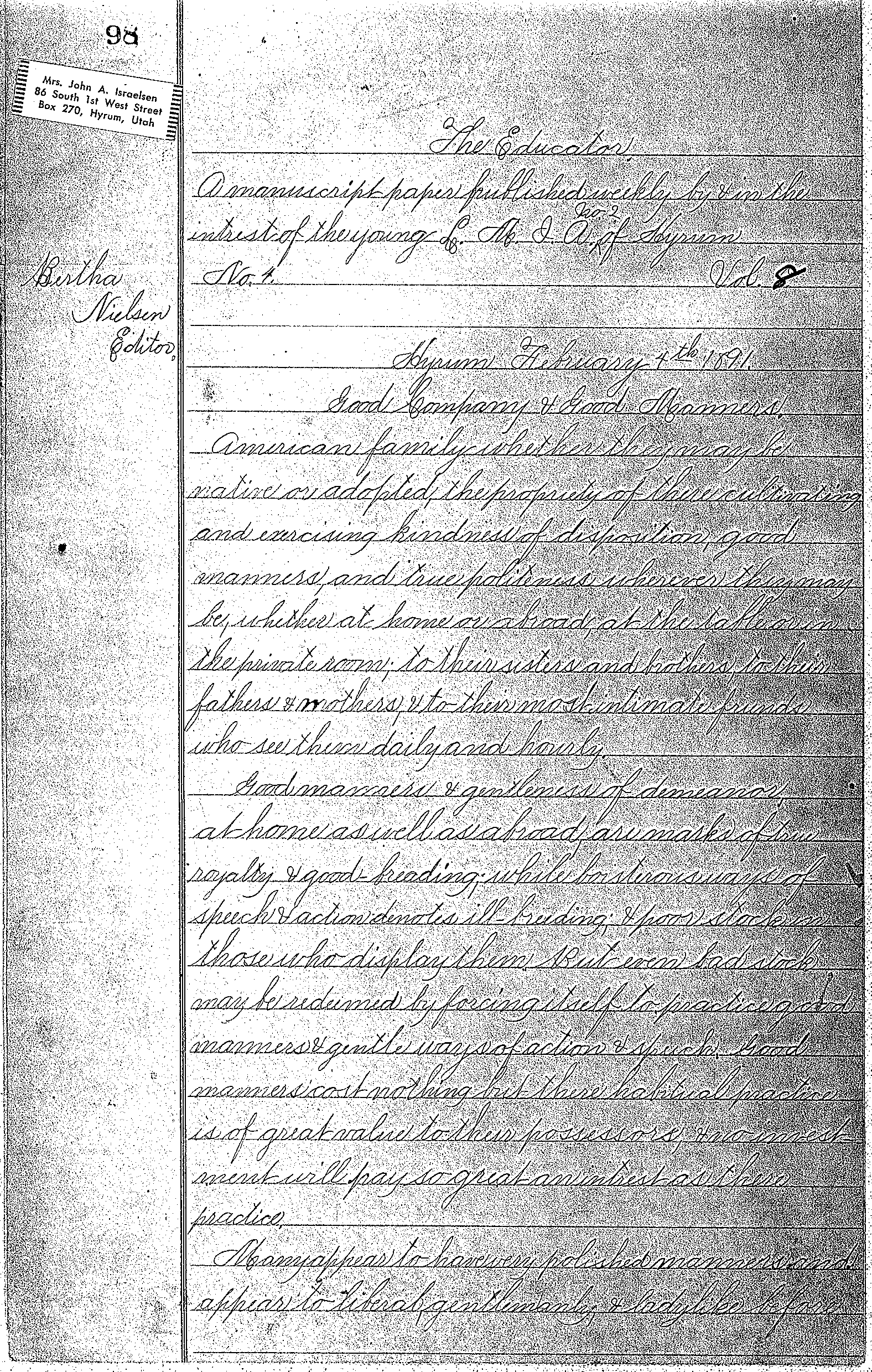
Volume and Issue Data: Vol. 8, No. 4, February 4, 1891
Size and Format: 7 3/4 x 13 inches, ledger book paper, single column
Editor/Publisher: Bertha Nielsen, editor; “A manuscript paper published weekly by & in the interest (sic) of the young L.M.I.A. No. 2 of Hyrum” (i.e., Young Ladies’ Mutual Improvement Assn.)
Title Changes and Continuation: Unknown
General Description & Notes
According to Alter, the Young Men’s and Young Ladies’ Mutual Improvement Associations in and around Hyrum, Utah published weekly literary journals largely in the interests and for the entertainment of their members during the late 1880s. The publications carried news, religious items and weather reports.
The Educator, along with “THE KNOWLEDGE SEEKER,” “THE YOUNG LADIES THOUGHTS,” “A MANUSCRIPT PAPER” and “THE EVENING STAR” were published by Mormon Mutual Improvement Associations under various editors, since officers in these organizations changed hands regularly.
Utah State University Special Collections and Archives has 25 file folders containing these various Mutual Improvement Association newspapers. They do not have a complete run of any of them, however.
Information Sources:
Bibliography: J. Cecil Alter, Early Utah Journalism (Salt Lake City: Utah State Historical Society, 1938), 90; Lorraine T. Washburn, “Culture in Dixie,” Utah Historical Quarterly, 29 (July 1961), 259-260; Mark A. Pendleton, “The Orderville United Order of Zion,” Utah Historical Quarterly, 7 (October 1939), 151.
Locations: John A. Israelson’s papers, Special Collections and Archives, Utah State University, Logan, UT
Volume and Issue Data: Vol. 1, No. 6, Oct. 8, 1898; only a few issues published
Size and Format: 8 x 10 inches; two pages; pen and ink
Editor/Publisher: Charles C. Carruthers, editor; F.L. Lowell, assistant
Title Changes and Continuation: None
General Description and Notes:
According to the McLean, the Tribune was an independent newspaper that provided community news and editorials on the differences between Canadian and American mining laws, customs and tariffs. The Tribune’s motto was “He that runs may read.” No price appears.
The Oct. 8, 1898 issue includes five advertisements and criticisms of Canadian officials and “their coadjutors, the B.C. press.” The paper was clearly unhappy with Canadian treatment of Americans in the eastern Alaska/Yukon mining region. Tribune editor Carruthers displayed a tendency to editorialize in almost every article. At the same time, he also records the names of many of the early arrivals in the country, pictures the difficulties between Canadians and Americans, and indicates the difficulties and dissatisfactions between labor and management.
Information Sources:
Bibliography: Dora E. McLean, Early Newspapers on the Upper Yukon Watershed: 1894-1907, unpublished M.A. thesis, University of Alaska, 1963, 38-43; James Wickersham, A Bibliography of Alaska Literature, 1724-1924 (Cordova, Ak.: Cordova Daily Times Print, 1927), 258; Melody Webb, Yukon: The Last Frontier (University of British Columbia Press/University of Nebraska Press, 1985/1993), p. 137; John McPhee, Coming into the Country (Bantam Books, 1979), p. 340.
Link: Melody Webb, Yukon: The Last Frontier (University of British Columbia Press/University of Nebraska Press, 1985-1993), p. 137
Place of Publication: Denial Bay Township, Australia (west side of Eyre Peninsula, 500 miles from Adelaide)
Frequency: “Weekly”
Volume and Issue Data: November 14, 1908 (first issue) through 1909
Size and Format: Early editions were three columns. After the New Year, 1909, it went to two columns.
Editor/Publisher: Dr. C.T. Abbott (with Mrs. Abbott, assistant production officer and general press hand”) [Alan Finch, Pens & Ems]
Title Changes and Continuation: None
General Description and Notes:
In his history of Australian journalism, Alan Finch describes The Denial Bay Starter as “produced in a violent mauve ink on a hectograph in atrocious handwriting.” According to Finch, the first editorial, or leading article, explained the anonymous editor’s goals for the publication:
“Dear friends, this obscene sheet is only started with the intention of amusing you and gathering for your perusal any little items of news that may be brought to our notice. We do not wish to enter into the arguments that arise from burning questions of the hour, but will try to plainly set before you both the good and the bad points of any discussion. We should be willing to inscribe any letter or correspondence that the public may forward to us . . . we do not wish to hurt anyone’s feelings but if we inadvertently do so please tell us and we will strive to make atonement in every possible way.”
The editor went on to explain the title of the new paper: “. . . this is a starter and we hope to see in the near future a type printed paper which will bring the West Coast more prominently before the public than it has been hitherto.”
The paper was issued each Saturday, but the editor remained anonymous until shortly after the New Year 1909, when the editor’s name was included at the top of the paper: Dr. C.T. Abbott, a medical doctor and relative newcomer to the area.
Number 20 was produced with the aid of a typewriter and duplicating stencil.
In the January 29, 1910 edition, the editor announced the paper’s retirement:
“The time has come, when the Starter will retire from the arena, and cease to exist. But we hope that this year old infant, has been able to bring other thought and ideas to your minds, than you had previously, that it had been able to sow on rich ground, a few seeds which in the future will spring up. “
The editor, Dr. Abbott, brought the paper to an end because he moved to a new position at Pine Creek.
Information Sources:
Bibliography: Alan Finch, Pens & Ems in Australia: Stories of Australian Newspapers (Adelaide, 1965), pp. 12-18.
Locations: Public Library, Adelaide, Australia; National Library, Canberra, Australia
Gazette-Extr., Philadelphia, 1846; attributed to Herman Melville; courtesy of Prof. Roger Stritmatter, Dept. of Humanities, Coppin State University, Baltimore, MD, USA



















 The Handwritten Newspapers Project