Flying Fish (Aus-CA, 1851)

Leave a comment

Publication History:

Place of Publication:  Shipboard Mary Catherine, out of Sydney en route to California (1851)

Frequency:  Unknown

Volume and Issue Data:  No. 1, May 31, 1851

Size and Format:  Unknown

Editor/Publisher:  “Some of the women passengers aboard”

Title Changes and Continuation:  None

General Description and Notes:

The Flying Fish was published by women passengers aboard the ship Mary Catherine out of Sydney, Australia, en route to the gold fields of California. The only known issue was dated May 31, 1851. The captain of the ship recorded in his log that to pass the time, some of the women passengers began writing a shipboard newspaper and published it on the day of the captain’s 32nd birdthday. He described it as “a little journal of fun and merriment.”

Two things are noteworthy about the Flying Fish. First, it is the only known shipboard paper produced exclusively by women. No doubt other shipboard papers had women contributors and scribes, but this is the only one, according to the sole remain independent documentary evidence from the voyage, founded, edited, and produced exclusively by women at sea.

Second, the fact that the captain consider the publication of the Flying Fish nothing more than something “to pass the time,” suggests that it was primarily a literary and humorous publication. The fact that Australia had been a British penal colony since its first settlements in 1788 may also indicate that the women were less than well educated or well read.  The passengers on board the ship who were  seeking their fortunes in California gold likely included former convicts, men and women. In such a context, the women’s journalistic and literary skills were probably not of a high caliber.

Information Sources:

Bibliography:  Captain Henry Thomas Fox, Log of Mary Catherine, in possession of Mrs. F.G. Marginson, Hamilton, Brisbane, Queensland, Australia, cited in Charles Bateson, Gold Fleet for California:  Forty Niners from Australia and New Zealand (Auckland:  Minerva Ltd., 1963), pp. 47, 136, 138; Roy Atwood, “Shipboard News: Nineteenth Century Handwritten Periodicals at Sea,” Paper Presentation to the History Division of the Association for Education in Journalism and Mass Communication Annual Convention, Chicago, IL, 1997.

Locations:  None located

Flumgudgeon Gazette and Bumble Bee Budget (OR, 1845)

Leave a comment

Flumgudgeon Gazette & Bumble Bee Budget (OR, 1845)

Publication History:

Place of Publication:  Oregon City, Oregon Territory

Frequency:  Bi-weekly

Volume and Issue Data:  Summer, 1845; total of eight issues

Size and Format:  Ink on foolscap; single column; twelve copies of each issue; number eight contains 13 pages

Editor/Publisher:  “Curltail Coon,” aka Charles Pickett (1845)

Title Changes and Continuation:  None

General Description & Notes:

The Flumgudgeon Gazette and Bumble Bee Budget was the first publication in the Oregon Territory and appeared during the meeting of the Legislative Committee in 1845.  The paper was subtitled, “A Newspaper of the Salmagundi Order, Devoted to Scratching and Stinging the Follies of the Times.”  According to Brier, Picket published eight issues of the paper and made about 12 copies of each number.  The paper was mainly a diatribe against the Legislative Committee of the Provisional Government of Oregon.  The paper consisted primarily of satire designed to sting the legislators.  Powell claims the paper “performed a useful service in pioneer Oregon by informing the settlers of the early activities of their government and by giving voice to opinions other than those of the legislators.”

Information Sources:

Bibliography:  Warren J. Brier, “A History of Newspapers in the Pacific Northwest, 1846-1896,” unpublished Ph.D. thesis, University of Iowa, Feb. 1957, pp. 5-10, 105-107; Warren J. Brier, “The ‘Flumgudgeon Gazette and Bumble Bee Budget,'” Journalism Quarterly, 36 (Summer 1959), 317-320; Robert F. Karolevitz, Newspapering in the Old West:  A Pictorial History of Journalism and Printing on the Frontier (New York:  Bonanza Books, 1969), p. 131; Bob Karolevitz, “Pen and Ink Newspapers of the Old West,” Frontier Times, 44:2 (Feb.-March 1970), 31; Sidney Warren, Farthest Frontier:  The Pacific Northwest (New York:  Macmillan Co, 1949), 190-191; Lawrence Clark Powell, “Flumgudgeon Gazette in 1845 Antedated the Spectator,” Oregon Historical Quarterly, XLI:2 (June, 1940), 203-207; Lawrence Clark Powell, Philosopher Pickett (Berkeley:  University of California Press, 1942), 12; Frederic Hudson, Journalism in the United States, From 1690 to 1872 (New York:  Harper and Bros., 1873), 590

Locations:  Vol.1, No. 8, Aug. 20, 1845 only:  OreHiSoc-Portland; reproduction of Vol.1, No. 8, Aug. 20, 1845 in Karolevitz (1970), p. 31; Karolevitz (1969), p. 131.

The Flower (RI, 1836)

Leave a comment

Publication History:

Place of Publication: Smithfield, Rhode Island

Frequency: Unknown

Volume and Issue Data:  1836

Size and Format: Unknown

Editor/Publisher: Unknown

Title Changes and Continuation: Unknown

General Description and Notes:

None

Information Sources:

Bibliography: None

Locations:  Newspapers and Periodicals,  American Antiquarian Society, Worcester, MA

The Flag (IL, 1856)

Leave a comment

Publication History:

Place of Publication:  Batavia Institute, Illinois

Frequency: Unknown

Volume and Issue Data:  ca. 1856

Size and Format:  21 pages

Editor/Publisher:  Unknown

Title Changes and Continuation: None

General Description and Notes:

None

Information Sources:

Bibliography: None

Locations:  Manuscripts, Illinois State Historical Library, Old State Capitol, Springfield, IL

The Family News (PA, 1902-1906)

Leave a comment

Publication History:

Place of Publication: Haverford, Pennsylvania?

Frequency: Unknown

Volume and Issue Data:  1902-1906

Size and Format:  352 pages

Editor/Publisher:  Christopher Morley (1890-1957)

Title Changes and Continuation: None

General Description and Notes:

Morley produced four other newspapers, all contained in the Morley Collection at Haverford.

Information Sources:

Bibliography: None

Locations:  Haverford College, The Quaker Collection, Haverford, PA

The Exponent (UT, 1877)

Leave a comment

Publication History:

Place of Publication:  St. George, Utah (ca. 1877)

Frequency:  Unknown

Volume and Issue Data:  Unknown

Size and Format:  Unknown

Editor/Publisher:  Unknown

Title Changes and Continuation:  Unknown

General Description & Notes:

 None

Information Sources:

Bibliography:  None

Locations:  No issues located, but cited in THE YOUNG LADIES’ DIADEM, Vol. 1, No. 6, Dec. 5, 1877, p. 1.

The Experiment (AL, 1870; NE, 1873)

Leave a comment

Publication History:

Place of Publication:  Oakland Hall, Chunchula, Alabama, and Willow Creek Farm, Waverly, Nebraska

Volume and Issue Data:  Monthly; Vol. 1, No. 1, Sept. 30, 1870, Vol. 1, No. 2, Oct. 15, 1870, Oakland Hall, Chunchula, AL; Vol. 1, No. 3 has very similar content and is dated the same as Vol. 1, No. 4, March 1, 1873, Willow Creek Farm, Waverly, NB

Size and Format:  Vol. 1, No. 1:  ledger paper, 22 x 24 in.; Vol. 1, Nos. 2 and 4:  ledger paper, 14 x. 22;  Vol. 1, No. 3:  ledger paper, 7.5 x 12

Editor/Publisher:  Vol. 1, Nos. 1 and 2 (in Alabama):  Chas. A. Pierce, editor, C.A. Caldwell, publisher; Vol. 1, Nos. 3 and 4 (Nebraska):  Charles A. Pierce, editor and proprietor

Title Changes and Continuations:  WILLOW CREEK JOURNAL

General Description & Notes:

The Experiment’s four extant numbers contain a variety of news stories, poems and essays.  Numbers three and four have very similar content, such that the third issue may have been a “draft” or early version of the fourth issue.

Numbers three and four contain an “editorial” which gives some history of the publication:

Two years ago at Oakland Hall, Ala., a paper was published, called ‘The Experiment.’  A few numbers had been issued, when suddenly the Editor was taken sick with a fever, caused by his Editorial labors.

Then, the Publisher went into other business [deserted him].  When the Editor recovered, and inquired for another Publisher, none could be had [found][And so] The publication of the Experiment was therefore suspended for a time.  [And] Now our intent is to continue publishing this paper through the [winter] year of 1873, if not longer.  The motto [is] will be the same as before; “Progress and Perseverence [sic].”  See Prospectus for Winter of 1872-1873 in [on third Page] another column.  Will all of the inhabitants of Willow Creek Farm give us their assistance?  [Note:  Boldface text appears only in No. 3; italic text appears only in No. 4; all other text is common to both issues]

The prospectus referred to in the editorials in both numbers notes that because spring work is coming, “we cannot publish regular issues all along during the Spring and Summer, but will try and publish one by the end of February, and once in a while one, until Fall” (Vol. 1, No. 3, p. 3, col. 1).

A serialized story about “Johnny’s Wanderings” (also titled “Johnny’s Adventures, or the life of a boy among the Indians” in Nos. 3 and 4) appears in all the numbers.  A “Synopsis” of the story appears in No. 3 (but not No. 4, although the Prospectus promises one) “so as the old readers of the story (who may have forgotten the part of it published in the No’s. 1&2 in 1870) as well as the new, may understand what follows” (Vol. 1, No. 3, p. 3, col. 1).  A note in small script appears above the title for the “Johnny” story in No. 3:  “All the articles of this paper are entirely original except those of this department.”

The first number identifies the “Rules” for reading and writing for the paper:

1st–No one except the Editor, Proof Reader and Publisher shall look at ‘The Experiment’ without writing an article for the same for every number.

2d–All articles for ‘The Experiment’ must be written in a plain hand, whi8ch can be easily read by the Editor.

3d–Articles for publication must be handed in before noon of the day previous to that on which the paper is issued.

4th–No one allowed to peep in the Editor’s drawer, or endeavor to read articles before they are published.  –Ed.

The editor, Charles A. Pierce, was the son of Charles W. Pierce, a civil war veteran, who was transferred to Demopolis, Alabama in 1866 as a major with the Freedman’s Bureau and District commander of western Alabama.  The senior Pierce served one term in the 41st Congress from Alabama’s fourth district in 1867.  It was during this time that his son, Charles A., began his first handwritten newspaper, THE EXPERIMENT, at Oakland Hall, Chunchula, Alabama.  In 1872 the family moved to Waverly, Nebraska, where THE EXPERIMENT, and its successor, WILLOW CREEK JOURNAL were published by Charles A in 1873.  THE CASKET appeared in Nebraska in 1875 as a school effort, no doubt with the help of Charles A.

Information Sources:

Bibliography:  None

Locations:  Nebraska State Historical Society, State Archives, Lincoln, NB, Charles W. Pierce papers, Ms. 554

The Evening Star (UT, 1884-1891)

Leave a comment

Publication History:

Place of Publication:  Hyrum, Cache County, Utah (ca. 1884-1891)

Frequency:  Weekly

Volume and Issue Data:  Vol. 1, No. 4, Oct. 18, 1884 (“Knowledge Seeker”);  copies of varied title papers run to 1891

Size and Format:  Legal size; six to 10 pages; pen and ink

Editor/Publisher:  Various editors; Young Men’s and Young Ladies’ Mutual Improvement Associations of Hyrum

Title Changes and Continuation:  See The Educator, The Knowledge Seeker; A Manuscript Paper; Young Ladies’ Thoughts

General Description & Notes:

According to Alter, the Young Men’s and Young Ladies’ Mutual Improvement Associations of Hyrum published weekly literary journals largely in the interests and for the entertainment of their members during the late 1880s.  The publications carried news, religious items and weather reports.

“The Knowledge Seeker” was published by the Young Men; “The Young Ladies Thoughts” and “The Evening Star” were published by the Young Ladies.  Apparently, “The Evening Star” succeeded “The Knowledge Seeker.”  These papers appeared under various editors, since officers in these organizations changed hands regularly.

Information Sources:

Bibliography:  J. Cecil Alter, Early Utah Journalism (Salt Lake City:  Utah State Historical Society, 1938), 90; Lorraine T. Washburn, “Culture in Dixie,” Utah Historical Quarterly, 29 (July 1961), 259-260; Mark A. Pendleton, “The Orderville United Order of Zion,” Utah Historical Quarterly, 7 (October 1939), 151

Locations:  John A. Israelson’s papers, Special Collections and Archives, Utah State University, Logan, UT

Evening Star (IL, 1857)

Leave a comment

Publication History: 

Place of Publication: Wheaton, Illinois

Frequency:   Unknown

Volume and Issue Data:  Vol. 1, no. 3

Size and Format: Unknown

Editor/Publisher:  Student Lyceum League (later known as the Beltionian Literary Society), Wheaton College

Title Changes and Continuation: Unknown

General Description and Notes:

Illinois’ oldest literary society.

Information Sources:

Bibliography: None

Locations:  Special Collections, Wheaton College, Wheaton, IL

The Evening Record (WI, 1896)

Leave a comment

Publication History:

Place of Publication: Sedgewick, Wisconsin

Frequency:  Unknown

Volume and Issue Data: March 15, 1896, Vol. 1, No. 2

Size and Format:  1 oversize sheet

Editor/Publisher:  The children of the Yort family, Sedgewick, Iron County, WI

Title Changes and Continuation: Unknown

General Description and Notes:

Handwritten and illustrated.

Information Sources:

Bibliography: None

Locations:  Newspapers, Sedgewick, WI: # SC-O, 15.  Archives, The State Historical Society of Wisconsin, Madison, WI

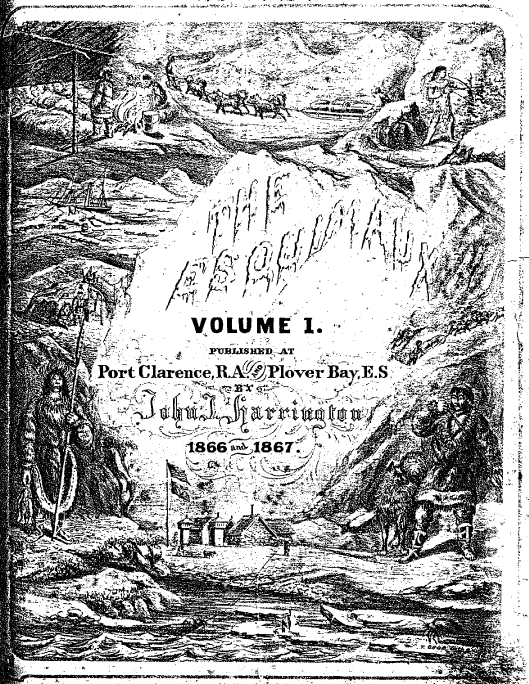
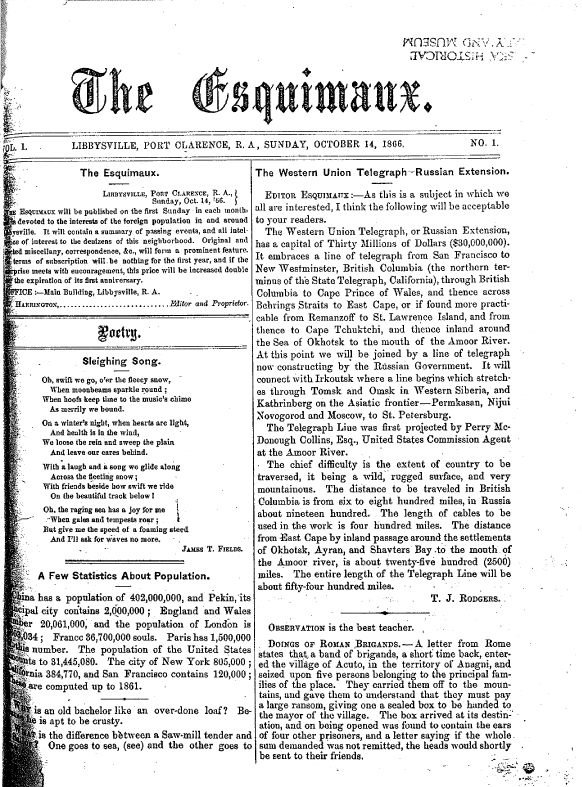
The Esquimeaux (AK, 1866-1867)

Leave a comment

The Esquimeaux (AK, 1866-1867)

Publication History:

Place of Publication:  Libbysville, Port Clarence, Russian America (Nos. 1-10, 1866-1867), and Camp Libby, Plover Bay, East Siberia (Nos. 11 and 12, 1867)

Frequency:  Monthly

Volume and Issue Data:  Vol. 1, Nos. 1-12; Sunday, Oct. 14, 1866; 12 issues

Size and Format:  52 pages; manuscript and printed editions

Editor/Publisher:  John J. Harrington, editor; Turnbull and Smith (San Francisco), publisher of printed numbers

Title Changes and Continuation:  None

General Description & Notes:

The Esquimeaux (AK, 1866-1867)

According to Wickersham, this monthly publication, of which Nos. 1 to 10 inclusive were published in Libbysville, Port Clarence, Russian America, and Nos. 11 and 12 in Camp Libby, Plover Bay, Eastern Siberia, appeared in both manuscript and later print.

The paper provided information of the workers building the Western Union Telegraph Expedition line planned from the United States in Seattle on Puget Sound, via the Fraser and Yukon rivers, to Port Clarence and then across the Bering Strait to Plover Bay and on to points in Asia and Europe.

After the abandonment of the project, because of the success of the Trans-Atlantic cable in 1866, and the U.S. purchase of Russian Alaska in March 1867 for $7 million, the manuscript was taken to San Francisco and printed there by the editor.  The editor’s preface is dated Oct. 31, 1867.

The Esquimeaux (AK, 1866-1867)

Information Sources:

Bibliography:  James Wickersham, A Bibliography of Alaska Literature, 1724-1924 (Cordova, Ak.:  Cordova Daily Times Print, 1927), 258

Citations: Daily Evening Bulletin (San Francisco, California), Monday, December 02, 1867; Issue [47]  

Locations:  Alaska State Libraries:  Alaska Historical Library, AkAAR, AkAU, AkK, AkNNC; CU-B?

Esmeralda Sun (NV, 1872)

Leave a comment

See Pine Grove Burlesque

The Eskimo Bulletin (AK, 1893-1902?)

Leave a comment

Eskimo Bulletin (AK, 1893, 1902)

Publication History:

Place of Publication:  Cape Prince of Wales, A.M.A. Mission School, Alaska (1893, 1902)

Frequency:  Annual? “Only Yearly in the World”

Volume and Issue Data:  March 24, 1893-Vol. 5, May, 1902?

Size and Format:  7 1/4 x 10 3/4 inches; some handwritten and mimeographed, some printed

Editor/Publisher:  W.T. Lopp (1894-1902); Oo-ten-na, Eskimo engraver; Kiok, I-ya-tunk-uk and Ad-loo-at, compositors; American Missionary Association Mission School

Title Changes and Continuation:  None

General Description & Notes:

See image

Information Sources:

Bibliography:  James Wickersham, A Bibliography of Alaska Literature, 1724-1924 (Cordova, Ak.:  Cordova Daily Times Print, 1927), 258

Links: http://chroniclingamerica.loc.gov/lccn/sn96060045/

Locations:  AkAU, AkU, CaACUAI, IdU, UkCU-Pa

The Enjoyer (MA, 1925-1926)

Leave a comment

Publication History:

Place of Publication: Massachusetts

Frequency:  Unknown

Volume and Issue Data:  1925-26

Size and Format:  Approx. 150 pp.

Editor/Publisher: Unknown

Title Changes and Continuation: Unknown

General Description and Notes:

Children’s papers.  George Wesley Bellows Papers, Box IV, folder 17.

Information Sources:

Bibliography: None

Locations:  George Wesley Bellows Papers, Box IV, folder 17.  College Archives and Special Collections, Amherst College, Amherst, MA

English Chips (RI, 1858)

Leave a comment

Publication History:

Place of Publication: Providence High School, Rhode Island

Frequency:  Annually?

Volume and Issue Data:  1858, three issues, about 12 pages total.

Size and Format: Unknown

Editor/Publisher:  Gardner and Stone

Title Changes and Continuation: Unknown

General Description and Notes:

Providence High School literary newspaper

Information Sources:

Bibliography: None

Locations:  Manuscripts, The Rhode Island Historical Society, Library, Providence, RI

The Emigrant (LA-CA, 1849)

Leave a comment

Publication History:

Place of Publication:  Shipboard Alhambra en route to California gold fields (1849)

Frequency:  Weekly; irregular

Volume and Issue Data:  The Alhambra departed New Orleans in the fall, 1849; only four numbers issued; known dates:  No. 3, Sept. 5; No. 4, Sept. 20, 1849

Size and Format:  “Two sheets of foolscap, closely written out in full”

Editor/Publisher:  “Mr. Moss”

Title Changes and Continuation:  None

General Description & Notes:

The Emigrant was published aboard the Alhambra, a ship which embarked for California from New Orleans in the fall of 1849.  The ship’s paper was supposed to be published weekly during the voyage, but lasted only four numbers.

The Ship Alhambra

The Alhambra’s master, Captain George Coffin, filled more than half of each issue with his own compositions of rhyme and verse.  In his privately printed memoirs, Captain Coffin noted, “On Saturday, August 23rd, appeared the first number of ‘The Emigrant.’  It consisted of two sheets of foolscap closely written out in full by Mr. Moss.”

Coffin claimed the paper “was well received, the reading matter was various, to please all tastes, and the croakers were silenced.”  He also claims audience response was so enthusiastic that when the second installment was ready on August 30, measures had to be taken to preserve order among the passengers.  “So great was the desire to get hold of it that it was voted that one of the passengers should read it aloud to the rest.”  A freshly minted medical school graduate, Dr. Clark, was selected to read the poem.  Captain Coffin noted the doctor “placed himself on the capstan, and the rest of the company gathered round, some standing, others seated about on spare spars, water casks, or whatever else they could find.”  The Captain-author, however, found that his work was not read with proper fire and feeling.  This lack of force and ability, according to Coffin, explained why the young doctor had no doubt failed in his chosen profession.

The Emigrant’s third issue, published Sept. 5, 1849, featured another of Captain Coffin’s poems, “Simon Spriggin’s Soliloquy.”  The issue also contained an advertisement:

WANTED:  A few degrees of south latitude.  Any person being able to furnish them shall be installed an honorary member of the Committee on Navigation.  Apply at the Surgeon’s office.

The Committee on Navigation was the title ironically given a group of the Alhambra’s passengers who were in the habit of offering the ship’s officers unsolicited advice on how to improve the operation of the vessel.

The Alhambra’s newspaper struggled through one more issue, then died.  Captain Coffin noted its passing:  “From this time ‘The Emigrant’ languished for want of sustenance; it did not appear the next Saturday.  It made one more effort on Saturday, September 20th, and then gave up the ghost.  The editorial valedictory had some reference to ‘casting pearls before swine . . .'” (p. 50).  Simon Spriggins bowed himself out with a final poem, the inspirational character of which may be gathered from this stanza:

“Your saddle bags shall yet be filled

With Sacramento’s glittering ore.

Your doubts and fears shall all be still’d

And troubles come not near you more.” (p. 51)

Lewis notes that The Emigrant and other shipboard newspapers (see, e.g., BAROMETER, THE PETREL, and SHARK) “lacked the formality of print but more nearly approached conventional journalism” than the various travel journals and diaries kept during the voyages.

According to Captain Coffin’s accounts published after the voyage, (41) On Saturday, August 23, appeared the first number of “The Emigrant.”  It consisted of two sheets of foolscap closely written out in fully by Mister Moss (Mr. Sam Moss, Jr.  “ super Cargo) [p.12].

(43) The first number of “The Emigrant” was well received, the reading matter was various, and the croakers were silenced.

(45) Saturday, August 30–The second number of “The Emigrant” appeared promptly by this morning.  So great was the desire to get hold of it, that it was voted that one of the passengers should read it aloud to the rest.  The selected Doctor Clark as the reader. . . .  He placed himself on the capstan, and the rest of the company gathered round, some standing, others seated about on spare spars, water casks, or whatever else they could find.

(49) September 6–The third number of “the Emigrant” appeared this day

Information Sources:

Bibliography:  George Coffin, A Pioneer Voyage to California and Round the World, 1849-1852, Ship Alhambra (Chicago:  privately printed, 1908); Oscar Lewis, Sea Routes to the Gold Fields:  The Migration by Water to California in 1849-1852 (New York:  A.A. Knopf, 1949), pp. 89-92; Roy Atwood, “Shipboard News: Nineteenth Century Handwritten Periodicals at Sea,” Paper Presentation to the History Division of the Association for Education in Journalism and Mass Communication Annual Convention, Chicago, IL, 1997.

Locations:  None located
The Electric Pen (MA, 1878)

Leave a comment

Publication History:

Place of Publication: Massachusetts?

Frequency: Unknown

Volume and Issue Data:  1878, Vol. l, Nos. 4-12 (28 pp.)

Size and Format: Unknown

Editor/Publisher: Unknown

Title Changes and Continuation: Unknown

General Description and Notes:

None

Information Sources:

Bibliography: None

Locations:  College Archives and Special Collections, Amherst College, Amherst, MA

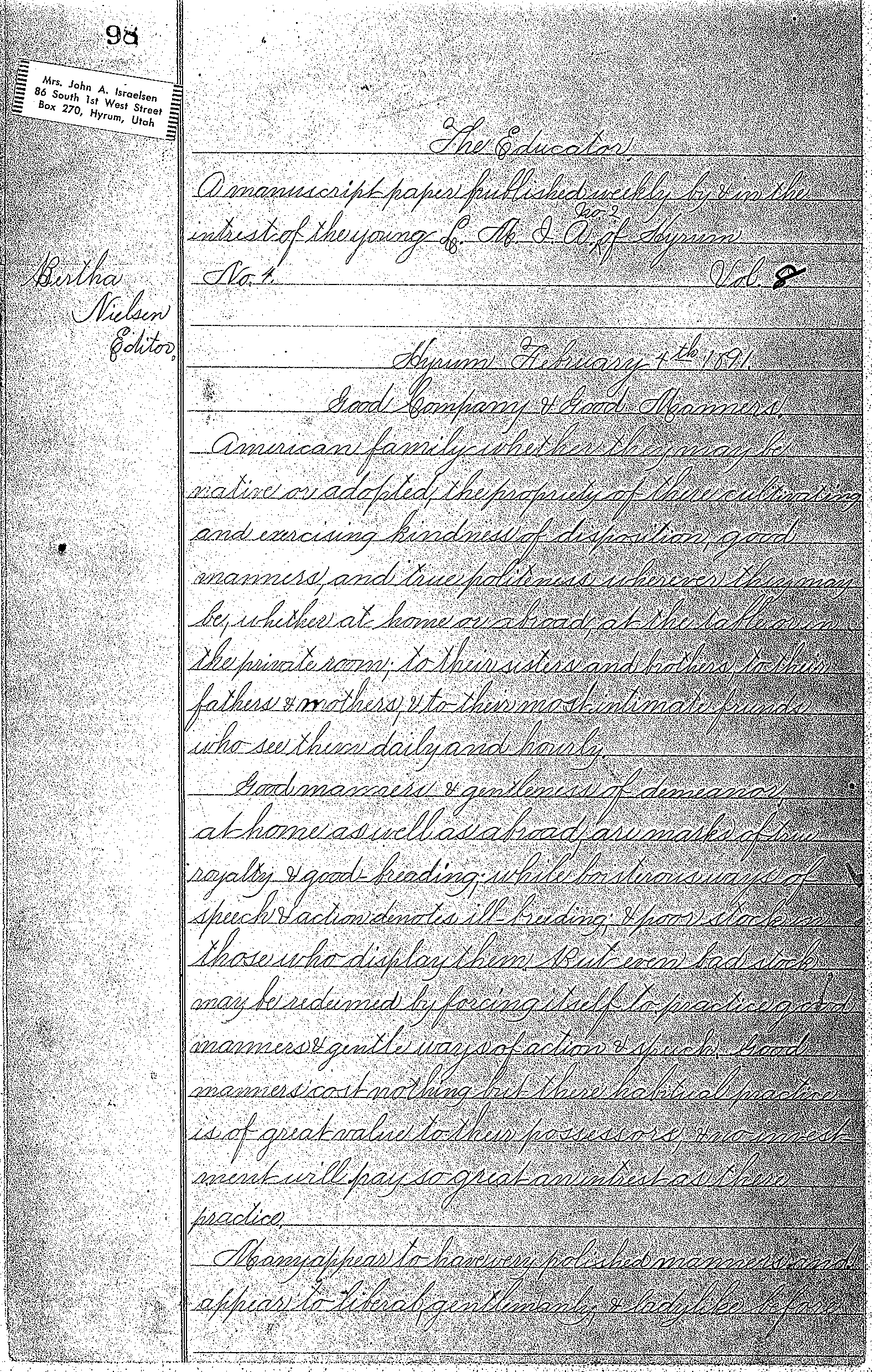
The Educator (UT, 1891)

Leave a comment

The Educator (UT, 1891)

Publication History:

Place of Publication:  Hyrum, Utah (1891)

Frequency:  “weekly”

Volume and Issue Data:  Vol. 8, No. 4, February 4, 1891

Size and Format:  7 3/4 x 13 inches, ledger book paper, single column

Editor/Publisher:  Bertha Nielsen, editor; “A manuscript paper published weekly by & in the interest (sic) of the young L.M.I.A. No. 2 of Hyrum” (i.e., Young Ladies’ Mutual Improvement Assn.)

Title Changes and Continuation:  Unknown

General Description & Notes

According to Alter, the Young Men’s and Young Ladies’ Mutual Improvement Associations in and around Hyrum, Utah published weekly literary journals largely in the interests and for the entertainment of their members during the late 1880s.  The publications carried news, religious items and weather reports.

The Educator, along with “THE KNOWLEDGE SEEKER,” “THE YOUNG LADIES THOUGHTS,” “A MANUSCRIPT PAPER” and “THE EVENING STAR” were published by Mormon Mutual Improvement Associations under various editors, since officers in these organizations changed hands regularly.

Utah State University Special Collections and Archives has 25 file folders containing these various Mutual Improvement Association newspapers.  They do not have a complete run of any of them, however.

Information Sources:

Bibliography:  J. Cecil Alter, Early Utah Journalism (Salt Lake City:  Utah State Historical Society, 1938), 90; Lorraine T. Washburn, “Culture in Dixie,” Utah Historical Quarterly, 29 (July 1961), 259-260; Mark A. Pendleton, “The Orderville United Order of Zion,” Utah Historical Quarterly, 7 (October 1939), 151.

Locations:  John A. Israelson’s papers, Special Collections and Archives, Utah State University, Logan, UT

Eastern Star (NH, No Date)

Leave a comment

East of the Nevada; or The Miner’s Voice from Colorado (NV, 1861?)

Leave a comment

Publication History:

Place of Publication:  Potosi, Nevada (then in northwest corner of New Mexico Territory)

Volume and Issue Data:  Vol. 1, No. 1, Feb. 19, 1861-?

Size and Format:  Unknown

Editor/Publisher:  J. A. Talbott

Title Changes and Continuation:  None

General Description & Notes:

According to Lingenfelter and Gash, editor J.A. Talbott, a former printer from Calaveras, came to Potosi following a silver discovery in 1860 without printing equipment.  Talbott justified publishing the East of the Nevada in its first issue:  “The manifold wants of our community rendering it necessary, owing to our isolated position, shut out from those sources of information and instruction that is as familiar as ‘household words’ in a settled community, renders it necessary to have a vehicle of thought amongst us by which an interchange of intelligence should be disseminated, questions discussed, wit circulated, and those precious gems preserved, without which ‘this world would be a void.’  For this end, and under our peculiar circumstances, our sheet is issued.”  The paper included a description of the principal mines of the district, a notice of the construction a theater and other local news.  The paper probably ran only a few issues, since the silver boom in Potosi was exhausted by October 1860, and Talbott joined the rush to Holcomb Valley.

The short life of the Miner’s Voice included competition with another local handwritten newspaper, the Potosi Nix Cum Rouscht, edited by Capt. J.E. Stevens, president of the Colorado Mining Company and founder of Potosi.

Information Sources:

Bibliography:  Robert F. Karolevitz, Newspapering in the Old West:  A Pictorial History of Journalism and Printing on the Frontier (New York:  Bonanza Books, 1969), p. 119; Richard E. Lingenfelter, The Newspapers of Nevada (San Francisco:  John Howell-Books, 1964), 66-67; Richard E. Lingenfelter and Karen R. Gash, The Newspapers of Nevada (Reno:  University of Nevada Press, 1984), pp. 170-171.

Index Sources:  None

Locations:  No issues located, but Feb. 19, 1861 issue (Vol. 1, No. 1) quoted in Los Angeles Star, March 9, 1861.

Older Entries Newer Entries