The Institute Ledger (IL, 1858)

Leave a comment

Publication History:

Place of Publication:  Batavia Institute, Illinois

Frequency:  Unknown

Volume and Issue Data:  Vol. 1, No. 2, March 30, 1858

Size and Format:  20 pages

Editor/Publisher:  Unknown

Title Changes and Continuation:  None

General Description and Notes:

Affiliated with the Batavia Institute.

Information Sources:

Bibliography:  None

Locations:  Manuscripts (SC 2006), Illinois State Historical Library, Old State Capitol, Springfield, IL

Illustrated Arctic News (ENG-AK, 1850-1851)

Leave a comment

Illustrated Arctic News (Eng-AK, 1850-1851)

Entry Updated: December 21, 2016

Publication History:

Place of Publication:  On board H.M.S. Resolute, Captain Horatio T. Austin, C.B., in search of the expedition under Sir John Franklin looking for the “Northwest Passage”

Frequency:  Five issues; frequency unknown

Volume and Issue Data:  October 1850-March 1851

Size and Format:  44.5 x 27 cm.; printed facsimile is folio, 12 x 19 inches, 57 pp

Editor/Publisher: Sherard Osborn and George F. McDougall?

Title Changes and Continuation: None

General Description and Notes:

Illustrated Arctic News (printed) (AK, 1850-1851)

Printed and published after the H.M.S. Resolute expedition returned home, from the five numbers originally issued in manuscript, October 1850-March 1851, on shipboard during the wintering of the H.M.S. Resolute in Barrow Strait.

The H.M.S. Terror, captained by Sir Franklin (and its companion ship, the H.M.S. Erebus), which the Resolute’s crew and other expeditions searched for over a period of 11 years, was finally found at the bottom of the Arctic Ocean above the Arctic Circle in September 2016, according the The Guardian (Sept. 12, 2016). The H.M.S. Terror was located 168 years after it went missing off King William Island in eastern Queen Maud Gulf in the Canadian Arctic Archipelago in Nunavut, Canada (see map below). The H.M.S. Erebus had been found several years earlier just to the south of where the Terror was later located.

hms-terror-map-northern-canada-arctic-ocean
Map: The H.M.S. Resolute wintered on the Barrow Strait in search of the Sir Franklin expedition. The H.M.S. Terror and its companion ship the H.M.S. Erebus were found, more than 160 years after they went missing, off King William Island in Queen Maud Gulf.

The H.M.S. Resolute, on which these handwritten newspapers were produced, became famous in politics and popular culture long after its retirement. Wood from the ship was later made into two desks, one of which the English crown gave as a gift to the United States President Rutherford B. Hayes in 1880. That desk still sits today in the Oval Office of the White House. That desk was also featured (as was its origin from the H.M.S. Resolute) in the popular film, National Treasure: Book of Secrets (2007), starring Nicholas Cage.

Information Sources:

Bibliography:  Sherard Osborn and George F. McDougall, eds., Facsimile of the Illustrated Arctic News, Published on Board H.M.S. Resolute, Captain Horatio T. Austin, C.B., In Search of the Expedition Under Sir John Franklin (London:  Ackerman, 1852)

Links: Captain Horatio T. Austin;  Sir John Franklin Northwest Passage Expedition; “Ship Found in Arctic 168 Years after Doomed Northwest Passage Attempt”; Franklin’s Last Voyage.

Locations: British Library (?);   Scott Polar Research Institute, Cambridge, England; Metropolitan Reference Library, Toronto, Ontario, Canada

Huntington Gazette (VT, 1810)

Leave a comment

Publication History:

Place of Publication: Huntington,Vermont

Frequency: Unknown

Volume and Issue Data:  March, 1810.  No known extant copies.

Size and Format: Brown wrapping paper, 7 inches by 4 1/2 inches, one side only

Editor/Publisher:  James Johns

Title Changes and Continuation: Vermont Autograph and Remarker

General Description and Notes:

James Johns describes this paper on the front page of his later manuscript paper, Vermont Autograph and Remarker of November 6, 1871:  “Should it be asked how long it is since I first took up this notion of a pen-printed newspaper, I answer that my first essay at it bore date back as earlly as March, 1810, I being then in my 13th year.  It was executed on a piece of brown wrapping paper nearly the size of this [approx. 7″ x 4 l/2”] when spread open, and printed on one side only and bore the title of Huntington Gazette; (I then lived in Huntington, the town next north by east of this.)  After that I used white writing paper, and sometimes altered the title as fancy dictated.  I have [end of page] . . .”

Information Sources:

Bibliography:  “James John, Vermont Pen Printer,” Proceedings of the Vermont Historical Society, New Series, 4:2 (1936), pp. 69-71

Link: The American Antiquarian Society, Amateur Newspapers Collection

Locations:  No known copies exist.  (Dennis R. Laurie, Assistant to the Curator of Newspapers and Periodicals, American Antiquarian Society, 185 Salisbury St., Worceseter, MA  01609-1634.  Phone 508/755-5221.)

Honey Bee (OR, 1874)

Leave a comment

Honey Bee (OR, no date)

Place of Publication: Jacksonville, Oregon

Frequency:  Unknown

Volume and Issue Data:  1, 1874

Size and Format:  10 pp. Ledger-size lined paper, written in cursive ink

Editor/Publisher:  Annie Miller

Title Changes and Continuation: None

General Description and Notes:

“Devoted to Art, Wit, Poetry, and Science” (cover page)

Motto: “Onward and Upward.”

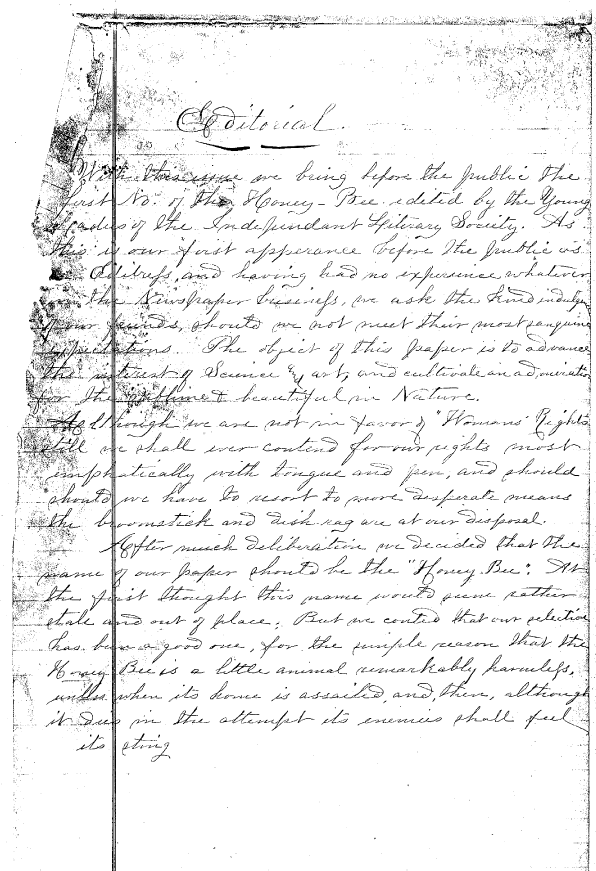
From the “Editorial” on page 2 (see image below): “With this issue we  bring before the public the first No. of the Honey-Bee, edited by the Young Ladies of the Independant (sic) Literary Society. ”  The editor continues, ” . . . having had no experience whatever in the Newspaper business, we ask the kind indulgence of our friends, should we not meet their most sanguine expectations.”

Honey Bee (OR, 1874)

Bibliography: None

Locations:  Special Collections, University of Oregon Library, Eugene, OR

Home Writer (UT, 1881-1883)

Leave a comment

Home Writer (UT, 1881-1883)

Publication History:

Place of Publication: Manti, Utah

Frequency:  Monthly

Volume and Issue Data:  13 numbers:  Vol. 1, No. 2 December 6, 1881, through Vol. 2, No.13 December 3, 1883.

Size and Format:  8”x12.5” ledger-size lined pages, written in ink

Editor/Publisher:  S.A. Parsons, Olive Lowry, Charles Tennant, Ettie C. Kyar, A.S. Squire, T. Parry, R.L. Byleu, Nephi Gledhill, Nancy Westenskow, J.J. Hansen

Title Changes and Continuation: None

General Description and Notes:

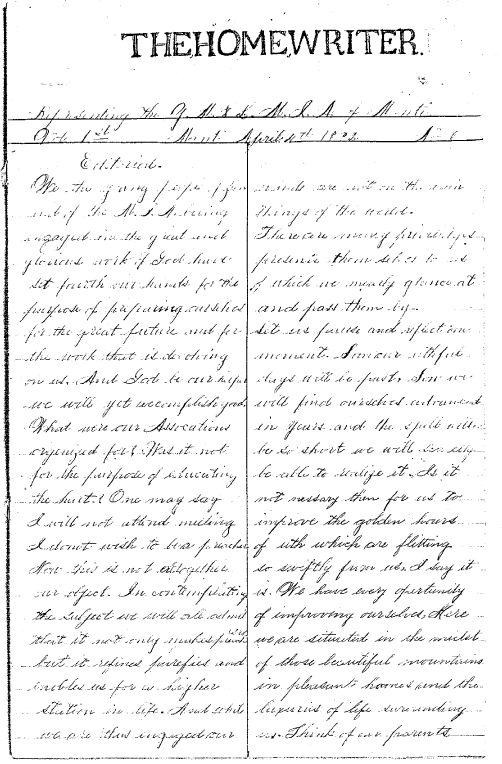
Motto:  Representing the Young Men and Young Ladies M.I. [Mutual Improvement] Association of Manti.

Includes editorials, hints on criticism, good thoughts, how to ? knowledge, wit and humor, mathematical problems, answers to problems, poetry, news, advertisements, births, deaths, marriages, etc.

Information Sources:

Home Writer (UT, 1881-1883)

Bibliography:  George T. Brooks Papers, Box 1 Fd. 2-4

Locations:  University Libraries, Manuscripts, University of Utah, Ms 368

The Hive (CT, 1828-1829)

Leave a comment

Publication History:

Place of Publication:  Torringford, Connecticut

Frequency:  Unknown

Volume and Issue Data:  7 issues extant, 1828-1829

Size and Format:  large size paper, 4 pages each

Editor/Publisher:  Unknown

Title Changes and Continuation: None

General Description and Notes:

None

Information Sources:

Bibliography:  None

Locations:  Salmon Brook Historical Society, Granby, CT

Hamiltonian (MA, 1840s)

Leave a comment

Publication History:

Place of Publication: Massachusetts?

Frequency: Unknown

Volume and Issue Data:  1840’s

Size and Format:  approx. 120 pp.

Editor/Publisher:  Hale family

Title Changes and Continuation:  “and other miscellaneous titles”

General Description and Notes:

Children’s projects.

Information Sources:

Bibliography:  None

Locations:  Hale Family Papers, Sophia Smith Collection, Archives, Smith College, Northampton, MA

Halaquah Times (OK, 1871-1875)

Leave a comment

Publication History:

Place of Publication: Wyandotte Mission School, Last Creek, Indian Territory (Oklahoma)

Volume and Issue Data:  Vol. 2, No. 3-Vol. 6, No. 6, ca. 1871-1875

Size and Format:  (check extant copies–at Kansas collection)

Editor/Publisher:  Ida Johnson and Julia Robitaille, editors; Halaquah, Literary Society of Wyandotte Mission School (1871-1875)

Title Changes and Continuations:  None

General Description and Notes:

According to Littlefield and Parins, the Halaquah Times was a manuscript magazine published by the students of the Wyandote Mission’s literary society.  It contained letters and essays on student and school activities.  Many of the essays focused on “social improvement.”  The magazine was edited by Ida Johnson and her associate July Robitaille.

According to Murphy and Murphy, the student editors made one copy and then had other students at the mission school make additional copies.

Information Sources:

Bibliography:  Carolyn Thomas Foreman, Oklahoma Imprints, 1835-1907 (Norman:  University of Oklahoma Press, 1936); Grace Ernestine Ray, Early Oklahoma Newspapers (Norman:  University of Oklahoma Press, 1928); James E. Murphy and Sharon M. Murphy, Let My People Know:  American Indian Journalism, 1828-1978 (Norman:  University, 1981); David F. Littlefield, Jr. and James W. Parins,  American Indian and Alaska Native Newspapers and Periodicals, 1826-1924 (Westport, Conn.:  Greenwood Press, 1984), 143-144.

Locations:  “Miscellaneous–Halaquah,” Manuscripts, Kansas State Historical Society, contains two undated issues, written in copybooks

The Grindstone Bee (SD, 1906)

Leave a comment

Grindstone Bee (SD, 1906)

Publication History:

Place of Publication:  Grindstone, South Dakota

Volume and Issue Data:  Vol. 1, No. 1, April 1, 1906; “whenever we feel like it”

Size and Format:  11 x 14 in.; 4 pp.

Editor/Publisher:  Wm. Henry Bruno

Title Changes and Continuations:  NA

General Description and Notes:

Grindstone Bee (SD, 1906)

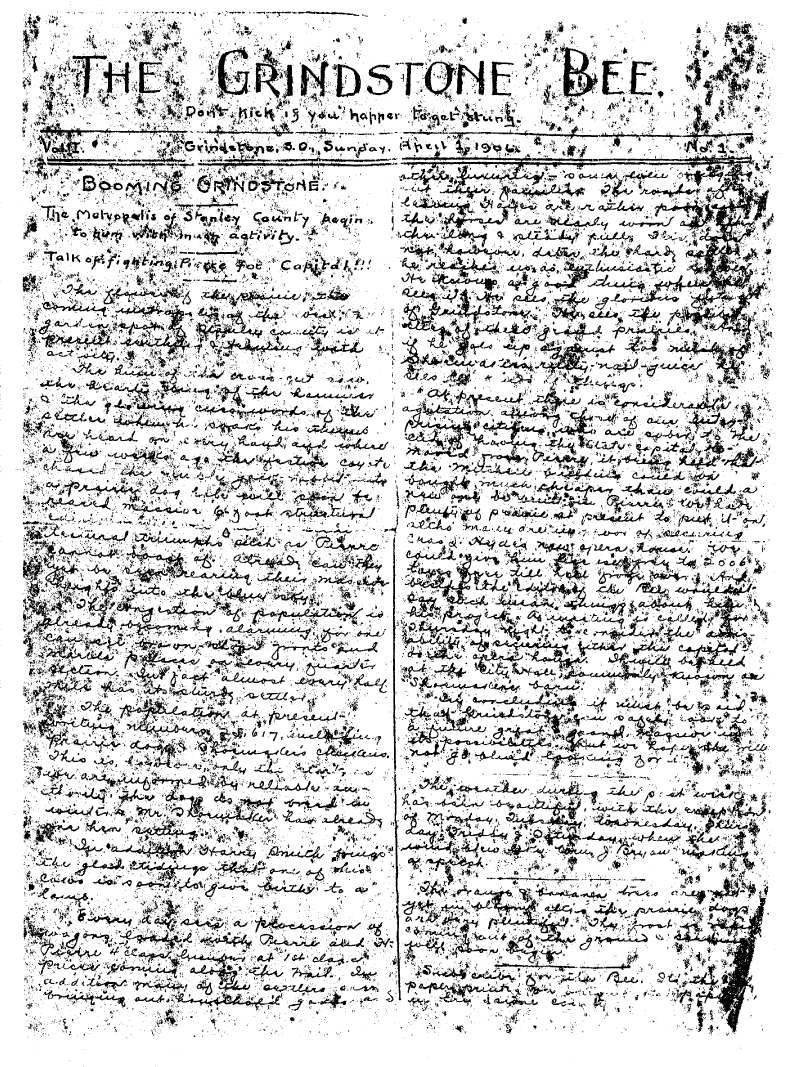
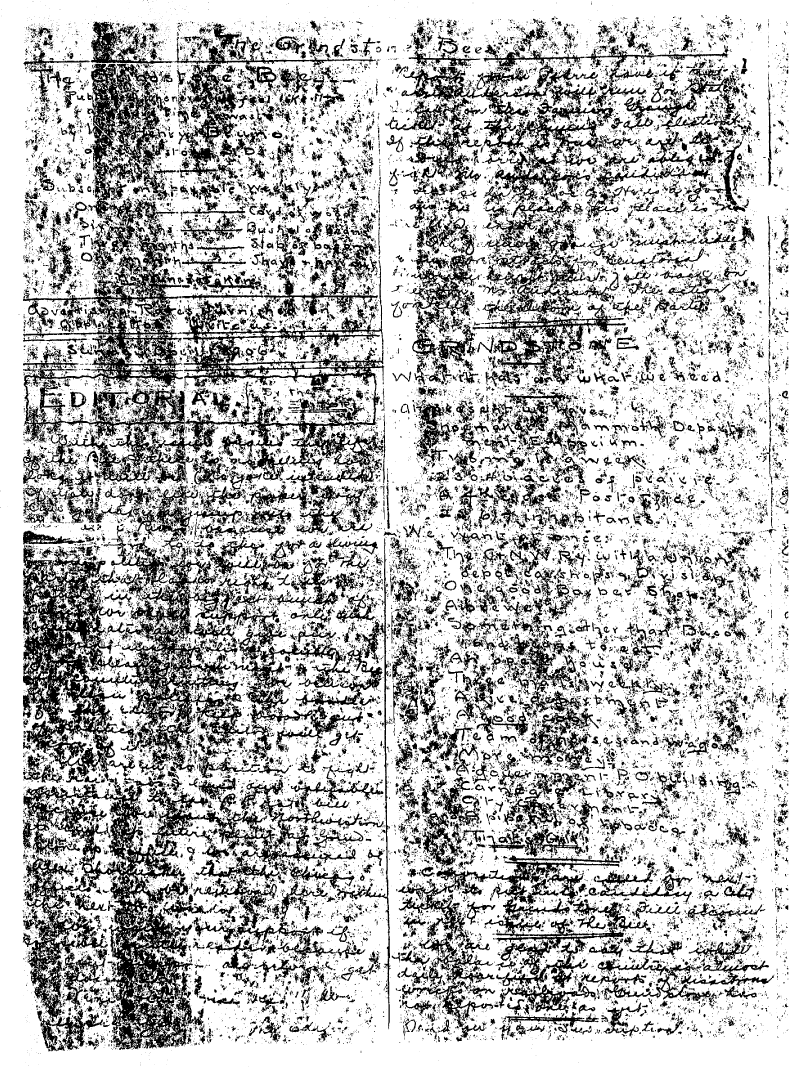
The date hints that it may be a spoof. Other indicators, such as the subscription rates on page 3 (“One year: cord of wood; six months: bushel of beans; three months: slab of bacon; one month: shave & hair cut”) and the motto,” Don’t kick if you happen to get stung,” also point toward an “April Fool’s” edition paper.

Information Sources:

Bibliography: None

Grindstone Bee (SD, 1906)

Locations: South Dakota Historical Society

Green Mountain Miscellany or Huntington Magazine (VT, 1834)

Leave a comment

Publication History:

Place of Publication: Huntington, Vermont

Frequency: Unknown

Volume and Issue Data: October 10, 1834

Size and Format: Unknown

Editor/Publisher:  James Johns

Title Changes and Continuation: Huntington Magazine

General Description and Notes:

The earliest extant issue of a pen-printed amateur newspaper.

Information Sources:

Bibliography: None

Locations:  American Antiquarian Society, Worcester, MA

The Grasshopper (TX, 1866-1869)

Leave a comment

Publication History:

Place of Publication:  Fort Buffalo Springs, Texas

Frequency:  Unknown

Volume and Issue Data:  Published sometime between 1866 and 1869.

Size and Format:  Unknown

Editor/Publisher:  H.H. McConnell

Title Changes and Continuation:  Same editor/publisher produced LITTLE JOKER at Jacksboro, Texas and the BIG INJUN at Fort Belknap, Texas.

General Description and Notes:

According to Whisenhunt, the Jacksboro area had no fewer than four newspapers between 1866 and 1869, although only one was printed.  The editor of all four was H.H. McConnell, a soldier first assigned to Jacksboro, Texas in 1866.  McConnell recounts his journalistic efforts and military experience on the Texas frontier in the Reconstruction period in his autobiography, Five Years a Cavalryman.

Shortly after he arrived in Jacksboro, McConnell and other soldiers published a weekly newspaper, LITTLE JOKER, on foolscap.  The paper circulated among the soldiers at Jacksboro.  The Jacksboro post was temporarily abandoned by the military, and the LITTLE JOKER “was ignominiously packed on a Quartermaster’s hourse and moved to Fort Belknap.”

At Fort Belknap soon issued another handwritten paper, BIG INJUN, intended for a military audience.  According to McConnell, “Here the genius of the editor again broke forth, and the ‘Big Injun’ for a time shed an undying lustre on the literature of the nineteenth century.”  The paper was short-lived:  “Like a meteor flashing along the midnight sky–brilliant for a moment, then rendering the darkness more intense–so the ‘Big Injun’ ran its course.”

McConnell’s transfer to nearby Fort Buffalo Springs marked the publication of his third handwritten, THE GRASSHOPPER.  Like its predecessors, THE GRASSHOPPER was short-lived.  Fort Buffalo Springs was soon abandoned for the more strategic Jacksboro post.

McConnell was finally reassigned to Fort Richardson where he contracted with a Weatherford, Tex. printer to publish The Flea.  This, his first printed newspaper, appeared Feb. 1, 1869, but lasted only six issues, until June 15, 1869.

According the Whisenut, McConnell’s handwritten papers did little more than provide diversion for the soldiers at their respective military posts, but “this was important.  Their very existence also implies that the life of the frontier soldier was mostly a monotonous existence despite the legend and aura of romance that surrounds the United States Cavalry.”

Information Sources:

Bibliography:  H.H. McConnell, Five Years a Cavalryman (Jacksboro, Texas:  J.N. Rogers and Co., 1889), p. 174; Donald W. Whisenhunt, “The Frontier Newspaper:  A Guide to Society and Culture,” Journalism Quarterly, 45:4 (Winter 1968), 727; see also Theronne Thompson, “Fort Buffalo Springs, Texas, Border Post,” West Texas Historical Association Yearbook, 36:168 (October 1960).

Location:  None

Granite Times (NV, 1908)

Leave a comment

Granite Times (NV, 1908)

Place of Publication:  Granite (seven miles west of Schurz in present-day Mineral County), Nevada

Frequency:  Weekly?

Volume and Issue Data:  March 20, 1908-May 1, 1908

Size and Format:  Two-page, three columns; graphite pencil and blue pencil headlines, or black ink in longhand, with occasional shading and coloring with crayon

Editor/Publisher:  Frank Eugene Bugbee (elected to Nevada Assembly 1931, 1933, and 1937) (1908)

Title Changes and Continuation:  Richard E. Lingenfelter, The Newspapers of Nevada (San Francisco:  John Howell-Books, 1964), 131, identifies paper as the Granite News.

General Description & Notes:

The Granite Times, according to its 1908 Easter edition, was “Devoted to the Mining and Material Interests of Granite and the Mountain View District.”  According to Highton, the paper was regularly sold for $1, while the special the Easter edition was $5.  The paper included general local news, editorials and poetry.  Stories addressed such events as the completion of an automobile road between Granite and Schurz.  The Rawhide Rustler, April 18, 1908, reproduced a portion of the Granite Times:  “We reproduce . . . a section of the Times, a paper printed in lead pencil in the new town of Granite . . . .  It shows the usual progressiveness of new mining camps in Nevada.”  Lingenfelter and Gash speculate that the Times suspended publication with its seventh number on May 1, 1908.

Earl and Moody report that editor Bugbee was an Ohio native who taught school in Kansas before arriving in Nevada at the turn of the century.  He visited several mining towns before joining the rush to Granite and starting the Times.  Bugbee reported in one issue that he had ordered a carload of type to print his paper, but through an error he received a mess of tripe.  He offered “a bar of soap and a pound of tripe” to those who solicited others for new subscriptions to the Times.  Noted the editor, “Do not get discouraged because have not the tools and equipment you should have to run your lease.  The editor has only three lead pencils, but he gets out a paper every week.”

The two extant issue of the Granite Times at the Nevada Historical Society were donated by Bugbee in 1909.

Information Sources:

Bibliography:  Phillip I. Earl and Eric Moody, “Type, Tripe and the Granite Times,” Nevada Magazine, (May-June 1982), 17-18; Jake Highton, Nevada Newspaper Days:  A History of Journalism in the Silver State (Stockton, Calif.:  Heritage West Books, 1990), pp. 97;  Richard E. Lingenfelter, The Newspapers of Nevada (San Francisco:  John Howell-Books, 1964), 131 (identifies paper as the Granite News); Richard E. Lingenfelter and Karen R. Gash, The Newspapers of Nevada (Reno:  University of Nevada Press, 1984), 110.

Locations:  April 17, May 1, 1908:  NvHi (also on microfilm)

The Grafton News (MA, no date)

Leave a comment

Publication History:

Place of Publication: Grafton, Massachusetts

Frequency: Unknown

Volume and Issue Data: Unknown

Size and Format:  Unknown

Editor/Publisher:  Unknown

Title Changes and Continuation: Unknown

General Description and Notes:

None

Information Sources:

Bibliography:  None

Link: The American Antiquarian Society, Amateur Newspapers Collection

Locations:  American Antiquarian Society, Worcester, MA

The Gold Canon Switch (NV, 1854)

Leave a comment

Publication History:

Place of Publication:  Johntown, Utah Territory (four miles from what became Virginia City, Nevada)

Frequency:  Frequency disputed:  weekly, monthly or irregular

Volume and Issue Data:  Ca. 1854

Size and Format:  “Often several sheets

Editor/Publisher:  Joseph Webb (1854)

Title Changes and Continuations:  Unknown

General Description & Notes:

According to De Quille and Highton, the Switch was “a spicy, handwritten weekly, ‘often several sheets,’ and passed from hand to hand.”  Lingenfelter and Gash say the paper was “probably issued monthly on letter paper and in a very small edition.”  De Quille claims the paper was widely circulated and read in Johntown when it was a major mining center.  The editor, Joe Webb, was a partner of “Old Virginy” Fenimore, for whom Virginia City was later named, according to Lingenfelter.

Information Sources:

Bibliography:  Bob Karolevitz, “Pen and Ink Newspapers of the Old West,” Frontier Times, 44:2 (Feb.-Mar., 1970), 31; Robert F. Karolevitz, Newspapering in the Old West:  A Pictorial History of Journalism and Printing on the Frontier (New York:  Bonanza Books, 1969), p. 114; Jake Highton, Nevada Newspaper Days:  A History of Journalism in the Silver State (Stockton, Calif.:  Heritage West Books, 1990), pp. 2; Dan De Quille, History of The Big Bonanza (New York:  Alfred A. Knopf, 1947), p. 11.

Index Sources:  Richard E. Lingenfelter, The Newspapers of Nevada (San Francisco:  John Howell-Books, 1964), 61; Richard E. Lingenfelter and Karen R. Gash, The Newspapers of Nevada (Reno:  University of Nevada Press, 1984).

Locations:  None

The Germantown Bulletin (MA, no date)

Leave a comment

Publication History:

Place of Publication: Germantown, Massachusetts

Frequency:  Unknown

Volume and Issue Data: Unknown

Size and Format: Unknown

Editor/Publisher:  Unknown

Title Changes and Continuation: Unknown

General Description and Notes:

 None

Information Sources:

Bibliography:  None

Link: The American Antiquarian Society, Amateur Newspapers Collection

Locations:  American Antiquarian Society, Worcester, MA

[The] Gazette-Extr[a].

Leave a comment

Publication History:

Place of Publication: Extant issue states: Philadelphia, PA, USA

Frequency:  Unknown

Volume and Issue Data: Extant issue dated April 11, 1846

Size and Format: 15 x 11 in. (40 x 25 cm.), one sheet, two pages

Editor/Publisher:  Attributed to Herman Melville (see notes below)

Title Changes and Continuation: Unknown

[The] Gazette-Extr[a], PA, 1846, front page

General Description and Notes:

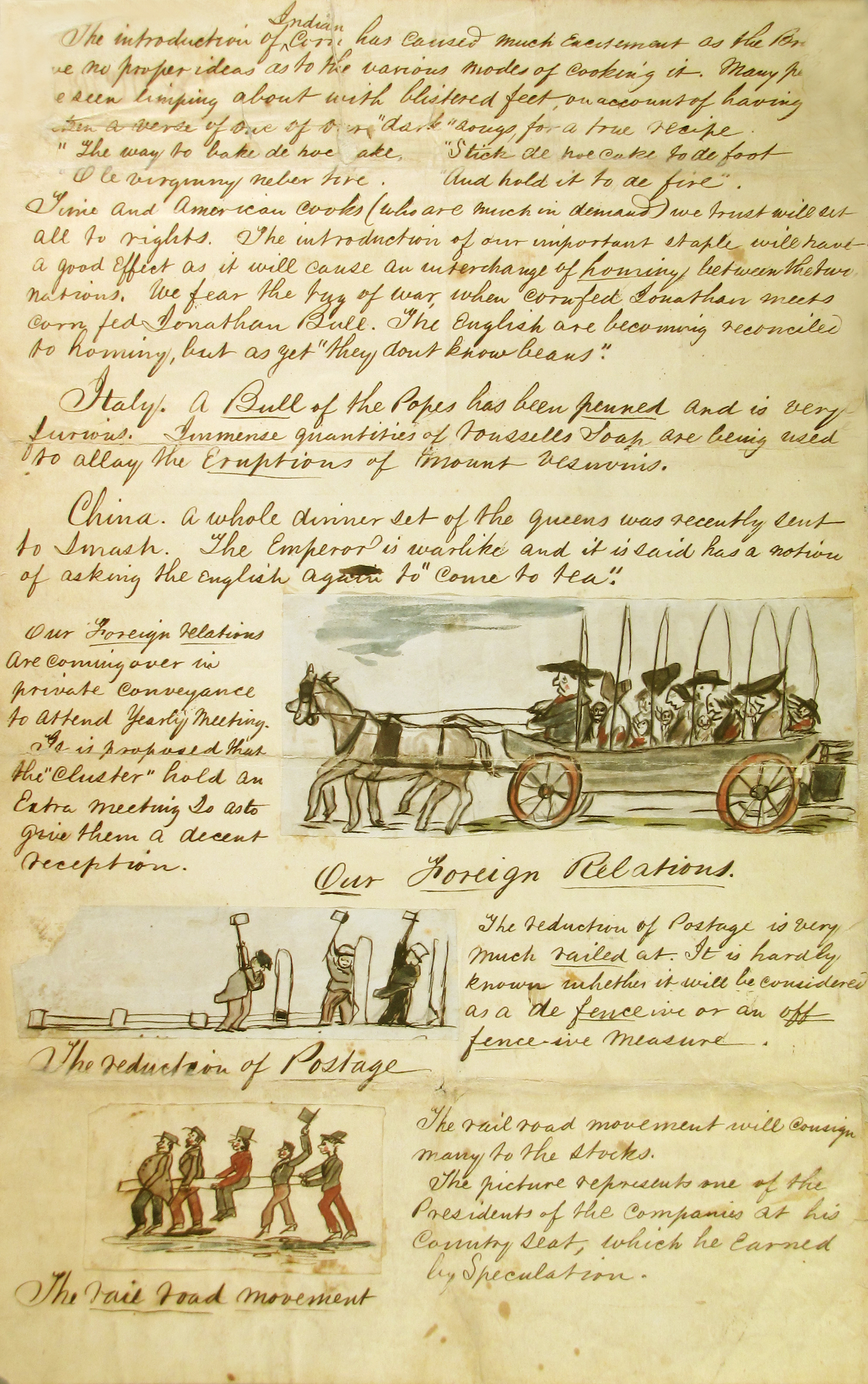
According to one scholar who has analyzed the paper, it is “an April 1846 satirical newspaper, The PHILADal GAZETTE – EXTR, with seven pen and ink drawings accompanying a 437 word handwritten commentary on U.S. and world news.”

[The] Gazette-Extr[a], PA, 1846, back page

The Gazette-Extra was introduced to the Handwritten Newspaper Project by Professor Roger Stritmatter of Coppin State University, Baltimore, MD, USA. He described how he came upon the manuscript and pursued its authorship:

“. . . I purchased [the document] from a New Jersey antique dealer in 2009 . . . . Since the acquisition I have had four published articles, three by experts from the University of Buffalo’s Cedar-Fox Center for Excellence for Document Analysis and Recognition, who are state-of-the-art experts in forensic handwriting, which identify the writer (and therefore the artist) as Herman Melville. . . . I thought I would send it along to you, with appreciation for your website and my permission to publish the images as part of your archive, should you be so inclined” (Roger Stritmatter, PhD, personal email correspondence to the HNP Editor, dated Feb. 6, 2022).

Sargur N. Srihari, with the Cedar-Fox Center for Excellence for Document Analysis and Recognition, presented “Determining Writership of Historical Manuscripts using Computational Methods” at workshop on Automatic Pattern Recognition and Historical Handwriting Analysis in Erlangen, Germany in June 2013. In his presentation, citing Stritmatter’s work, he writes:

“A case for determining authorship of a historical manuscript is the Hydrachos manuscript (H.)1 . It is an April 1846 satirical newspaper, The PHILADal GAZETTE – EXTR, with seven pen and ink drawings accompanying a 437 word handwritten commentary on U.S. and world news. “Hydrachos” is the document’s misspelling of the name of a notorious paleontological curiosity of the 1840s, the Hydrarchos Sillimani, also called Basilosaurus and eventually renamed Zeuglodon cetoides. As summarized in the words of a contemporary novelist it was the “skeleton of an extinct monster, found in the year 1842, on the plantation of Judge Creagh, in Alabama.”[10]. The Alabama doctors declared it a huge reptile, and bestowed upon it the name of Basilosaurus. But some specimen bones of it being taken across the sea to Owen, the English Anatomist, it turned out that this alleged reptile was a whale, though of a departed species. In 1846 the remains of the Hydrarchos, having previously appeared in 1845 in New York at the Apollo Saloon, were on display at the Philadelphia Natural Museum housed in the Masonic Hall on Chestnut Street[13, 115] which is so conspicuously alluded to in the H. document’s opening lines. Measuring 40 x 25 cm, the document contains satirical news content, primarily from the United States, Great Britain, Italy, and China, on both the recto (Figure 1(b)) and verso sides (Figure 1(a)). Lexical, grammatical, thematic, visual, content, and situational analysis[17] all support the hypothesis that the manuscript’s author is the New England author Herman Melville whose description of the controversy surrounding the “extinct monster” unearthed in Alabama from Moby Dick (Chapter 104, “The Fossil Whale”). This synoptic report, drawing a more complete unpublished analysis by Stritmatter [17], summarizes some reasons for hypothesizing this attribution, surprising as it might seem to contemporary Melville scholars. Although Melville does not use the word Hydrachos, many other phrases and allusions in the manuscript can be traced to his published writings. A striking example is the document’s leading conceit of the sea monster capable of carrying mail between America and England. Melville’s fall 1847 satirical squib to Yankee Doodle, appearing in print eighteen months after the date on the Hydrachos manuscript, similarly views the sea monster not as an extinct pile of bones but as a living asset to the communications industry. The satire offers a reward of one thousand dollars to anyone able to ”procure a private interview with the Sea-serpent, of Nahant notoriety,” for the purpose of concluding a negotiation with the Postmaster General to license the beast ”for the transmission of European mails from Boston to Halifax” (Hayford 429). The satire also advertises for a ”smart jockey” to ”superintend” the shipment. The situation of Melville’s satire directly echoes the Hydrachos visual depiction of a sea monster mounted by a ”rider,” equipped like a horse jockey with a bridle and a riding hat, ferrying mail between Boston and Liverpool. Like so much else in Melville’s writing, the motif of the sea monster transporting international mail from the Eastern United States to Europe can be directly traced to Melville’s own circumstances. In April 1846 he was engaged in an intense transatlantic correspondence with his brother Gansevoort, the secretary to the American legation in London, who was concluding negotiations for the publication of Herman’s first book, Typee. The book was published in England by John Murray and in the United States by Wiley & Putnam in March, 1846; throughout March Gansevoort was sending Herman British newspapers containing Typee reviews. The H. document, which has been folded five times vertically and once horizontally, to form an envelope-sized packet, 9×12 cm, preserves traces of evidence that it was at one time sent through the mail as a part of such a correspondence. More specifically, the April 11 date is of particular interest given that Gansevoort sent to Herman by the March 18 ”Unicorn” a number of papers, ”principally Examiners & Critics contg notices of Herman’s Marquesas Islands” (Parker, ”London Journal,” 53). It is proposed that this is the shipment alluded to in the H. manuscripts statement that ”our file of foreign papers was delivered at the cluster office” – the latter perhaps referring to Alan Melville’s Wall Street law office in Manhattan, where international correspondence for the family was typically routed. Qualitative stylistic analysis supports the attribution. In the 437 word document, Stritmatter[17] was able to trace 59 words and phrases many of an apparently particularistic nature, found in the Melville canon . . . .”

According to an article published in the Baltimore Sun (2018), the handwritten paper’s stories “purport to relate news events that occurred in Boston, England, China and Italy. Stritmatter thinks that a piece of commentary datelined Cape May, N.J., is an inside-joke referring to a family event. ‘These satiric mock newspapers were very popular in the 19th century,’ Stritmatter said. ‘They originated aboard ships and were a way that people entertained themselves and each other.’”

Information Sources

Bibliography:  

Gregory R. Ball, Danjun Pu, Roger Stritmatter and Sargur N. Srihari, “Comparison of Historical Documents for Writership,” 2010.  

Gregory R. Ball, Sargur N. Srihari, and Roger Stritmatter, “Writer Verification of Historical Documents Among Cohort Writers,” 2010.   

Mary Carole McCauley, “Finding a white whale: Coppin State professor might have confirmed lost Herman Melville manuscript,” Baltimore Sun, Oct 17, 2018 (online).

Srihari, Sargur N. “Determining Writership of Historical Manuscripts Using Computational Methods,” presented at “Automatic Pattern Recognition and Historical Handwriting Analysis” workshop at Erlangen, Germany, June 14-15, 2013. 

Roger Stritmatter “Arrangement, Natural Variation, Legibility and Continuity as Discriminating Elements in Handwriting Analysis: A Study of Herman Melville’s April 11, 1846 Hydrarchos Satire,” Journal of Forensic Document Examination 27 (2017) 31-55 (https://doi.org/10.31974/jfde27-31-55)

Locations:  
Private collection of Professor Roger Stritmatter

The Gas Light (MO, 1850)

Leave a comment

Publication History:

Place of Publication: Keytesville, MO

Frequency:  Unknown, published sporadically for nearly a year

Volume and Issue Data: Started June 1850

Size and Format: Unknown

Editor/Publisher:  “Timothy Timbertoes” and “Samuel Sugarstick” (pseudonyms)

Title Changes and Continuation: Unknown

General Description and Notes:

 According to the History of Howard and Chariton Counties, the paper professed to be “neutral in religion and politics.” The writers made fun of local leaders and gave satirical accounts of quilting parties, shooting matches and weddings.

According to Jolliffe and Whitehouse, “This publication cannot be named a ‘newspaper,’ given the lack of information about it.”

Information Sources:

Bibliography:  Lee Jolliffe and Virginia Whitehouse, “Handwritten Newspapers on the Frontier? The Prevalence Problem, ” paper presented at the AEJMC History Division Mid-Year Meeting, Columbia, MO, 1994; History of Howard and Chariton Counties, Missouri (St. Louis: National Historical Company, 1883), p. 511.

Locations:  None

The Fulton County Daily Report (GA, 1889)

Leave a comment

Publication History:

Place of Publication: Atlanta, Georgia

Frequency:  Daily, weekdays only

Volume and Issue Data: Feb. 1, 1889ff. (unclear how many are handwritten).

Size and Format: Unknown

Editor/Publisher: Unknown

Title Changes and Continuation: Unknown

General Description and Notes:

A legal publication of the courts of Fulton County, GA.  “Official organ of the U.S. District Court . . . and of the Superior Courts of Fulton County as the official court newspaper.”

Information Sources:

Bibliography: None

Locations:  Microfilm (call number:  FILM KFG 90.N6F8), University of Georgia Libraries, Athens, GA

Froth (MI, 1864-1865)

Leave a comment

Publication History:

Place of Publication: Michigan?

Frequency:  Unknown

Volume and Issue Data:  1864-1865

Size and Format:  Unknown

Editor/Publisher:  Unknown

Title Changes and Continuation:  Unknown

General Description and Notes:

May be partially manuscript.  It is listed as a “relevant listing” within their printed holdings.

Information Sources:

Bibliography: None

Locations:  Printed Holdings,  Bentley Historical Library, The University of Michigan, Ann Arbor, MI

Ford City Herald (TX, 1864)

Leave a comment

Ford City Herald (TX, 1864), front page

Publication History:

Place of Publication: Camp Ford, Tyler, Smith County, Texas

Frequency:  Unknown; only one extant issue known, but in the extant edition the editors promise “Our Next Herald” (page four, bottom of column two)

Volume and Issue Data:  Vol. 1, No. 1, July 4, 1864

Size and Format: 8 1/2 x 11; four pages; three columns; pen and ink

Editor/Publisher:  Probably Capt. William H. May (and J.P. Robens?), also editor(s) of The Old Flag; a 12-page facsimile edition of The Old Flag, published by J.P. Robens and William H. May entitled, The Old Flag: First Publication by Union Prisoners at Camp Ford, Tyler, Texas includes some items and advertisements from the Ford City Herald

Title Changes and Continuation:  Related to the Old Flag, but continuation unknown

General Description and Notes:

While reference to The Herald was made in the facsimile edition of The Old Flag , the Handwritten Newspapers Project was unaware of any extant copies of The Herald until October 2012 when Renee M. Savits, of the Library of Virginia’s Civil War 150 Legacy Project notified us that a donor, the great-great-granddaughter of Capt. William H. May, editor of the Old Flag, had supplied the project with a framed copy of The Herald and a collection of letters from Capt. May before his capture near New Orleans in the summer of 1863.
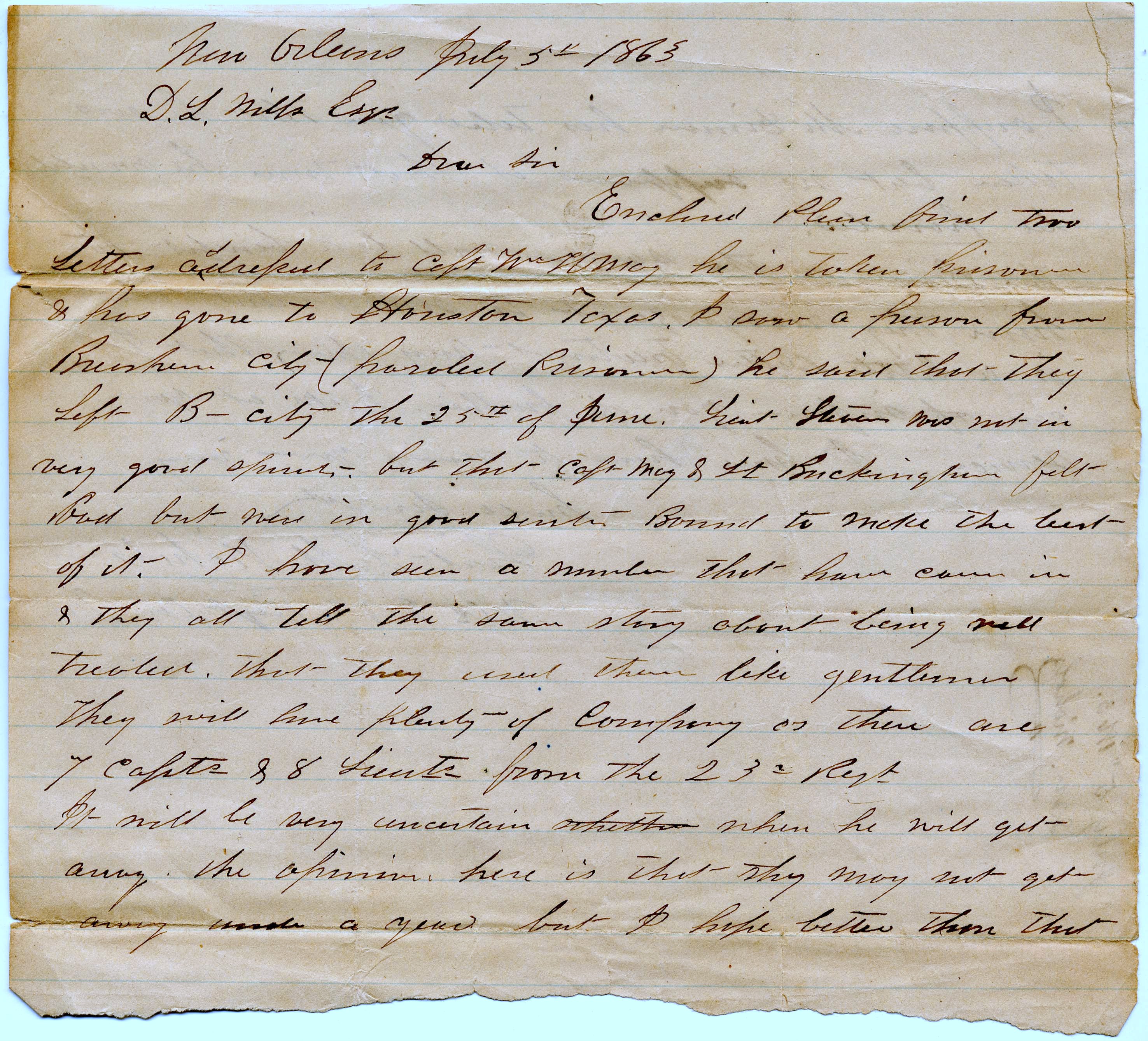
Letter re. Capt. Wm. May, July 5,1863, explaining he has been taken prisoner (p.1)

Letter re. Capt. Wm. May, July 5,1863, explaining he has been taken prisoner (p.1)

Capt. May served with Co. I, 23rd Infantry Regiment, Connecticut, in Brashear City, LA, and New Orleans in 1863. A two-page letter dated July 5, 1863 (right, courtesy of the CW 150 Legacy Project) indicates his capture and transport to Houston, TX.

The Herald is closely related to the The Old Flag, which was published at Camp Ford, the Confederate prison at Tyler, Texas, during an imprisonment of 13 months.  On page two, under “Herald Job Printing Office,” the editor indicates the relationship between the two papers when he writes,

“This branch of our imense (sic) establishment is now complete. The new Type and Materials of The Herald, in addition to the well stocked Office of

Letter re. Capt. Wm. May, July 5,1863, explaining he has been taken prisoner (p.2)

Letter re. Capt. Wm. May, July 5,1863, explaining he has been taken prisoner (p.2)

the “OLD FLAG,” removed and refitted, enables us to give notice that we are fully prepared to execute all kinds of Plain and Fancy Job Printing with neatness and dispatch. Terms, CASH.”

Under “Terms” (first page, top left column), the editor of The Herald also wrote, “The Herald is published Semi-Occasionally; subscription, Two Bits, payable in Lincoln Green at time of Publication.”
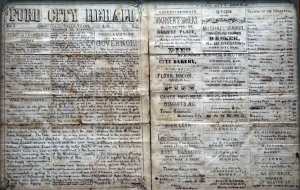
Ford City Herald (TX, 1864), Camp Ford, Tyler, TX

According to the editor of The Old Flag, each issue was read aloud in the various cabins by some member of the “Mess.”  When all had read or heard it read, the paper was returned by the “subscriber” to the “office publication.”

The Old Flag’s primary goal was to relieve the almost unbearably eventless and monotonous life of Camp Ford.  Contributions commented on local news and camp issues, displayed poetry and art, and played with satire, jokes and chess problems.  Advertisements, which appeared in every issue, were genuine.  Most offered the services of skilled prisoners for the benefit of the others.  For example, pipe makers, barbers, cigar makers, shoe shines and “job printing” (by the editor) were all available in the prison city.
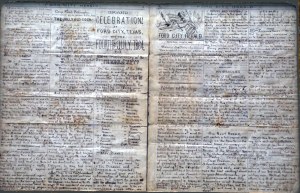
Ford City Herald (TX, 1864), pages 2-3

Camp Ford was the largest Confederate military prison in Texas during the Civil War.  The prison held both officers and enlisted men from 1863 until the end of war.  The prison held as many as 4,900 prisoners by July 1864.  Living conditions in the tented enclosures were generally good compared to some other Civil War prison camps.  Fresh water, adequate shelter and plentiful food supplies made the prison a relatively healthy place; during its 21-month existence, roughly 250 soldiers died in the camp.  Most soldiers were allowed to keep many of their possessions, to manufacture items for sale and to purchase food and supplies from local farmers and merchants.[1]  To facilitate these economic transactions, The Old Flag published a “REVIEW OF THE TEXAS MARKET-for the Month of February, 1864” in its March 1 edition.

Capt. William H. May, of the 23rd Connecticut Volunteers, with the assistance of other Union soldiers, published and edited the Ford City Herald in July 1864 and at least three issues of The Old Flag between February 17 and March 13, 1864,[2] during their 13-month confinement in the Confederate prison camp. According to J.P. Robens, one of the prisoners, The Old Flag was published on sheets of “unruled letter paper, in imitation of print, a steel pen being employed in the absence of a Hoe Press.”[3]  The three-column, four-page paper made liberal use of large headlines and graphic elements.

The Old Flag’s primary goal was “to contribute as far as possible towards enlivening the monotonous, and at times almost unbearably eventless life of Camp Ford–and to cultivate a mutual good feeling between all.”  Contributions were solicited on matters of local news and camp issues.  The Old Flag published poetry and art, and included satire, jokes and chess problems.  Display advertisements appeared in every issue, and “most of them bona fide, genuine.”  Most of the ads promoted the services of skilled prisoners for the benefit of the others.  For example, pipe makers, barbers, cigar makers, shoe shines and “job printing” (by the editor) were all available in the prison city.[4]

The lithographed reproduction of The Old Flag was published in New York in 1864 and included a “List of officers, prisoners of war at Camp Ford . . . giving rank, regiment, where and when captured.”

After prisoners were released from Camp Ford, the editor published a lithographed reproduction of the handwritten version.

According to Mary Witkowski, of the Bridgeport Public Library, Bridgeport, CT, Captain May was a newspaper man in civilian life.

Information Sources:                                                        

Bibliography:  F. Lee Lawrence and Robert W. Glover, Camp Ford, C.S.A.:  The Story of Union Prisoners in Texas(Austin:  Texas Civil War Centennial Advisory Committee, 1964), 36-37;  The Old Flag (privately published, 1914); see also Roy Alden Atwood, “Captive Audiences: Handwritten Prisoner-of-War Newspapers of the Texan Santa Fe Expedition and the War Between the States,” Annual Convention of the American Journalism Historians Association (AJHA), Salt Lake City, UT, Oct. 1993.

Locations:  

Library of Virginia’s Civil War 150 Legacy Project (thanks to Renee M. Savits, of the CW 150 Legacy Project), William H. May papers (Leonora Schmidt, great-great-granddaughter, collection); for Old Flag, see Barnum Museum, Bridgeport, CT; The Old Flag, lithographed reproduction:  DLC


[1].  Patricia L. Faust, editor, Historical Times Illustrated Encyclopedia of the Civil War, p. 110.

[2].  The date on The Old Flag, 1:3, is March 13, 1864, but a poem on p. 3, “To Mrs. Col R.T.P. Allen,” is dated March 14.  The poem was likely a day-late insertion.

[3].  J.P. Robens, “Preface,” The Old Flag, lithograph reproduction (New York:  W.H. May, [1864]), n.p.

[4].  The Old Flag, 1:1 (Feb. 17, 1864), p. 2.

Older Entries Newer Entries