See HONEY BEE
The Battleford Fluke (SK, 1897)
June 20, 2011
1897, Alphabetical Order, B, Canada, Children Papers, Saskatchewan Leave a comment
Publication History:
Place of Publication: Battleford, Saskatchewan, Canada
Frequency: Unknown
Volume and Issue Data: 1897
Size and Format: Single page
Editor/Publisher: Unknown
Title Changes and Continuation: Unknown
General Description and Notes:
None
Information Sources:
Bibliography: None
Locations: Saskatchewan Archives, University of Saskatchewan, Saskatoon, Saskatchewan; Laurie Family Papers (S-A668)
Barometer (MA-CA, 1849)
June 20, 2011
1849, Alphabetical Order, B, California Gold Rush Papers, Massachusetts, Shipboard Papers, United States Leave a comment
Publication History:
Place of Publication: Shipboard Edward Everett (1849)
Frequency: Weekly, every Saturday
Volume and Issue Data: The Edward Everett departed Boston Jan. 13, 1849
Size and Format: Four pages, handwritten
Editor/Publisher: “A board of five editors was responsible for the journal” (Lewis); members of the Boston and California Joint Mining and Trading Company en route to the California gold fields
Title Changes and Continuation: None
General Description & Notes:
According to Lewis, the first organized contingent to leave Boston for the California gold fields was the Boston and California Joint Mining and Trading Company. The group sailed from Boston aboard the Edward Everett, a 700-ton “fast-ship,” on January 13, 1849. The company of 150 men, included eight sea captains, four doctors, a clergyman, a mineralogist, a geologist, merchants, manufacturers, farmers, artisans and medical and divinity students.
The Edward Everett was a relatively new ship (approximately six years old) and well equipped. The bunks below deck were named after Boston localities. To combat boredom at sea, numerous regularly scheduled activities were organized, including a musical band, a weekly newspaper, Sunday and mid-week church services, and lectures.
The ship’s newspaper Barometer was intended to circulate the ship’s news among the passengers and the crew, and to publish “original contributions in prose and verse.” Lewis calls the Barometer, “probably the earliest of the gold-ship ‘newspapers'” (p. 89). According to Lewis, the Barometer was
a four-page hand-written sheet issued every Saturday during the voyage of the Edward Everett. A board of five editors was responsible for the journal, the columns of which were filled with daily happenings on the ship, together with a record of her position and speed, and a leavening of lighter fare in the form of “original prose and poetical matter.”
Lewis notes that this and other shipboard newspapers (see, e.g., EMIGRANT, THE PETREL, and SHARK) “lacked the formality of print but more nearly approached conventional journalism” than the various travel journals and diaries kept during the voyages.
Information Sources:
Bibliography: Oscar Lewis, Sea Routes to the Gold Fields: The Migration by Water to California in 1849-1852 (New York: A.A. Knopf, 1949), pp. 89-92; Roy Atwood, “Shipboard News: Nineteenth Century Handwritten Periodicals at Sea,” Paper Presentation to the History Division of the Association for Education in Journalism and Mass Communication Annual Convention, Chicago, IL, 1997.
Locations: Bancroft Library, CA?
————————————————————
The Bark Shanty Times (MI, ca. 1857)
June 20, 2011
1857, Alphabetical Order, B, Community Papers, Michigan, United States Leave a comment
Publication History:
Place of Publication: Bark Shanty or Port Sanilac, Michigan
Frequency: Unknown
Volume and Issue Data: In the papers of Uri Urich Raymond, 1857-1883
Size and Format: “Foolscap size and numbers about 200 pages”
Editor/Publisher: Multiple, Uri Urich Raymond was a contributor
Title Changes and Continuation: Port Sanilac Times
General Description & Notes:
According to a transcription produced by Cathi B. Campbell in 2005, Oliver Raymond (relative of Uri Urich Raymond) give a brief history of the town, key settlers and the paper: “Bark Shanty was the original name for Port Sanilac, and the Times was the first institution for the public weal. No types or presses were needed to conduct this enterprise; it was self executing and the editor was not howling continually for the subscribers to pay up. The community in general took a hand in editing the paper but Mr. U. Raymond acted as janitor and property man, though he disclaims any responsibility for its publications. He simply allowed blank writing paper to remain on the counter of his store and any and all were at liberty to write anything they chose and the public were at equal liberty to go and read without money and without price. As the pages were written they were sewed together. It is of foolscap size and numbers about 200 pages.”[emphasis added]
The book, Michigan: A Guide to the Wolverine State (1941), has a description of the paper and explanation of its role in the community (available through Google Books)
Information Sources:
Bibliography: Michigan: A Guide to the Wolverine State (Michigan Administrative Board, 1941), p. 458.
Locations: Manuscript Holdings, Bentley Historical Library, The University of Michigan, Ann Arbor, MI; Library of Congress entry: http://chroniclingamerica.loc.gov/lccn/sn97070569/
El Balsero [The Rafter] (Cuba, 1994-95)
June 20, 2011
1994, Alphabetical Order, B, Cuba, Refugee Camp Papers Leave a comment

Publication History:
Place of Publication: Refugee Detention Camp, Base Naval de la Bahía de Guantánamo (Spanish), officially known as U.S. Naval Station, Guantánamo Bay (commonly called GTMO, or “Gitmo,” in military jargon), Cuba
Frequency: Irregular
Volume and Issue Data: 1994-1995
Size and Format: Variable
Editor/Publisher: Juan Avilés Castaigne (PoLO) (?) and others
Title Changes and Continuation: None; see other (related?) Cuban Refugee papers from this same place and period: Exodo and El Bravo
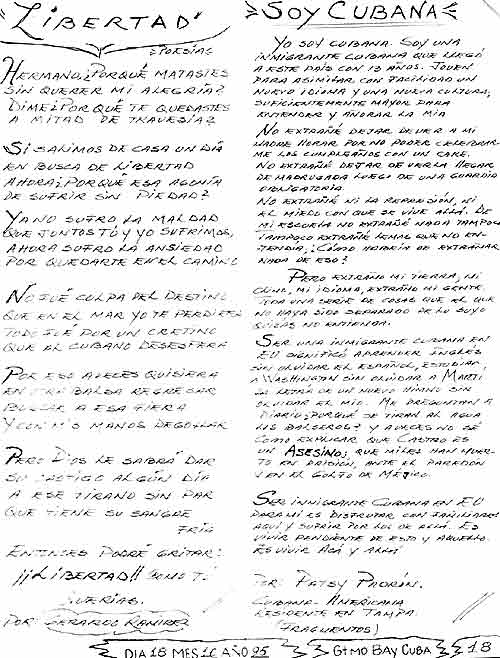
General Description and Notes:
The cover and additional pages from one of the Cuban rafter refugee newspapers entitled El Balsero (The Rafter) are part of a collection of handwritten papers published by Cuban refugees detained at Guantánamo Bay, Cuba, during the so-called “Cuban Refugee Boat Crisis” in the mid-1990s. Intercepted by U.S. Coast Guard ships, as many as 30,000 Cuban refugees floating on makeshift vessels were taken to U.S. Naval Base at Guantánamo Bay, Cuba, under the orders of U.S. President Bill Clinton’s administration. While detained and unsure of their futures, some of the Cuban detainees produced handwritten newspapers and other political and cultural materials on the base. Beginning in May 1995, the Clinton administration decided to allow the majority of the detainees to immigrate to the USA.
The caption on the newspaper’s front page (shown above) reads “Goodbye Guantánamo, the most beautiful land that eyes have seen.”
Information Sources:
Bibliography: “The Cuban Rafter Phenomenon,” website, http://balseros.miami.edu/ (accessed, December 1, 2022), University of Miami, Miami, Florida; see also the Caribbean Sea Migration collection, 1959-2014, David M. Rubenstein Rare Book & Manuscript Library, Duke University, Durham, NC: https://archives.lib.duke.edu/catalog/caribbeansea (contains original black-and-white pen and ink drawing by Juan Avilés Castaigne (PoLO) showing Bill Clinton as a spider with rafters caught in net, 1995 March 14, https://repository.duke.edu/dc/caribbeansea/csmep02016
Locations: From the collection of Siro del Castillo, Cuban Heritage Collection, University of Miami
Auburn Reporter (AR, 1881)
June 20, 2011
1881, A, Alphabetical Order, Arkansas, Community Papers, Images, United States Leave a comment
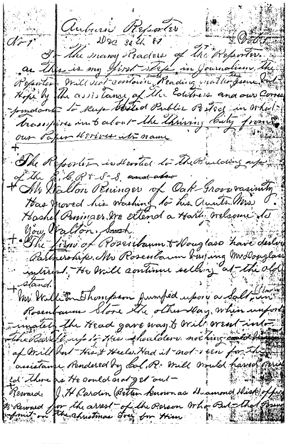
Auburn Reporter, AR, 1881, p. 1
Publication History:
Place of Publication: Town now defunct. Sebastian County near Ft. Smith, Arkansas
Frequency: Unknown
Volume and Issue Data: extant copy: Vol. 1, No. 1, Dec. 30, 1881
Size and Format: 10.5 x 7 inches
Editor/Publisher: Unknown “editress”
Title Changes and Continuation: Unknown
General Description & Notes:
See attached images. One irony in the introductory statement of No. 1, the editor indicates that the paper will keep the “public posted in what transpires in & about the Thriving City from our Paper derives its name” (sic). The town Auburn is now defunct.

Auburn Reporter, AR, 1881, p. 2
The first page includes briefs on the activities of several individuals. The second page’s top story is about a “bad accident on Christmas eve.” The bottom of the page two and all of page three contain more brief anecdotes about individuals. The fourth and last page invites subscribers:
“If you would keep up with the times, Subscribe for the Reporter for $1 a year.”
Information Sources:
Bibliography: None
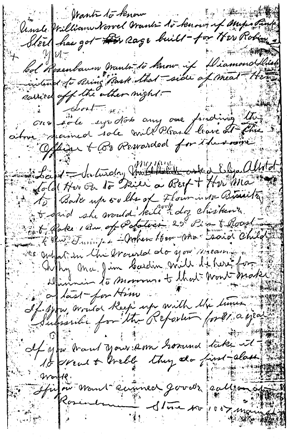
Auburn Reporter, AR, 1881, p. 4
Locations: Arkansas Newspaper Project. Extant copy at Arkansas Historical Commission, Little Rock, AK

Auburn Reporter, AR, 1881, p. 3
Atlantian Journal (IN, 1845-1848)
June 20, 2011
1845, A, Alphabetical Order, Indiana, Organization Newspapers, United States Leave a comment
Publication History:
Place of Publication: Terre Haute, Indiana
Frequency: Weekly
Volume and Issue Data: Three volumes, 1845-1848
Size and Format: Unknown
Editor/Publisher: The Terre Haute Atlantian Literati
Title Changes and Continuation: Unknown
General Description & Notes:
The journal consists of writings on Indiana and midwestern history, travel accounts, and essays on literary and social topics.
Information Sources:
Bibliography: None
Locations: William Henry Smith Memorial Library, Indiana Historical Society, Indianapolis, IN
Athabasca Journal and English River Inquirer (SK, 1845)
June 20, 2011
1845, A, Alphabetical Order, Canada, Frontier Papers, Saskatchewan Leave a comment
Publication History:
Place of Publication: Bear Island Lake, on the upper Churchill (or English) River north of Lac la Ronge, Saskatchewan
Frequency: Unknown
Volume and Issue Data: August 8, 1845
Size and Format: 11 pages, foolscap
Editor/Publisher: Bernard Rogan Ross
Title Changes and Continuation: None
General Description & Notes:
According to The Beaver magazine, Bernard Rogan Ross tried to relieve the monotony of a trip by York boat over the regular route of the old fur trade by writing a newspaper, couched in the journalistic style of the period, about the doings of the people of his brigade of three boads proceeding slowly up the Churchill or English River towards Methy Passage. Although his writing is extremely fine and small, the issue of Aug. 8, 1845, of this Athabasca Journal and English River Inquirer, as he called it, took up 11 closely-written pages of foolscap. It was preserved by his daughter, (Mrs. George A. Graham) and later published in part of the Fort William Daily Times-Journal of Dec. 27, 1928.
The paper is dated at Bear Island Lake, on the upper Churchill north of Lac la Ronge, in what is now Saskatchewan, and carries the announcement that the next issue would be published the following week at Ile a la Crosse. The price is stated to be six pence per customer payable, not in cash, but in Saskatchewan pemmican.
The first page is devoted to “Shipping Intelligence,” and included news of ship arrivals and gossip about the Dutchess of Kent. During this period, the Oregon boundary question was hot news. As this paper was written, however, the issue had been settled two months earlier. Without this knowledge, Ross wrote that he suspected the Americans would start a war over the issue. He warned the southerners that Canada could not only defend itself, but could “lay waste the North-western States with fire and sword, nor cease until the British flag waved triumphantly thoughout the Union.”
Chief Trader Bernard R. Ross, F.R.G.S., was only 18 years old when he wrote this account, and this was apparently his first trip west. He became a well known naturalist (Ross’s Goose), an anthropologist, and a prolific contributor to the British Museum and Smithsonian Institution.
Information Sources:
Bibliography: Bernard Rogan Ross, “Fur Trade Gossip Sheet,” The Beaver: Magazine of the North (Spring 1955)
Locations: Cited in the Fort William Daily Times-Journal, Dec. 27, 1928; location of copy mentioned in The Beaver preserved by Ross’s daughter is unknown
————————————————————
The Argus (PEI, 1885)
June 20, 2011
1885, A, Alphabetical Order, Canada, Prince Edward Island, Uncategorized Leave a comment
See The Pownal Argus
————————————————————
Annapolitan (MD, 1853)
June 20, 2011
1853, A, Alphabetical Order, Maryland, Uncategorized, United States Leave a comment
Publication History:
Place of Publication: Annapolis, Maryland
Frequency: Monthly
Volume and Issue Data: July 1853
Size and Format: Unknown
Editor/Publisher: J.N. Myers
Title Changes and Continuation: Unknown
General Description & Notes:
None
Information Sources:
Bibliography: None
Locations: Original held at the Erie Historical Museum, Erie, PA. Photocopy at Maryland State Archives, Hall of Records, 350 Rowe Blvd., Annapolis, MD .
Amherst Juvenile (MA, 1874)
June 20, 2011
1874, A, Alphabetical Order, Children Papers, Massachusetts, United States Leave a comment
Publication History:
Place of Publication: Amherst, Massachusetts
Frequency: Unknown
Volume and Issue Data: 1874, Vol. 1, nos. 1,2,3 (12 pp.)
Size and Format: Unknown
Editor/Publisher: Unknown
Title Changes and Continuation: Unknown
General Description and Notes:
Children’s Paper.
Information Sources:
Bibliography: None
Locations: Bliss family Papers, Box 2, folder 30, Amherst College Library Archives (see
http://asteria.fivecolleges.edu/findaids/amherst/ma21_list.html),
Amherst, MA
The American Youth (NJ, 1884)
June 20, 2011
1884, A, Alphabetical Order, Children Papers, New Jersey, United States Leave a comment
Publication History:
Place of Publication: Newark, NJ
Frequency: Unknown
Volume and Issue Data: Vol. III, No. 23, April, 12, 1884
Size and Format: Unknown
Editor/Publisher: “published by W.V. Belknap”
Title Changes and Continuation: Unknown
General Description and Notes:
New Jersey Historical Society has classified it as a “manuscript boys’ newspaper”
Information Sources
Bibliography: None
Locations: New Jersey Historical Society, Newark, NJ, MG25
Amateur Gazette (MA, 1874-1882?)
June 20, 2011
1874, A, Alphabetical Order, Massachusetts, Organization Newspapers, United States Leave a comment
Publication History:
Place of Publication: New England (likely Massachusetts)
Frequency: Unknown
Volume and Issue Data: Unknown
Size and Format: Size unknown, this may be letterpress with some handwritten corrections or addenda
Editor/Publisher: John Green Oliver (? – Letter calls the Amateur Gazette “his letterpress”)
Title Changes and Continuation: Unknown (possibly The Monthly Meteor)
General Description and Notes:
Letterpress compiled in a scrapbook by John Green Oliver of Worcester, MA, from 1874 to 1882, including newspapers of other members of the New England Amateur Journalists’ Association and assorted ephemera and memorabilia of his press activities, all in meticulous emulation of professional job printing and the fraternal culture thereof.
One of the newspapers in this collection, according to Sarah M. Black, Smith College Rare Book Room assistant (as of 1993), is Vol. 1, No. 1 of The Monthly Meteor, Dec. 1881 (28 pp.), including wrappers, which is “printed by hectography with holograph touch-ups and is thus partially handwritten and certainly a hand-made facsimile of a manuscript original.”
Information Sources:
Bibliography: None
Locations: Rare Book Room, William Allan Neilson Library, Smith College, Northampton, MA
Alma Courier (MO, 1880s)
June 20, 2011
1880, A, Alphabetical Order, Children Papers, Missouri, United States Leave a comment
Publication History:
Place of Publication: Alma, Missouri
Frequency: Unknown
Volume and Issue Data: 1880s
Size and Format: Unknown
Editor/Publisher: Unknown
Title Changes and Continuation: Unknown
General Description and Notes:
According to Jolliffee and Whitehouse, the Alma Courier was “reportedly a community paper emanating from the Alma Public School in the early 1880s.” They report that “it was published frequently and regularly, included a variety of news stories in each issue, and displayed a recognizable title and format.”
Local historian Garrison notes that the paper was “all written by hand on good quality of essay paper and tied at the top with pink and blue silk ribbons.” It included area and school news, editorials and small advertisements.
Information Sources:
Bibliography: Lee Jolliffe and Virginia Whitehouse, “Handwritten Newspapers on the Frontier? The Prevalence Problem, ” paper presented at the AEJMC History Division Mid-Year Meeting, Columbia, MO, 1994; Milton Garrison, A History of Alma (privately published, 1936), Harvey J. Higgins Historical Society, Higginsville, MO.
Locations: None
The Alliance Ohio (OH, 1893)
June 20, 2011
1893, A, Alphabetical Order, Ohio, Organization Newspapers, United States Leave a comment
Publication History:
Place of Publication: Ohio?
Frequency: Unknown
Volume and Issue Data: 1893
Size and Format: Unknown
Editor/Publisher: Grange Society
Title Changes and Continuation: Unknown
General Description and Notes:
Grange Society newspaper.
Information Sources:
Bibliography: None
Locations: Ohio Historical Society, Columbus, OH
The Algona Bee (IA, 1857-1858)
June 20, 2011
1857, A, Alphabetical Order, Frontier Papers, Images, Iowa, United States Leave a comment
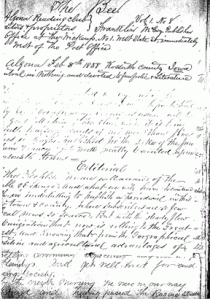
The Algona Bee (IA, 1858)
Publication History:
Place of Publication: Algona (Kossuth County), Iowa (ca. 1857-1858)
Frequency: Weekly; irregular
Volume and Issue Data: Vol. 1, No. 1, Dec. 21, 1857 (note: another date, Jan. 8th, 1858 is marked out above the Dec. 21 entry)
Size and Format: 8 1/2 x 11 inches; two columns
Editor/Publisher: Franklin McCoy; Algona Reading Club (et al.?)
Title Changes and Continuation: Unknown
General Description & Notes:
The Bee was apparently produced by the Algona Reading Club, identified as editors and proprietors (see Vol. 1, No. 8, Feb. 8, 1858). This number lists the paper’s office at “the wickeup No. 1 West State St. immediately West of the Post Office,” and identifies Franklin McCoy as “publisher.” However, other pages (many of which are almost illegible) mention an “editress.”
The paper contains poetry, anecdotes, editorials and short story items. The clear difference in handwriting style and script size between the numbers suggests at least two different writers were responsible for the paper’s production. The first issue opens with the following introductory editorial:
“We are happy to present to our friends this first number of ‘The Bee’ as the first paper published in this ‘little world of Algona,’ and tho [sic] now small and may-be insignificant in the eyes of many–still we have sanguine hopes that it will thrive–and before many years stand the first and oldest among our village papers. A person when first starting in an enterprise like this feels rather delicately. Many fears arise wether [sic] the paper will suit the readers. Knowing there are as many minds as persons and also knowing, that unless all these minds are satisfied, we are the losers, we feel still more anxiety than we would otherwise.
“The Bee is intended to be strictly a neutral paper. We shall strive to please all by offending none. It will abound in wit and humor–be graced with sound intellectual studies and pleasing stories–have all the news of the day–we hope none of the gossip [original emphasis]. We have able correspondents for the Bee who will favour it with their productions from time to time. A few advertisements will be inserted just to help pay expenses. We have tried to tell you imperfectly however what we shall strive to make the Bee, and we humbly beg our friends to stand by us and not allow it to sink into obscurity as the paper in our neighboring community has done.”
The Feb. 8, 1858 issue says, “The Bee is published weekly, but if the stories do not improve soon it will be published only Semi Occasionally.” The editor also notes that “Business cards of not more than five lines in length published for the sake of the fun, flair and fancy. Job work neatly executed upon reasonable terms.”
Information Sources:
Bibliography: None
Locations: Harvey Ingham Papers, Vol. 2, Box 2, Iowa State Historical Society, Des Moines, IA
————————————————————
Alexandrian Eclectic Review (NJ, 1884)
June 20, 2011
1884, A, Alphabetical Order, Children Papers, New Jersey, United States Leave a comment
Publication History:
Place of Publication: Newark, New Jersey
Frequency: Unknown
Volume and Issue Data: April 12, 1884, Vol. III, No. 23
Size and Format: Unknown
Editor/Publisher: W.V. Belknap
Title Changes and Continuation: Unknown
General Description and Notes:
A manuscript boys’ newspaper.
Information Sources:
Bibliography: None
Locations: New Jersey Historical Society, Newark, NJ
Alexandrian Eclectic Review (MA, 1831)
June 20, 2011
1831, A, Alphabetical Order, Massachusetts, School Newspapers, United States Leave a comment
Publication History:
Place of Publication: Amherst College, Amherst Massachusetts
Frequency: Unknown
Volume and Issue Data: 1831 vol. 1, no.4
Size and Format: 2 pages
Editor/Publisher: Unknown
Title Changes and Continuation: Unknown
General Description and Notes:
Student paper.
Information Sources:
Bibliography: None
Locations: Amherst College Library Archives, Special Collections, Amherst College, Amherst, MA.
Alaska Forum (AK, 1900-1906)
June 20, 2011
1900, A, Alaska, Alaska Gold Rush Papers, Alphabetical Order, Mining Camp Papers, United States Leave a comment
Publication History:
Place of Publication: Rampart, Alaska (1900-1906)
Frequency: Weekly
Volume and Issue Data: Sept. 27, 1900-Aug. 4, 1906
Size and Format: 8 x 10 inches; 2 cols; 4 pages
Editor/Publisher: W.R. Edwards, editor (1900); J.B. Wingate, editor (1901-1906), manager (1900-1906)
Title Changes and Continuation: Occasionally cited as the Rampart Forum
General Description & Notes:
According to McLean, Edwards promoted mining stock and Wingate was a mining recorder, mail carrier and miner then they started printing the Alaska Forum. The partnership lasted only five months, with Edwards leaving to start the rival Rampart Miner six months later (The Miner last only about one year). By July 1904, however, the local Episcopal Church recalled the iron printing press Wingate leased to publish the Forum, intending to lease to the promoters of a new paper, the Yukon Valley News. Wingate fought the termination of his lease in court, but failed in his claims. Wingate, without a press, tried to continue to publish the Forum to hold off his new rival. Using old copies of his paper as a base, he pasted over the previous week’s news handwritten and typewritten material reproduced on a hectograph machine. The absence of old copies of the Forum and the difficulties of publishing the manual versions led to a two-month suspension of the paper. Wingate resumed printing the Forum when he had a new, foot-powered press built. The shafts and fixtures of the press had been turned on a lathe run by dog-power, leading Wingate to refer to his printing plant as a “five-dog-power press.”
The Forum cost 25 cents and contained advertising, local news, especially stories related to mining, editorials, and occasional attacks on the Episcopal Church, judges (particularly Judge Wickersham, compiler of the Bibliography on Alaskan Literature, who had ruled against Wingate’s bid to keep the Episcopal press) and others Wingate opposed. The tone of the paper became noticeably more strident after the loss of the printing press.
Information Sources:
Bibliography: Dora E. McLean, Early Newspapers on the Upper Yukon Watershed: 1894-1907, unpublished M.A. thesis, University of Alaska, 1963, 44-56; James Wickersham, A Bibliography of Alaska Literature, 1724-1924 (Cordova, AK: Cordova Daily Times Print, 1927), 251.
Locations: AlHi-Juneau, AK
————————————————————
The Agate (MI, 1846)
June 20, 2011
1846, A, Alphabetical Order, Michigan, Military Papers, Uncategorized, United States Leave a comment
Publication History:
Place of Publication: Fort Wilkins, Michigan
Frequency: NA
Volume and Issue Data: 1846
Size and Format: NA
Editor/Publisher: NA
Title Changes and Continuation: Unknown
General Description and Notes:
The records from Fort Wilkins include The Agate.
Information Sources:
Bibliography: None
Locations: Bentley Historical Library, Manuscript Holdings, Fort Wilkins Records (1846), The University of Michigan, Ann Arbor, MI


 The Handwritten Newspapers Project