Philomathean Gazette (UT, 1873)

Leave a comment

Philomathean Gazette (UT, 1873)

Place of Publication: Payson City, Utah County, Utah Territory

Frequency:  “Published every Monday”

Volume and Issue Data:  Vol. 2, No. 18, Feb. 24, 1873

Size and Format:  8.5 x 14 inches; single column; pen and ink, 8+ pp.

Editor/Publisher:  John Redington, editor

Title Changes and Continuation:  None

General Description and Notes:

The Gazette was “devoted to the interest of the Payson Philomathean Society,” an organization apparently supportive of the Mormon Church and its mission activities.  Vol. 2, No. 18, contains “original poetry” on “The Union of Souls” on pages one and two with an editor’s note: “To [sic] lengthy to publish in full, Ed.”

A story on “Travels on the Islands in the South Pacific Ocean” (pp. 2-5) recounts the efforts of the editor who “was called by the First Presidency of our Church to go on a mission to the South Pacific Islands, to preach the gospel to the inhabitants of that part of the world.”

Another story, “How Mr. Gray became a Farmer,” is continued from the previous issue of the paper, and continues to the issue to follow.

At least two pages are devoted to correspondence (dated Feb. 23) to the editor.  Both letters published refer to the Philomathean Society’s meetings, but provide no details as to its purpose or membership.

Information Sources:

Bibliography:  None

Locations: Utah State Historical Society, Mss A 2591, Salt Lake City, UT

The Petrel (MA-CA, 1849)

Leave a comment

Publication History:

Place of Publication:  “On board Ship Duxbury,” clipper out of Boston en route to the California gold fields)

Frequency:  Weekly; irregular; “published every Monday morning”

Volume and Issue Data:   Vol. 1, No. 1, March 26, 1849; Vol. 1, No. 2, April 2, 1849; Vol. 1, Nos. 3-7 and 9, no dates; Vol. 1, No. 8, lead article dated June 10, 1849; Vol. 1, No. 10, no date, but article on “Celebration of American Independence.”  The third number has no title or volume-number.  The term “petrel” apparently refers to various sea birds.

Size and Format:  8 x 10 in.; oil cloth-like paper; two columns; pen and ink; illustrated; 2-4 pp., variable

Editor/Publisher:  Unknown (“Smike, Jr.”?)

Title Changes and Continuation:  Continuation or contemporary of Shark (See Shark) published aboard the Duxbury on same voyage

General Description and Notes:

The Petrel was published onboard the Duxbury apparently during the same voyage as produced the Shark.  The issue numbering suggests that both papers may have been published contemporaneously.

The Duxbury left Boston for the California gold fields in February, 1849 carrying the Old Harvard Company, one of the hundreds of New England joint-stock companies organized to capitalize on the gold of California.  One writer states that during 1849, 102 joint stock companies sailed from Massachusetts alone, the number of their members ranging from five to 180, the average being around 50, and their total exceeding 4,200.  Each member paid an equal sum into the common treasury.  Each had an equal voice in tis management and stood to reap an equal share of the profits.  Often there was also a board of directors, chosen from among the town’s leaders, older men who helped finance the expeditions but themselves remained at home. (Lewis, p. 22).

The first issue, published March 26, 1849, contained the following introduction:

 “Ourselves.”  We appear before our readers to-day, for the first time, with our weekly budget of fun, fact, and fancy, for the particular edification our amusement of the passengers on board of the Ship Duxbury now on her voyage from Boston to San Francisco.  We shall continue its publication as often as circumstances will admit, and should be pleased to receive well written communications upon any subject that may be thought interesting to the “crowd.”  All communications must be handed in as early as Friday morning.–Smike, Jr.

One passenger observed that there was “too much praying on board.”  Each morning the Duxbury’s preacher, the Rev. Brierly, read a chapter from the Bible, offered a prayer, and delivered a brief sermon.  On Wednesdays he presided over a prayer meeting; on Sundays he preached “a full-length sermon” and followed this with a class discussion group; on Tuesdays and Fridays he conducted a lyceum.  This was during the early stages of the voyage; later this comprehensive program collapsed, as it did on so many other ships, and during the final weeks of the Duxbury’s company seems to have been without religious instruction of any kind.

Hard feelings developed between officers and passengers aboard the Duxbury on the first leg of its voyage.  The chief complaint was against the food and the manner of service.  The Duxbury, an ancient three-masted craft, so hard to maneuver that she was said to require all of Massachusetts Bay in which to turn, left Boston so loaded that the galley space was inadequate.  After a week of subsisting on two sparse meals a day, the passengers met and made known their grievances.  For a long time their protests were disregarded.  “Petition after petition was sent in to the captain without producing any other effect than the reply, ‘If it is not enough, go without.'”  The group continued on short rations–“we were allowed one-half pint of weak tea a day and three pounds of sugar a month’–until the Duxbury reached Rio.  There a committee of passengers related their troubles to the United States consul.  The result was that the capacity of the galley was ordered enlarged and the passengers thereafter fared rather better.

Lewis notes that this and other shipboard newspapers (see, e.g., Barometer, The Emigrant, and The Petrel) “lacked the formality of print but more nearly approached conventional journalism” than the various travel journals and diaries kept during the voyages.

Greever reports that Easterners frequently chose to go to California via ship around Cape Horn.  “Between December 14, 1848, and January 18, 1849 [probably about the time the Duxbury embarked on its voyage], sixty-one ships with an average of fifty passengers each sailed for California from New York City, Boston, Salem, Philadelphia, Baltimore, and Norfolk.  In the month of February, 1849, . . . seventy [ships sailed] from Boston  . . . .” (pp. 21-22)

“The trip around from the East Coast around the Horn and up to San Francisco often took more than six months; the average time was 168 days” (p. 23)

“If Thanksgiving, Christmas, or the Fourth of July occurred during the trip, there would be quite a celebration” (p. 22).

The two highlights of the journey around South America were stops in Rio and at Juan Ferdnandez island. The Petrel recorded the pleasures of shore leave and even illustrated the events in later issues (see The Petrel figures).

Captain DeCosta also imitated newspapers of the day with an entry that read:  “By telegraph–We have, says a New York paper, just received intelligence from a California-bound vessel, stating that they have a very rare animal on board, which was caught crossing the line . . . .”  While the story was a hoax, the joke could only have worked if the passengers were familiar with the “telegraph news” system of the day, and took the practice of ship-borne intelligence for granted.

Information Sources:

Bibliography:  See Oscar Lewis, Sea Routes to the Gold Fields:  The Migration by Water to Californiain 1849-1852 (New York:  A.A. Knopf, 1949), p. 89.  See also G.B. Worden letter to Ira Brown:  Rio de Janeiro, ALS 1849 April 23, University of  California, Berkeley, Bancroft Library, Manuscript Collection, Mss C-B 547:138; and William S. Greever, Bonanza West:  The Story of Western Mining Rushes,  1848-1900 (University of Idaho Press, 1963), pp. 21-23

Locations:  Eleven numbers:  Huntington Library, Manuscripts Division, San Marino, California; accompanying the journal of the Duxbury voyage, Boston-San Francisco, by William H. DeCosta, 1849, Feb.-June 23 (HM 234); 10 numbers:  University of California, Berkeley, Bancroft Library, Manuscript Collection, Mss C-F 147; three numbers: (no dates, circa Feb.-July, 1849) Natural History Museum of Los Angeles County

The Penny Whistle (MA, no date)

Leave a comment

Publication History:

Place of Publication: Newton Center, MA

Frequency:  Unknown

Volume and Issue Data: Unknown

Size and Format: Unknown

Editor/Publisher: Unknown

Title Changes and Continuation: Unknown

General Description and Notes:

None

Information Sources:

Bibliography:  None

Locations:  American Antiquarian Society, Worcester, MA

The Payson Advocate (UT, 1865)

Leave a comment

Publication History:

Place of Publication: Payson, Utah (ca. 1865)

Frequency:  Unknown

Volume and Issue Data:  At least 6 issues, ca. 1865

Size and Format:  Approx. 8 pages

Editor/Publisher:  Unknown

Title Changes and Continuation:  Unknown (also known as The Advocate)

General Description and Notes:

Alter quotes the Deseret News, March 29, 1865:

The Payson Advocate and The Intelligencer.  Manuscript newspapers, 8 pages each, judging from letters, and No. 6 of the Advocate, are proving interesting and beneficial to both writers and readers–a very commendable mode of using a portion of leisure time.”

(See also The Intelligencer)

Information Sources:

Bibliography:  J. Cecil Alter, Early Utah Journalism (Salt Lake City:  Utah State Historical Society, 1938), 190

Locations:  No issues located, but cited in the Deseret News,March 29, 1865

The Parsonville Times (NY, no date)

Leave a comment

THE PARSONSVILLE TIMES

Publication History: Unknown

Place of Publication: Flushing, NY

Frequency:  Unknown

Volume and Issue Data: Unknown

Size and Format: Unknown

Editor/Publisher: Unknown

Title Changes and Continuation: None

General Description and Notes: 

None

Information Sources:

Bibliography:  None

Locations:  American Antiquarian Society, Worcester, MA

The Panguitch Register (UT, 1880-1884)

Leave a comment

Publication History:

Place of Publication:  Panguitch, Garfield County, Utah

Frequency:  Unknown

Volume and Issue Data: 1880-1884

Size and Format:  Unknown

Editor/Publisher:  John M. Dunning and JohnT. Daly, Sr.

Title Changes and Continuation:  The Cactus and/or, The Garfield County News, The Recorder, The Register

General Description and Notes:

Lucy Hatch of the Panguitch Daughters of Utah Pioneers read a paper on Dec. 29, 1932, “Ready Material of the Pioneers” which noted that:

The paper was first called the Cactus, but later the name was changed, some say to the Garfield County News, others say The Recorder, and some say the Register.”

“It was published from about 1880-1884.”

Information Sources:

Bibliography: None

Locations:   Unknown

Owl (CA, 1859)

Leave a comment

Publication History:

Place of Publication: North Bloomfield, California (1859)

Frequency:  Only one issue known

Volume and Issue Data:  ca. February 1859

Size and Format:  Unknown

Editor/Publisher:  Unknown

Title Changes and Continuation:  None (see Miner’s News)

General Description and Notes:

According to Kennedy, North Bloomfield, a mining town on the South Fork of the Yuba River, did not have a printed newspaper in the 1850s, but the Hydraulic Press identified at least two manuscript papers, the Owl and the Miner’s News.

In the Feb. 5, 1859 issue of the Press, the editor reported that the Owl was North Bloomfield’s paper:

THE OWL.  This is the name of a manuscript paper published at North Bloomfield, and of which we have received a copy.  The owl was Minerva’s bird; but there is not much wisdom about this one.  We learn from its advertising columns that one gentleman holds all of the following positions:  Post Master, Express Agent, Justice of the Peace, Road Overseer, School Director, Gold Dust buyer and News Agent.  There’s honor for you.  Talk about republics being ungrateful.

B.P. Avery, editor of the Hydraulic Press, did not identify the editor or provide other details about the Owl.  No other references to the manuscript paper are known.

Information Sources:

Bibliography: ChesterB. Kennedy, “Newspapers of the California Northern Mines, 1850-1860–A Record of Life, Letters and Culture,” unpublished Ph.D. dissertation, Stanford University, 1949, pp. 25, 39, 511-12, 608

Locations:  None located, but cited in Hydraulic Press, Feb. 5, 1859

Our Port Folio (NJ, 1865-1885)

Leave a comment

Publication History:

Place of Publication:  Lake Hopatcong, NJ, Public School

Frequency: Unknown

Volume and Issue Data:  1865-1885

Size and Format:  22 pages

Editor/Publisher:  “The young ladies of the public school in district no. 4.”

Title Changes and Continuation:  None

General Description and Notes:

“The young ladies of the public school in district no. 4.” It is faintly written, in pencil or badly faded ink.

Information Sources:               

Bibliography: None

Locations:  New Jersey Historical Society, Newark, NJ

Our Paper (WI, 1867)

Leave a comment

Publication History:

Place of Publication:  Madison, WI (?)

Frequency: Unknown

Volume and Issue Data:  Vol. 1, No. 8, January 20, 1867

Size and Format: Unknown

Editor/Publisher:  Charles D. Purple and Mary Cooper

Title Changes and Continuation: None

General Description and Notes:

The paper was produced for an unnamed organization led by A.F. Frank with J.M. Haight as secretary. The State Historical Society of Wisconsin identifies the publication as a “manuscript temperance paper.” Presented by the Michigan Historical Collections via Robert Warner, Ann Arbor, Michigan, 1966.

Information Sources:                           

Bibliography: None

Locations:  The State Historical Society of Wisconsin, Madison, WI

Our Home (MA, 1848)

Leave a comment

Publication History:

Place of Publication:  Unknown

Frequency:  Unknown

Volume and Issue Data:  1848

Size and Format:  Approximately 15 pp.

Editor/Publisher:  Harriet Kellogg, age 20

Title Changes and Continuation: Unknown

General Description and Notes:

Amateur newspaper located in the Dunham Family Papers at Smith College.

Information Sources:

Bibliography: None

Locations:  Dunham Family Papers, Sophia Smith Collection, Smith College, Northampton, MA

Optimist (AK, 1910)

Leave a comment

Publication History:

Place of Publication:  Iditarod (“at the Fish Market Bldg.”), Alaska

Frequency:  Irregular; approximately weekly

Volume and Issue Data:  No. 5, July 29, 1910; No. 6, Aug. 8, 1910

Size and Format:  24 x 36 inches; written on manila paper

Editor/Publisher:  Jim Wylie, editor and publisher

Title Changes and Continuation:  None

General Description and Notes:

None

Information Sources:

Bibliography:  James Wickersham, A Bibliography of Alaska Literature, 1724-1924 (Cordova, Ak.:  Cordova Daily Times Print, 1927), 266

Locations:  Unknown

The Olive Branch (MI, 1851)

Leave a comment

Publication History:

Place of Publication:  Unknown

Frequency: Unknown

Volume and Issue Data:  1851

Size and Format: Unknown

Editor/Publisher: Unknown

Title Changes and Continuation: None

General Description and Notes:

None

Information Sources:

Bibliography:  None

Locations:  Manuscript Holdings, Bentley Historical Library, The University of Michigan,  Ann Arbor, MI

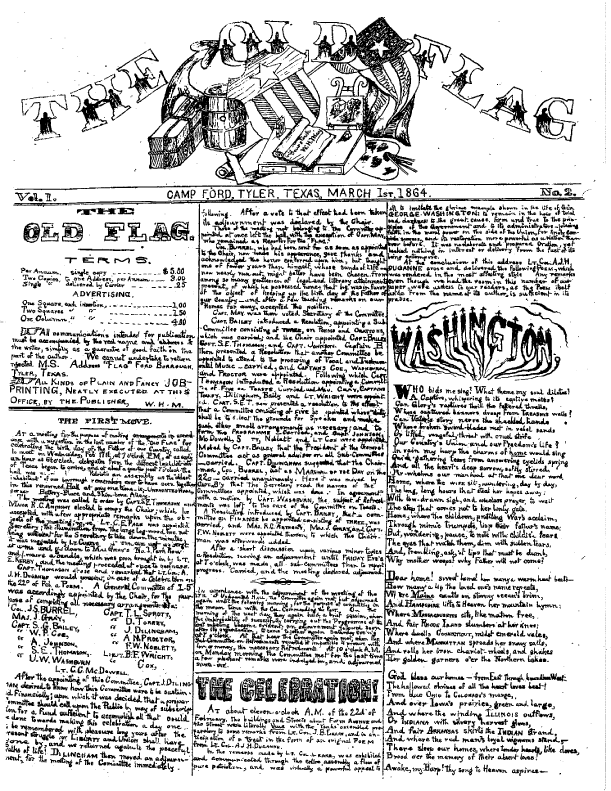
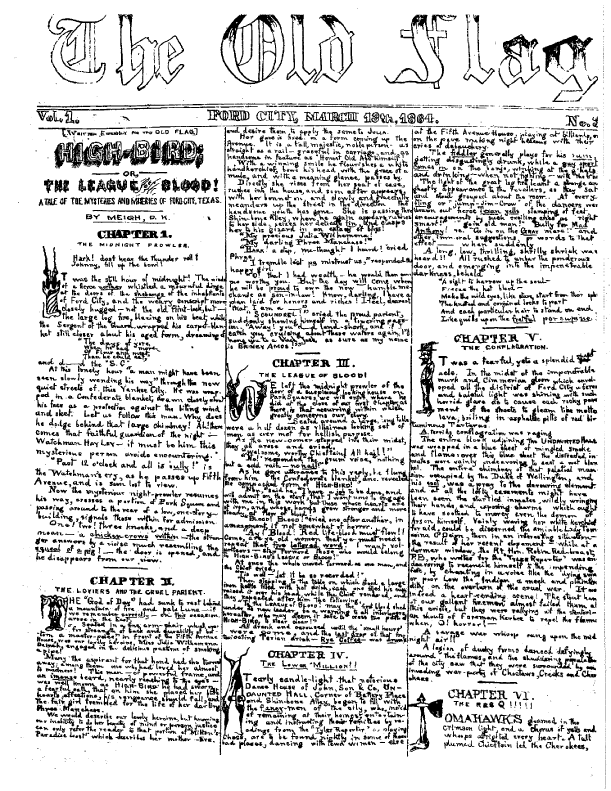
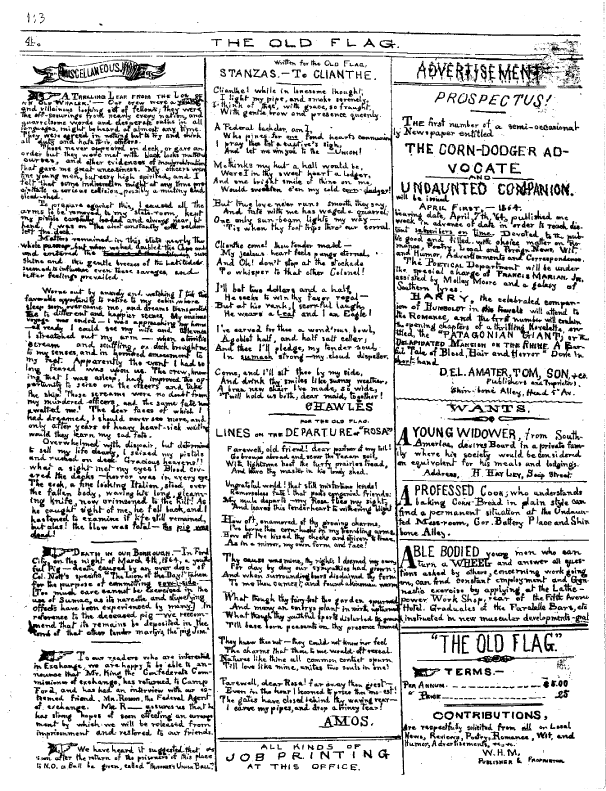
The Old Flag (TX, 1864)

Leave a comment

The Old Flag (TX, 1864)

Publication History:

Place of Publication: Camp Ford, Tyler, Smith County, Texas

Frequency:  Bi-weekly, irregular

Volume and Issue Data:  Vol. 1, No. 1, Feb. 17, 1864-No.3, March 13, 1864

Size and Format: 8 1/2 x 11; four pages per issue; three columns; pen and ink

Editor/Publisher:  Capt. William H. May (and J.P. Robens?); a 12-page facsimile edition was published by J.P. Robens and William H. May entitled, The Old Flag: First Publication by Union Prisoners at Camp Ford, Tyler, Texas, V. 1, No. 1-3; Feb. 17-March 13, 1864: Preface includes history of the manuscript plus some items and advertisements from the Ford City Herald

Title Changes and Continuation:  Some references to advertisements from the Ford City Herald  in the Library of Virginia’s Civil War 150 Legacy Project (thanks to Renee M. Savits, of the CW 150 Legacy Project). According to the Herald, “This branch of our imense (sic) establishment is now complete. The new Type and Materials of The Herald, in addition to the well stocked Office of the “OLD FLAG,” removed and refitted, enables us to give notice that we are fully prepared to execute all kinds of Plain and Fancy Job Printing with neatness and dispatch. Terms, CASH.”

General Description and Notes:

The Old Flag was published by a Union soldier during an imprisonment of 13 months in the Confederate prison at Tyler, Texas.  Each issue was read aloud in the various cabins by some member of the “Mess.”  When all had read or heard it read, the paper was returned by the “subscriber” to the “office publication.”

The paper’s primary goal was to relieve the almost unbearably eventless and monotonous life of Camp Ford.  Contributions commented on local news and camp issues, displayed poetry and art, and played with satire, jokes and chess problems.  Advertisements, which appeared in every issue, were genuine.  Most offered the services of skilled prisoners for the benefit of the others.  For example, pipe makers, barbers, cigar makers, shoe shines and “job printing” (by the editor) were all available in the prison city.
The Old Flag (TX, 1864)

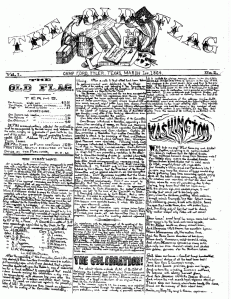
The Old Flag was one of two and possibly three handwritten Civil War newspapers published at Camp Ford, a Confederate prison complex in Tyler and Hempstead, Texas.  Camp Ford was the largest Confederate military prison in Texas.  The prison held both officers and enlisted men from 1863 to the end of war.  The prison held as many as 4,900 prisoners by July 1864.  Living conditions in the tented enclosure were generally good.  Fresh water, adequate shelter and plentiful food supplies made the prison a relatively healthy place; during its 21-month existence, roughly 250 soldiers died in the camp.  Most soldiers were allowed to keep many of their possessions, to manufacture items for sale and to purchase food and supplies from local farmers and merchants.[1]  To facilitate these economic transactions, The Old Flag published a “REVIEW OF THE TEXAS MARKET-for the Month of February, 1864” in its March 1 edition.

Capt. William H. May, of the 23rd Connecticut Volunteers, with the assistance of other Union soldiers, published and edited at least three issues of The Old Flag between February 17 and March 13, 1864,[2] during their 13-month confinement in the Confederate prison camp.  According to J.P. Robens, one of the prisoners, the paper was published on sheets of “unruled letter paper, in imitation of print, a steel pen being employed in the absence of a Hoe Press.”[3]  The three-column, four-page paper made liberal use of large headlines and graphic elements.

The paper’s primary goal was “to contribute as far as possible towards enlivening the monotonous, and at times almost unbearably eventless life of Camp Ford–and to cultivate a mutual good feeling between all.”  Contributions were solicited on matters of local news and camp issues.  The Old Flag published poetry and art, and included satire, jokes and chess problems.  Display advertisements appeared in every issue, and “most of them bona fide, genuine.”  Most of the ads promoted the services of skilled prisoners for the benefit of the others.  For example, pipe makers, barbers, cigar makers, shoe shines and “job printing” (by the editor) were all available in the prison city.[4]

————————————————————————————–

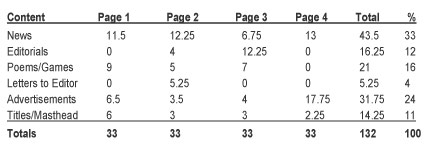
Summary of Contents of The Old Flag, 1:1, February 17, 1864

(Measured in column inches; 33 column inches per page)


————————————————————————————————-

The Old Flag (TX, 1864)

The first number announced that the next issue would be in “an entire new dress, we having received new Types from the Foundry of J. Connor & Son, of N.Y.!  This number is printed with ‘secesh’ ink, which does not appear to ‘take’ well upon Yankee paper.”[5]  Only one copy was published of each number, which was then read aloud in the various cabins by some member of the “Mess.”  When all the prisoners had read or heard it read, the paper was returned by the “Subscriber” to the “Office of Publication.”[6]

In the third number, March 15, 1864, the editor published his intentions to preserve The Old Flag after his release from Camp Ford.

TO OUR PATRONS

We shall make it our first object on our arrival at New York City–which will probably be within a few week after our Exchange–to learn the practicability of getting the three numbers of the “Old Flag” Lithographed.  Should the expense be too great to warrant our adopting this means of securing fac simile [sic] copies, we shall print with types as nearly as similar to the letter penned by us as can be procured, with heading and illustrations engraved.  We shall endeavor to make the copies close imitations of the original papers.  In addition we propose to publish a few accurate pictures, delineating life at Camp Ford, Camp Groce, &c, printed on sheets inserted in each number of the “Old Flag” with a Title Page, and complete List of the Officers Prisoners [sic] at this place, neatly bound.

The editor kept his promise.  The lithographed reproduction of The Old Flag was published in New York in 1864 and included a “List of officers, prisoners of war at Camp Ford . . . giving rank, regiment, where and when captured.”

After prisoners were released from Camp Ford, the editor published a lithographed reproduction of the handwritten.

According to Mary Witkowski, of the Bridgeport Public Library, Bridgeport, CT, Captain May was a newspaper man in civilian life.

Information Sources:                                                         

The Old Flag (TX, 1864)

Bibliography:  Roy Alden Atwood, “Captive Audiences: Handwritten Prisoner-of-War Newspapers of the Texan Santa Fe Expedition and the War Between the States,” Annual Convention of the American Journalism Historians Association (AJHA), Salt Lake City, UT, Oct. 1993;  F. Lee Lawrence and Robert W. Glover, Camp Ford, C.S.A.:  The Story of Union Prisoners in Texas(Austin:  Texas Civil War Centennial Advisory Committee, 1964), 36-37;  The Old Flag (privately published, 1914).

Locations:  Barnum Museum, Bridgeport, CT; The Old Flag, lithographed reproduction:  DLC


[1].  Patricia L. Faust, editor, Historical Times Illustrated Encyclopedia of the Civil War, p. 110.

[2].  The date on The Old Flag, 1:3, isMarch 13, 1864, but a poem on p. 3, “To Mrs. Col R.T.P. Allen,” is dated March 14.  The poem was likely a day-late insertion.

[3].  J.P. Robens, “Preface,” The Old Flag, lithograph reproduction (New York:  W.H. May, [1864]), n.p.

[4].  The Old Flag, 1:3 (March 13, 1864), p. 2:  “Statistic–There have been manufactured by knife in this camp, since last September, over forty setts [sic]of Chessmen, of which Lt. John Woodward has himself completed eight of the best!

“The number of Pipes turned out, as near as can be arrived at, is not less than Five Hundred–both of wood and clay.”

[5].  The Old Flag, 1:1 (Feb. 17, 1864), p. 2.

[6].  J.P. Robens, “Preface,” n.p.

The Nutshell (MA, no date)

Leave a comment

Publication History:

Place of Publication: East Marshfield, MA

Frequency:  Unknown

Volume and Issue Data: Unknown

Size and Format: Unknown

Editor/Publisher: Unknown

Title Changes and Continuation: None

General Description and Notes:

None

Information Sources:

Bibliography:  None

Locations:  American Antiquarian Society,  Worcester, MA

The Nugget (ZIM, 1890)

Leave a comment

Publication History:

Place of Publication:  Fort Victoria, Mashonaland, Zimbabwe (Rhodesia)

Frequency: Unknown

Volume and Issue Data: November 11, 1890

Size and Format: In manuscript; motto: “Root hog or bust”

Editor/Publisher: H.R. Vennell

Title Changes and Continuation: Unknown

General Description and Notes:

According to the British South Africa Company Historical Catalogue and Souvenir of Rhodesia, Empire Exhibition, 1936-1937,

   “273. First Newspaper, Mashonaland. – The Nugget, with the motto Root hog or bust, produced in manuscript at Fort Victoria, 11th November, 1890 (two months after the occupation of Mashonaland). The Editor says frankly that his principal object was to be the first in the field of journalism in the country. Printed and published by H. R. Vennell at the Nugget Publishing Company’s works, Fort Victoria, Mashonaland. No price is mentioned.

– Government Archives, Salisbury”

Information Sources: 

Bibliography:  British South Africa Company Historical Catalogue and Souvenir of Rhodesia, Empire Exhibition, 1936-1937 (1937); Jerry Don Vann, Rosemary T. VanArsdel, Periodicals of Queen Victoria’s Empire: An Exploration (Toronto: University of Toronto Press, 1996), p. 290; Press Reference-Zimbabwe; Louis W. Bolze, “The Book Publishing Scene in Zimbabwe,” The African Book Publishing Record, 6:3-4 (1980), 229–236

Locations:  None

Norwoodiana (Eng-Aus, 1867)

Leave a comment

Norwoodiana (Eng-Aus, 1867)

Norwoodiana (Eng-Aus, 1867)

Publication History:

Place of Publication: Aboard the ship Norwood on its journey from England to Western Australia with convicts, April 27 (date of first issue) to July 6, 1867

Frequency:  Unknown

Volume and Issue Data:  “Introduction” issue, April 27, 1867

Size and Format:  See image of the front page of April 27, 1867

Editor/Publisher:  Unknown

Title Changes and Continuation:  None

General Description and Notes:

Convict shipboard paper en route from England to Western Australia. Irwin’s published account includes it as “Norwoodiana, or, Sayings and doings on route to Western Australia : a manuscript journal made during the 1867 voyage of the convict ship Norwood, April 27 to July 6, 1867.

Information Sources:                            

Bibliography: William Irvin, Journals on board the convict ships Palmerston, 1861, Belgravia, 28th Apr. 1866-23rd June, 1866 and Norwood, 27th Apr.-6th July, 1867 [microform], reproduction of typescript; transcribed by Bob & Tops Dent 1996 with permission of the Mitchell Library from the original manuscript held by the NSW State Library.

Locations:  State Library of Western Australia; thanks to Annette Delbianco of the SLWA.

Noilpum (CA, 1857-1858)

Leave a comment

Publication History:

Place of Publication:  Hay Fork, Trinity County, California (ca. 1857-1858)

Frequency:  Unknown

Volume and Issue Data:  Unknown

Size and Format:  Unknown

Editor/Publisher:  Unknown (Isaac Cox?)

Title Changes and Continuation:  Unknown

General Description and Notes:

Kennedy notes that “except for a manuscript paper called the Noilpum, published at Hay Fork, all of Trinity County’s early newspapers were printed at Weaverville.  At most, only a very few copies may have been produced, and none are extant.

Isaac Cox reported in his history of Trinity County published in 1858,

We have named the “Noilpum” without spreading ourselves into explanatory easings, but now it comes.  It is the Hay Fork newspaper, an institution to absorb and assimilitate the literary exudations not otherwise provided for; a newspaper which, if presented to a Faust or Guttenberg of our day, would soon learn to know the “devil,” which again in all probability would cause relief in the tar and pitch market, the only operators in that commodity at present being the brokers of the squaw boudoirs.  The Noilpum is a goodly paper, and though it advocates the Administration in order not to hurt its books, would go dead downright for Jackson and Douglas in the question of “honest opinion.”   A paper is “ably” conducted, knowing nothing of Hoe and Co.’s Mammoth Cylinder, Anti-Friction, anti, etc. presses, or any other sleight-of-hand exponent of public greasing, being thus thrown back on pen and ink, will naturally get muddy and greasy enough to answer to the “mudsill” call and the pet name of printers’ cordiality, “dirty sheet.”  We may guess now you know what the “Noilpum” is.

Kennedy speculates that the Noilpum may have been a humorous paper (despite the lame attempt at humor above).

Information Sources:                        

Bibliography:  Isaac Cox, The Annals of Trinity County (San Francisco:  Commercial Book and Job Steam Printing, 1858), 125;  Chester P. Kennedy, “Newspapers of the California Northern Mines, 1850-1860–A Record of Life, Letters and Culture,” unpublished Ph.D. dissertation, Stanford, 1949, pp. 30-31, 39, 289, 574-75, and 603)

Locations:  None located

The Night Blooming Cereus (NS, 1869-1871)

Leave a comment

Publication History:

Place of Publication: Pugwash, Nova Scotia, Canada (a small village on the north shore.)

Frequency:  Semi-monthly

Volume and Issue Data:  From Nov. 1869 to Mar. 1871

Size and Format: Unknown

Editor/Publisher:  Unknown

Title Changes and Continuation: None

General Description and Notes:

It was the official organ of the Literary Association in Nova Scotia, devoted to science, poetry and art.

Information Sources:                

Bibliography:  “Flashback” (column), The Chronicle-Herald, June 15, 1964, p. 24.  Newspaper Library, Public Archives of Nova Scotia, 6016 University Avenue, Halifax, NS

Locations: North Cumberland Historical Society, Pugwash, Nova Scotia; Special Collections, Dalhousie University Library, Halifax, NS, Canada

Neya Powagans (AB, 1991-present?)

Leave a comment

Publication History:

Place of Publication: Calgary, Alberta, Canada

Frequency: Bimonthly

Volume and Issue Data:  Vol. 1, No. 1, February, 1992

Size and Format: Unknown

Editor/Publisher:  Geoff Burtonshaw (2324-3rd Ave. NW, Calgary)

Title Changes and Continuation: None

General Description and Notes:          

This paper describes itself as a “Metis Newsletter.” According the Glenbow Museum, the editor, R. Geoffrey Burtonshaw, 1916- , was born on a farm near Valpoy, Manitoba. He moved to Calgary, Alberta in 1952 and worked as a carpenter until he retired in 1981. He subsequently became interested in Metis genealogy and collected a vast amount of information on the subject.

In the spring of 1991, he started Neya Powagans: The Metis Newsletter, a bi-monthly publication. He also assembles a Metis Researcher contact list and hosts Metis Research Nights at his house. At present he answers up to 700 written enquiries a year on Metis genealogy. He also volunteers on a regular basis at the Glenbow Museum, assisting Metis genealogy researchers.

Unclear from online sources and given the age of the editor if the paper is still published.

Information Sources:

Bibliography:  None

Link: Glenbow Museum, Calgary, AB

Locations: Neya Powagans: The Metis Newsletter, 2324 – 3rd Ave. N.W.  Calgary, AB, Canada; Manitoba Genealogical Society Library, Winnipeg, Manitoba; Glenbow Museum and Archives, Calgary, Alberta

The New Moon (MO, 1842)

Leave a comment

The New Moon, MO, 1842

Publication History:

Place of Publication:  Jefferson City or Arrow Rock, MO

Frequency: Unknown (one issue?)

Volume and Issue Data: February 23, 1842

Size and Format: Unknown

Editor/Publisher:  Unknown

Title Changes and Continuation: None

General Description and Notes:

According to the Missouri Historical Society, “The New Moon was a mock newspaper sent to Miss Missouri I. Ewing of Jefferson City, MO, from an unknown ‘publisher.’  A unique issue, it provides an entertaining news account of an excursion from Jefferson City to a point new [sic] Arrow Rock, MO, for a country wedding.

According to Jolliffe and Whitehouse, The New Moon “was probably not a continuing, circulated publication”  and “it appears that the entire issue satirizes a single event–a wedding.” They conclude that the paper was “a single copy of an amusing feminist newsletter.”

Information Sources:                           

Bibliography: Lee Jolliffe and Virginia Whitehouse, “Handwritten Newspapers on the Frontier? The Prevalence Problem, ” paper presented at the AEJMC History Division Mid-Year Meeting, Columbia, MO, 1994.

Locations:  Edwards Family Papers, Missouri Historical Society Archives, St. Louis, MO

Older Entries Newer Entries