The Grasshopper (TX, 1866-1869)

Leave a comment

Publication History:

Place of Publication:  Fort Buffalo Springs, Texas

Frequency:  Unknown

Volume and Issue Data:  Published sometime between 1866 and 1869.

Size and Format:  Unknown

Editor/Publisher:  H.H. McConnell

Title Changes and Continuation:  Same editor/publisher produced LITTLE JOKER at Jacksboro, Texas and the BIG INJUN at Fort Belknap, Texas.

General Description and Notes:

According to Whisenhunt, the Jacksboro area had no fewer than four newspapers between 1866 and 1869, although only one was printed.  The editor of all four was H.H. McConnell, a soldier first assigned to Jacksboro, Texas in 1866.  McConnell recounts his journalistic efforts and military experience on the Texas frontier in the Reconstruction period in his autobiography, Five Years a Cavalryman.

Shortly after he arrived in Jacksboro, McConnell and other soldiers published a weekly newspaper, LITTLE JOKER, on foolscap.  The paper circulated among the soldiers at Jacksboro.  The Jacksboro post was temporarily abandoned by the military, and the LITTLE JOKER “was ignominiously packed on a Quartermaster’s hourse and moved to Fort Belknap.”

At Fort Belknap soon issued another handwritten paper, BIG INJUN, intended for a military audience.  According to McConnell, “Here the genius of the editor again broke forth, and the ‘Big Injun’ for a time shed an undying lustre on the literature of the nineteenth century.”  The paper was short-lived:  “Like a meteor flashing along the midnight sky–brilliant for a moment, then rendering the darkness more intense–so the ‘Big Injun’ ran its course.”

McConnell’s transfer to nearby Fort Buffalo Springs marked the publication of his third handwritten, THE GRASSHOPPER.  Like its predecessors, THE GRASSHOPPER was short-lived.  Fort Buffalo Springs was soon abandoned for the more strategic Jacksboro post.

McConnell was finally reassigned to Fort Richardson where he contracted with a Weatherford, Tex. printer to publish The Flea.  This, his first printed newspaper, appeared Feb. 1, 1869, but lasted only six issues, until June 15, 1869.

According the Whisenut, McConnell’s handwritten papers did little more than provide diversion for the soldiers at their respective military posts, but “this was important.  Their very existence also implies that the life of the frontier soldier was mostly a monotonous existence despite the legend and aura of romance that surrounds the United States Cavalry.”

Information Sources:

Bibliography:  H.H. McConnell, Five Years a Cavalryman (Jacksboro, Texas:  J.N. Rogers and Co., 1889), p. 174; Donald W. Whisenhunt, “The Frontier Newspaper:  A Guide to Society and Culture,” Journalism Quarterly, 45:4 (Winter 1968), 727; see also Theronne Thompson, “Fort Buffalo Springs, Texas, Border Post,” West Texas Historical Association Yearbook, 36:168 (October 1960).

Location:  None

The Gold Coast Gazette & Commercial Intelligencer (GHA, 1822-1825)

Leave a comment

Publication History:

Place of Publication:  Ghana, West Africa

Frequency: Unknown

Volume and Issue Data: April 21, 1822-1825

Size and Format: “handwritten;” semi-official organ of the colonial government

Editor/Publisher: Sir Charles MacCarthy, governor of the British Gold Coast settlements

Title Changes and Continuation: Unknown

General Description and Notes:

According to Jennifer Hasty’s history of the press in Ghana,

The first newspaper, The Gold Coast Gazette and Commercial Intelligencer, was published from 1822-25 by Sir Charles MacCarthy, governor of the British Gold Coast settlements. As a semi-official organ of the colonial government, the central goal of this Cape Coast newspaper was to provide information to European merchants and civil servants in the colony. Recognizing the growing number of mission-educated Africans in the Gold Coast, the paper also aimed at promoting literacy, encouraging rural development, and quelling the political aspirations of this class of native elites by securing their loyalty and conformity with the colonial system.

The appropriation of print media by local African elites began in mid-century with the publication of The Accra Herald by Charles Bannerman, son of a British lieutenant governor and a princess from the Asante royal family. Handwritten like MacCarthy’s former colonial paper, The Accra Herald was circulated to some 300 subscribers, two-thirds of them African. Enduring for 16 years, the success of Bannerman’s paper stimulated a proliferation of African-owned newspapers in the late nineteenth century . . . (emphasis added)

Governor MacCarthy was later killed in the First Ashanti war. His death and the claim that the victorious natives used his skull as a drinking cup did nothing to improve relations between the British and the coastal tribes. At least two other Ashanti Wars were fought in the 19th century.

Information Sources:

Bibliography:  John D. Chick, “The Asanti Times: A Footnote in Ghanaian Press History,” African Affairs, 76:302 (1977), p. 80 (fn.3); “The Story of Africa: African History from the Dawn of Time,” BBC World Service, accessed August 18, 2011; Jennifer Hasty, “Ghana,” World Press Encyclopedia (2003);  JenniferHasty,  Big Language and Brown Envelopes: The Press and Political Culture in Ghana,  Ph.D. Dissertation, Duke University, 1999

Locations:  Unknown

Flumgudgeon Gazette and Bumble Bee Budget (OR, 1845)

Leave a comment

Flumgudgeon Gazette & Bumble Bee Budget (OR, 1845)

Publication History:

Place of Publication:  Oregon City, Oregon Territory

Frequency:  Bi-weekly

Volume and Issue Data:  Summer, 1845; total of eight issues

Size and Format:  Ink on foolscap; single column; twelve copies of each issue; number eight contains 13 pages

Editor/Publisher:  “Curltail Coon,” aka Charles Pickett (1845)

Title Changes and Continuation:  None

General Description & Notes:

The Flumgudgeon Gazette and Bumble Bee Budget was the first publication in the Oregon Territory and appeared during the meeting of the Legislative Committee in 1845.  The paper was subtitled, “A Newspaper of the Salmagundi Order, Devoted to Scratching and Stinging the Follies of the Times.”  According to Brier, Picket published eight issues of the paper and made about 12 copies of each number.  The paper was mainly a diatribe against the Legislative Committee of the Provisional Government of Oregon.  The paper consisted primarily of satire designed to sting the legislators.  Powell claims the paper “performed a useful service in pioneer Oregon by informing the settlers of the early activities of their government and by giving voice to opinions other than those of the legislators.”

Information Sources:

Bibliography:  Warren J. Brier, “A History of Newspapers in the Pacific Northwest, 1846-1896,” unpublished Ph.D. thesis, University of Iowa, Feb. 1957, pp. 5-10, 105-107; Warren J. Brier, “The ‘Flumgudgeon Gazette and Bumble Bee Budget,'” Journalism Quarterly, 36 (Summer 1959), 317-320; Robert F. Karolevitz, Newspapering in the Old West:  A Pictorial History of Journalism and Printing on the Frontier (New York:  Bonanza Books, 1969), p. 131; Bob Karolevitz, “Pen and Ink Newspapers of the Old West,” Frontier Times, 44:2 (Feb.-March 1970), 31; Sidney Warren, Farthest Frontier:  The Pacific Northwest (New York:  Macmillan Co, 1949), 190-191; Lawrence Clark Powell, “Flumgudgeon Gazette in 1845 Antedated the Spectator,” Oregon Historical Quarterly, XLI:2 (June, 1940), 203-207; Lawrence Clark Powell, Philosopher Pickett (Berkeley:  University of California Press, 1942), 12; Frederic Hudson, Journalism in the United States, From 1690 to 1872 (New York:  Harper and Bros., 1873), 590

Locations:  Vol.1, No. 8, Aug. 20, 1845 only:  OreHiSoc-Portland; reproduction of Vol.1, No. 8, Aug. 20, 1845 in Karolevitz (1970), p. 31; Karolevitz (1969), p. 131.

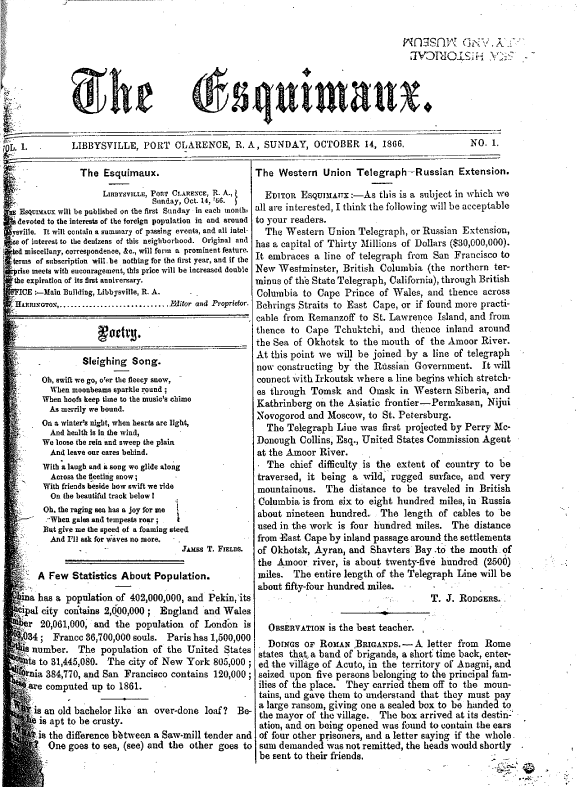
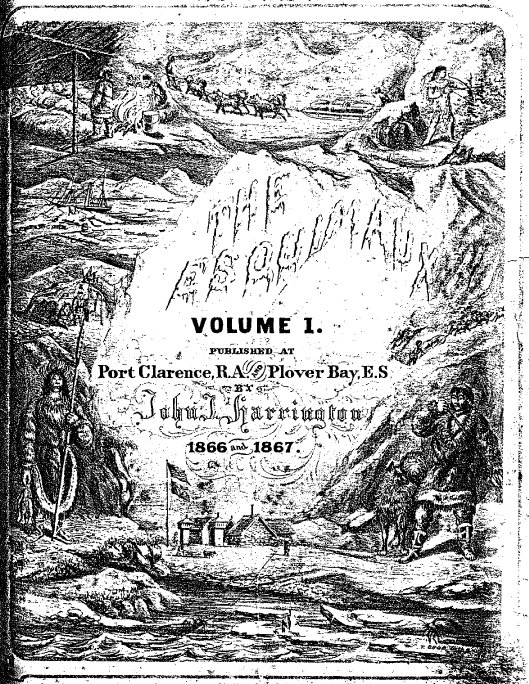
The Esquimeaux (AK, 1866-1867)

Leave a comment

The Esquimeaux (AK, 1866-1867)

Publication History:

Place of Publication:  Libbysville, Port Clarence, Russian America (Nos. 1-10, 1866-1867), and Camp Libby, Plover Bay, East Siberia (Nos. 11 and 12, 1867)

Frequency:  Monthly

Volume and Issue Data:  Vol. 1, Nos. 1-12; Sunday, Oct. 14, 1866; 12 issues

Size and Format:  52 pages; manuscript and printed editions

Editor/Publisher:  John J. Harrington, editor; Turnbull and Smith (San Francisco), publisher of printed numbers

Title Changes and Continuation:  None

General Description & Notes:

The Esquimeaux (AK, 1866-1867)

According to Wickersham, this monthly publication, of which Nos. 1 to 10 inclusive were published in Libbysville, Port Clarence, Russian America, and Nos. 11 and 12 in Camp Libby, Plover Bay, Eastern Siberia, appeared in both manuscript and later print.

The paper provided information of the workers building the Western Union Telegraph Expedition line planned from the United States in Seattle on Puget Sound, via the Fraser and Yukon rivers, to Port Clarence and then across the Bering Strait to Plover Bay and on to points in Asia and Europe.

After the abandonment of the project, because of the success of the Trans-Atlantic cable in 1866, and the U.S. purchase of Russian Alaska in March 1867 for $7 million, the manuscript was taken to San Francisco and printed there by the editor.  The editor’s preface is dated Oct. 31, 1867.

The Esquimeaux (AK, 1866-1867)

Information Sources:

Bibliography:  James Wickersham, A Bibliography of Alaska Literature, 1724-1924 (Cordova, Ak.:  Cordova Daily Times Print, 1927), 258

Citations: Daily Evening Bulletin (San Francisco, California), Monday, December 02, 1867; Issue [47]  

Locations:  Alaska State Libraries:  Alaska Historical Library, AkAAR, AkAU, AkK, AkNNC; CU-B?

Esmeralda Sun (NV, 1872)

Leave a comment

See Pine Grove Burlesque

Eagle City Tribune (AK, 1898)

Leave a comment

Eagle City Tribune (AK, 1898)

Publication History:

Place of Publication:  Eagle City, Alaska (1898)

Frequency:  Weekly

Volume and Issue Data:  Vol. 1, No. 6, Oct. 8, 1898; only a few issues published

Size and Format:  8 x 10 inches; two pages; pen and ink

Editor/Publisher:  Charles C. Carruthers, editor; F.L. Lowell, assistant

Title Changes and Continuation:  None

General Description and Notes:

According to the McLean, the Tribune was an independent newspaper that provided community news and editorials on the differences between Canadian and American mining laws, customs and tariffs.  The Tribune’s motto was “He that runs may read.”  No price appears.

The Oct. 8, 1898 issue includes five advertisements and criticisms of Canadian officials and “their coadjutors, the B.C. press.”  The paper was clearly unhappy with Canadian treatment of Americans in the eastern Alaska/Yukon mining region.  Tribune editor Carruthers displayed a tendency to editorialize in almost every article.  At the same time, he also records the names of many of the early arrivals in the country, pictures the difficulties between Canadians and Americans, and indicates the difficulties and dissatisfactions between labor and management.

Information Sources:

Bibliography:  Dora E. McLean, Early Newspapers on the Upper Yukon Watershed:  1894-1907, unpublished M.A. thesis, University of Alaska, 1963, 38-43; James Wickersham, A Bibliography of Alaska Literature, 1724-1924 (Cordova, Ak.:  Cordova Daily Times Print, 1927), 258; Melody Webb, Yukon: The Last Frontier (University of British Columbia Press/University of Nebraska Press, 1985/1993), p. 137; John McPhee, Coming into the Country (Bantam Books, 1979), p. 340.

Link: Melody Webb, Yukon: The Last Frontier (University of British Columbia Press/University of Nebraska Press, 1985-1993), p. 137

Locations:  Oct. 8, 1898: AKHisLib-Juneau; photocopy reprint in McLean (1963), 42-43

Domestic Quarterly Review (IA, 1844)

Leave a comment

Publication History:

Place of Publication:  Washington, Iowa; Sigourney, Iowa (1844)

Frequency:  Quarterly?

Volume and Issue Data:  Vol. 1, No. 1, April 1, 1844; at least three issues

Size and Format:  Four pages, 13″x21″; three columns per page

Editor/Publisher:  S.A. James

Title Changes and Continuation:  None

General Description and Notes:

According to Littler, the first issue of the Domestic Quarterly Review was “without doubt the first document published in the county that at all approximated in dignity of appearance, manner and matter of regular newspaper issue.”  Littler says the Review was a “12 column sheet, 3 wide columns to the page, and the pages were in size 13 by 21 inches” and “contained “probably as much matter in it as are found in regularly printed newspaper sheets of the same size.”

James described the Review as “a complete family, Young Lady or Gentleman’s newspaper” devoted “to Literature, Amusement and Particular Intelligence.”  The Review was “written and published at the low price of $1.00 a year, invariably in advance, and will be mailed to subscribers so as to reach them on the first day of each quarter in any part of the United States.”  James included a request that “Editors will confer a favor by giving the above notice (with this notice) an insertion.”

The editor of another local handwritten paper, the Quarterly Visitor, notes in that publication’s summer 1844 issue that “the printing office, publishing the ‘Quarterly Review,’ has removed to Sigourney in Keokuk Co.”  The Keokuk County History of 1880, which made liberal use of interviews with James, says that he issued three numbers of his handwritten newspaper.  The county history also notes that James lived in a small log cabin with his family for sometime after his move, so it seems doubtful that the “printing office” involved much more than the writing skills of James and perhaps his wife, Sarah.

Information Sources:

Bibliography:  Nathan Littler, History of Washington County, (Iowa), 1835-1875, ed. by Edna Jones (Washington, Iowa:  Jonathan Clark, 1977), 221-222; The History of Keokuk County, Iowa (Des Moines:  Union Historical Company, 1880), 459-460; Roy Alden Atwood, “Handwritten Newspapers on the Iowa Frontier, 1844-1854,” Journalism History, 7:2 (Summer 1980), 56-59, 66-67.

Locations:  No extant issues located, but quoted in Littler (1977).

The Denial Bay Starter (Australia, 1908)

Leave a comment

The Denial Bay Starter, Australia, 1908

Publication History:

Place of Publication:  Denial Bay Township, Australia (west side of Eyre Peninsula, 500 miles from Adelaide)

Frequency:  “Weekly”

Volume and Issue Data:  November 14, 1908 (first issue) through 1909

Size and Format:  Early editions were three columns. After the New Year, 1909, it went to two columns.

Editor/Publisher: Dr. C.T. Abbott (with Mrs. Abbott, assistant production officer and general press hand”) [Alan Finch, Pens & Ems]

Title Changes and Continuation: None

General Description and Notes:

In his history of Australian journalism, Alan Finch describes The Denial Bay Starter as “produced in a violent mauve ink on a hectograph in atrocious handwriting.” According to Finch, the first editorial, or leading article, explained the anonymous editor’s goals for the publication:

“Dear friends, this obscene sheet is only started with the intention of amusing you and gathering for your perusal any little items of news that may be brought to our notice. We do not wish to enter into the arguments that arise from burning questions of the hour, but will try to plainly set before you both the good and the bad points of any discussion. We should be willing to inscribe any letter or correspondence that the public may forward to us . . . we do not wish to hurt anyone’s feelings but if we inadvertently do so please tell us and we will strive to make atonement in every possible way.”

The editor went on to explain the title of the new paper: “. . . this is a starter and we hope to see in the near future a type printed paper which will bring the West Coast more prominently before the public than it has been hitherto.”

The paper was issued each Saturday, but the editor remained anonymous until shortly after the New Year 1909, when the editor’s name was included at the top of the paper: Dr. C.T. Abbott, a medical doctor and relative newcomer to the area.

Number 20 was produced with the aid of  a typewriter and duplicating stencil.

In the January 29, 1910 edition, the editor announced the paper’s retirement:

“The time has come, when the Starter will retire from the arena, and cease to exist. But we hope that this year old infant, has been able to bring other thought and ideas to your minds, than you had previously, that it had been able to sow on rich ground, a few seeds which in the future will spring up. “

The editor, Dr. Abbott, brought the paper to an end because he moved to a new position at Pine Creek.

Information Sources:

Bibliography:  Alan Finch, Pens & Ems in Australia: Stories of Australian Newspapers (Adelaide, 1965), pp. 12-18.

Locations: Public Library, Adelaide, Australia; National Library, Canberra, Australia

The Chugg Water Journal (WY, 1849)

Leave a comment

Chugg Water Journal (WY, 1849)

[Post updated August 17, 2011; thanks to Andrew Tucker for information about Fort Laramie’s Commanding Officer William Scott Ketchum]

Publication History:

Place of Publication:  Fort Laramie, Wyoming; “office under the hill, but still within hearing of the Juvenile Infirmary, when the wind is favorable” (November 1849, Vol. 1, No. 4)

Volume and Issue Data:  October-December, 1849; “will appear occasionally, and sometimes oftener, if not sooner” (Oct. 1849, Vol. 1, No. 2)

Size and Format:  7.75 x 11.5 inches, two columns, with cursive writing and ink illustration with captions

Editor/Publisher:  “The Quartette”

Title Changes and Continuations:  None

General Description and Notes:

The editors describe the paper as “the largest paper printed at Fort Laramie.” .

According to Andrew Tucker (see bibliography below), William Scott Ketchum, one of the names mentioned in the Journal, was an officer of the 6th Infantry stationed at Fort Gibson and later Fort Laramie. He was the commander at Fort Laramie when the Journal was published.

In the October 1849 issue (Vol. 1, No. 2), a joke mentions Ketchum: “Why is the Commander of the Infantry Company at this Post a terror to evil-doers? ‘Cause he Ketch-um.”

Chugg Water Journal (WY, 1849)

Tucker reports that Ketchum was a West Point grad and served as an Army officer in the Second Seminole War, and had frontier duty at Fort Gibson and Fort Laramie. He went on to become a brigadier general by the end of the Civil War. After he retired, he was allegedly poisoned by Elizabeth Wharton, the widow of one his fellow officers. The trial afterward gained international attention. Wharton was apparently acquitted.

Information Sources:

Bibliography: Michael L. Tate, The Frontier Army in the Settlement of the West (Norman: University of Oklahoma Press, 2001), pp. 264-265; thanks to Andrew Tucker, a relative of William Scott Ketchum, for the citation of the Tate book and the background information about Ketchum (via email exchanges with the HNP editor, August 16-17, 2011)

Links:  Michael L. Tate, The Frontier Army in the Settlement of the West (Norman: University of Oklahoma Press, 2001)pp. 264-265; Library of Congress, Chronicling America: Historic American Newspapers

Locations:  Wyoming Department of Commerce, Division of Parks and Cultural Resources, Historical Research and Publications Unit, Cheyenne, WY (microfilmed)

Chalacha Pioneer (OR, 1855)

Leave a comment

Publication History:

Place of Publication:  Chalacha, Washington Territory (Oregon), (1855)

Frequency:  At least two issues

Volume and Issue Data:  July 1 and 7, 1855

Size and Format: Unknown

Editor/Publisher: Unknown

Title Changes and Continuation: Unknown

General Description and Notes:

None

Information Sources:

Bibliography: None

Locations:  Oregon State Historical Society

The Cactus (UT, 1878?-1884)

Leave a comment

Publication History:

Place of Publication:  Panguitch, Garfield County, Utah (1878? 1880?-1884)

Frequency:  Irregular, “when the spirit moved”

Volume and Issue Data:  Started 1878 or 1879 and published until about 1884

Size and Format:  8 x 10 inches, four pages

Editor/Publisher:  John M. Dunning, editor and publisher; James T. Daly, Sr., correspondent or writer

Title Changes and Continuation:  Garfield County News, The Recorder, The Register

General Description & Notes:

The paper was first called the Cactus, but the name was changed, possibly, to the Garfield County News, The Recorder, and/or The Register.  The paper was not issued regularly but “when the spirit moved.”

According to Alter, editor Dunning was said to have been a humorist and prepared his own jokes for fillers.  Many of his poems and other writings also appeared in the Cactus.  Says Alter, “It may have been a manuscript, pen-and-ink newspaper.”

Alter notes that “the Manti Home Sentinel mentions March 26, 1886 as being: ‘among our latest exchanges:’ though the echang practice was so universal it is more than likely the Register was just beginning when it received this notice.”

According Lucy Hatch, a member of the Panguitch Daughters of the Utah Pioneers, Dunning published the first newspaper in the town “from about 1880 to 1884” and that Daly was a correspondent or writer.

Information Sources:

Bibliography:  J. Cecil Alter,  Early Utah Journalism (Salt Lake City:  Utah Historical Society, 1938), p. 180

Locations:  No issues located

See also the Panguitch Register

Bugle (NV, 1880)

Leave a comment

Publication History:

Place of Publication:  Junctionville (also known as Bonelli’s Ferry), Nevada

Frequency:  Weekly

Volume and Issue Data:  c. Feb. 1880-c. 1880

Size and Format:  Written on letter sheets

Editor/Publisher:  Leonard Bonelli, Bugle Publishing Co.

Title Changes and Continuation:  None

General Description & Notes:

The Pioche Record, Feb. 28, 1880, reports that the Bugle was a weekly written on letter sheets by the ferryman’s son, Leonard Bonelli, who lists himself as the editor and the Bugle Publishing Co. as publisher.

Information Sources:

Bibliography:  Pioche Record, Feb. 28, 1880; Lingenfelter and Gash, The Newspapers of Nevada (Reno:  University of Nevada Press, 1984), p. 123.

Locations:  No extant issues located

Bow and Arrow (MI, 1833)

Leave a comment

Publication History:

Place of Publication:  Michilimackinac, Michigan (1833)

Frequency:  Unknown

Volume and Issue Data:  No. 2, Oct. 1, 1833

Size and Format:  Unknown

Editor/Publisher:  Henry Rowe Schoolcraft (1833)

Title Changes and Continuations:  None

General Description & Notes:

According to Littlefield and Parins, The Bow and Arrow was a manuscript magazine devoted to Indian life, history, opinion, and names.  This was editor Schoolcraft’s third handwritten publication, the first being a literary magaznie published from 1809 to 1818 and the second being The Muzzinyegun or Literary Voyager (1826-1827) published in Sault Ste. Marie, Mich.  The Oct. 1, 1833 issue of the Bow and Arrow contained an article entitled “The Indian” dealing with stereotypes and characteristics of the American Indian.

Information Sources:

Bibliography:  Vernon Kinietz, “Schoolcraft’s Manuscript Magazines,” Bibliographical Society of America Papers, 35 (April-June, 1941), 151-154.  Indexed in David F. Littlefield, Jr. and James W. ParinsAmerican Indian and Alaska Native Newspapers and Periodicals, 1826-1924 (Westport, Conn.:  Greenwood Press, 1984), 44.

Locations:  DLC

Big Injun (TX, 1866, 1869)

Leave a comment

Publication History:

Place of Publication:  Fort Belknap, Texas

Frequency:  Unknown

Volume and Issue Data:  Published sometime between 1866 and 1869.

Size and Format:  Unknown

Editor/Publisher:  H.H. McConnell

Title Changes and Continuation:  Same editor/publisher produced LITTLE JOKER at Jacksboro, Texas, prior to his transfer to Fort Belknap.  After creating BIG INJUN, he was transfered again a short distance to Fort Buffalo and “again broke forth” with THE GRASSHOPPER.

General Description & Notes:

According to Whisenhunt, the Jacksboro area had no fewer than four newspapers between 1866 and 1869, although only one was printed.  The editor of all four was H.H. McConnell, a soldier first assigned to Jacksboro, Texas in 1866.  McConnell recounts his journalistic efforts and military experience on the Texas frontier in the Reconstruction period in his autobiography, Five Years a Cavalryman.

Shortly after he arrived in Jacksboro, McConnell and other soldiers published a weekly newspaper, LITTLE JOKER, on foolscap.  The paper circulated among the soldiers at Jacksboro.  The Jacksboro post was temporarily abandoned by the military, and the LITTLE JOKER “was ignominiously packed on a Quartermaster’s hourse and moved to Fort Belknap.”

At Fort Belknap soon issued another handwritten paper, BIG INJUN, intended for a military audience.  According to McConnell, “Here the genius of the editor again broke forth, and the ‘Big Injun’ for a time shed an undying lustre on the literature of the nineteenth century.”  The paper was short-lived:  “Like a meteor flashing along the midnight sky–brilliant for a moment, then rendering the darkness more intense–so the ‘Big Injun’ ran its course.”

McConnell’s transfer to nearby Fort Buffalo Springs marked the publication of his third handwritten, THE GRASSHOPPER.  Like its predecessors, THE GRASSHOPPER was short-lived.  Fort Buffalo Springs was soon abandoned for the more strategic Jacksboro post.

McConnell was finally reassigned to Fort Richardson where he contracted with a Weatherford, Tex. printer to publish The Flea.  This, his first printed newspaper, appeared Feb. 1, 1869, but lasted only six issues, until June 15, 1869.

According the Whisenut, McConnell’s handwritten papers did little more than provide diversion for the soldiers at their respective military posts, but “this was important.  Their very existence also impolies that the life of the frontier soldier was mostly a monotonous existence despite the legend and aura of romance that surrounds the United States Cavalry.”

Information Sources:

Bibliography:  H.H. McConnell, Five Years a Cavalryman (Jacksboro, Texas:  J.N. Rogers and Co., 1889), p. 174; Donald W. Whisenhunt, “The Frontier Newspaper:  A Guide to Society and Culture,” Journalism Quarterly, 45:4 (Winter 1968), 727; see also Theronne Thompson, “Fort Buffalo Springs, Texas, Border Post,” West Texas Historical Association Yearbook, 36:168 (October 1960).

Locations:  None

Athabasca Journal and English River Inquirer (SK, 1845)

Leave a comment

Publication History:

Place of Publication:  Bear Island Lake, on the upper Churchill (or English) River north of Lac la Ronge, Saskatchewan

Frequency:  Unknown

Volume and Issue Data:  August 8, 1845

Size and Format:  11 pages, foolscap

Editor/Publisher:  Bernard Rogan Ross

Title Changes and Continuation:  None

General Description & Notes:

According to The Beaver magazine, Bernard Rogan Ross tried to relieve the monotony of a trip by York boat over the regular route of the old fur trade by writing a newspaper, couched in the journalistic style of the period, about the doings of the people of his brigade of three boads proceeding slowly up the Churchill or English River towards Methy Passage.  Although his writing is extremely fine and small, the issue of Aug. 8, 1845, of this Athabasca Journal and English River Inquirer, as he called it, took up 11 closely-written pages of foolscap.  It was preserved by his daughter, (Mrs. George A. Graham) and later published in part of the Fort William Daily Times-Journal of Dec. 27, 1928.

The paper is dated at Bear Island Lake, on the upper Churchill north of Lac la Ronge, in what is now Saskatchewan, and carries the announcement that the next issue would be published the following week at Ile a la Crosse.  The price is stated to be six pence per customer payable, not in cash, but in Saskatchewan pemmican.

The first page is devoted to “Shipping Intelligence,” and included news of ship arrivals and gossip about the Dutchess of Kent.  During this period, the Oregon boundary question was hot news.  As this paper was written, however, the issue had been settled two months earlier.  Without this knowledge, Ross wrote that he suspected the Americans would start a war over the issue.  He warned the southerners that Canada could not only defend itself, but could “lay waste the North-western States with fire and sword, nor cease until the British flag waved triumphantly thoughout the Union.”

Chief Trader Bernard R. Ross, F.R.G.S., was only 18 years old when he wrote this account, and this was apparently his first trip west.  He became a well known naturalist (Ross’s Goose), an anthropologist, and a prolific contributor to the British Museum and Smithsonian Institution.

Information Sources:

Bibliography:  Bernard Rogan Ross, “Fur Trade Gossip Sheet,” The Beaver:  Magazine of the North (Spring 1955)

Locations:  Cited in the Fort William Daily Times-Journal, Dec. 27, 1928; location of copy mentioned in The Beaver preserved by Ross’s daughter is unknown


————————————————————

The Algona Bee (IA, 1857-1858)

Leave a comment

The Algona Bee (IA, 1858)

Publication History:

Place of Publication:  Algona (Kossuth County), Iowa (ca. 1857-1858)

Frequency:  Weekly; irregular

Volume and Issue Data:  Vol. 1, No. 1, Dec. 21, 1857 (note:  another date, Jan. 8th, 1858 is marked out above the Dec. 21 entry)

Size and Format:  8 1/2 x 11 inches; two columns

Editor/Publisher:  Franklin McCoy; Algona Reading Club (et al.?)

Title Changes and Continuation:  Unknown

General Description & Notes:

The Bee was apparently produced by the Algona Reading Club, identified as editors and proprietors (see Vol. 1, No. 8, Feb. 8, 1858).  This number lists the paper’s office at “the wickeup No. 1 West State St. immediately West of the Post Office,” and identifies Franklin McCoy as “publisher.”  However, other pages (many of which are almost illegible) mention an “editress.”

The paper contains poetry, anecdotes, editorials and short story items.  The clear difference in handwriting style and script size between the numbers suggests at least two different writers were responsible for the paper’s production.  The first issue opens with the following introductory editorial:

“We are happy to present to our friends this first number of ‘The Bee’ as the first paper published in this ‘little world of Algona,’ and tho [sic] now small and may-be insignificant in the eyes of many–still we have sanguine hopes that it will thrive–and before many years stand the first and oldest among our village papers.  A person when first starting in an enterprise like this feels rather delicately.  Many fears arise wether [sic] the paper will suit the readers.  Knowing there are as many minds as persons and also knowing, that unless all these minds are satisfied, we are the losers, we feel still more anxiety than we would otherwise.

“The Bee is intended to be strictly a neutral paper.  We shall strive to please all by offending none.  It will abound in wit and humor–be graced with sound intellectual studies and pleasing stories–have all the news of the day–we hope none of the gossip [original emphasis].  We have able correspondents for the Bee who will favour it with their productions from time to time.  A few advertisements will be inserted just to help pay expenses.  We have tried to tell you imperfectly however what we shall strive to make the Bee, and we humbly beg our friends to stand by us and not allow it to sink into obscurity as the paper in our neighboring community has done.”

The Feb. 8, 1858 issue says, “The Bee is published weekly, but if the stories do not improve soon it will be published only Semi Occasionally.”  The editor also notes that “Business cards of not more than five lines in length published for the sake of the fun, flair and fancy.  Job work neatly executed upon reasonable terms.”

Information Sources:

Bibliography:  None

Locations:  Harvey Ingham Papers, Vol. 2, Box 2, Iowa State Historical Society, Des Moines, IA

————————————————————

The Advocate (UT, 1888)

Leave a comment

Publication History:

Place of Publication:  Holden, Utah (Holden Ward, Millard Stake)

Frequency:  Bi-monthly

Volume and Issue Data:  Vol.2 No.2  March 10, 1888

Size and Format:  ledger/legal size lined page, one column

Editor/Publisher:  B.H. Stringam and John Wood

Title Changes and Continuation:  None

 General Description & Notes:

According to Chad Flake, dozens of illusive newspapers sprang up in small towns which could not justify a printed paper, or were predecessors to the printed newspaper.  One such was The Advocate, circulated in Holden, Utah, in the late 1880’s.

Information Sources:

Bibliography:  Chad, Flake, “Early Utah Journalism:  A Brief Summary,” in Utah Newspapers–Traces of Her Past, ed. by Robert P. Holley. Utah Newspaper Project, Salt Lake City–Marriott Library, 1984.

Locations:  Mormon Archives, Salt Lake City, UT

————————————————————

Accra Herald (GHA, 1858-1874)

Leave a comment

Publication History:

Place of Publication:  Accra, Ghana, West Africa

Frequency: Unknown

Volume and Issue Data: Published from 1858, for 16 years; “circulated among 300 subscribers, two-thirds of them African”

Size and Format: “handwritten”

Editor/Publisher: Charles Bannerman, “first African to publish a newspaper in West Africa” (according to Akufo-Addo)

Title Changes and Continuation: Unknown

General Description and Notes:

According to John Chick, the paper appeared in 1857, the year of Ghanaian independence. However, according to the BBC, the year was 1858:

The first African produced paper in West Africa was Charles Bannerman’s Accra Herald, produced in 1858 in the Gold Coast (modern Ghana).

Akufo-Addo also support the 1858 date. He claims that Charles Bannerman was  the first African to publish a newspaper in West Africa.

According to Hasty,

The first newspaper, The Gold Coast Gazette and Commercial Intelligencer, was published from 1822-25 by Sir Charles MacCarthy, governor of the British Gold Coast settlements. As a semi-official organ of the colonial government, the central goal of this Cape Coast newspaper was to provide information to European merchants and civil servants in the colony. Recognizing the growing number of mission-educated Africans in the Gold Coast, the paper also aimed at promoting literacy, encouraging rural development, and quelling the political aspirations of this class of native elites by securing their loyalty and conformity with the colonial system.

The appropriation of print media by local African elites began in mid-century with the publication of The Accra Herald by Charles Bannerman, son of a British lieutenant governor and a princess from the Asante royal family. Handwritten like MacCarthy’s former colonial paper, The Accra Herald was circulated to some 300 subscribers, two-thirds of them African. Enduring for 16 years, the success of Bannerman’s paper stimulated a proliferation of African-owned newspapers in the late nineteenth century . . . (emphasis added)

Information Sources:

Bibliography:  John D. Chick, “The Asanti Times: A Footnote in Ghanaian Press History,” African Affairs, 76:302 (1977), p. 80 (fn.3); “The Story of Africa: African History from the Dawn of Time,” BBC World Service, accessed August 18, 2011; Nano Akufo-Addo, “Welcome Back! A Goodwill Message,” The Statesman, republished on the Modern Ghana website, March 21, 2011; Jennifer Hasty, “Ghana,” World Press Encyclopedia (2003);  JenniferHasty,  Big Language and Brown Envelopes: The Press and Political Culture in Ghana,  Ph.D. Dissertation, Duke University, 1999

Locations:  Unknown

Newer Entries