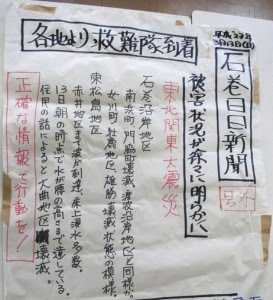
Ishinomaki Hibi Shimbun (JPN, 2011)

Leave a comment

Ishinomaki Hibi Shimibun (JPN, 2011)

Publication History:

Place of Publication:  Ishinomaki, Miyagi Prefecture, Japan

Frequency:   Six days while the newspaper could not be printed after massive earthquake, tsunami and nuclear power disasters affected the region

Volume and Issue Data:  March 12-17, 2011

Size and Format:  Poster-sized paper

Editor/Publisher:  Hiroyuki Takeuchi, chief reporter, and the Hibi Shimbun staff

Title Changes and Continuation:  None

General Description & Notes:

In the aftermath of the Japanese earthquake and tsunami in March 2011, the Ishinomaki Hibi Shimbun newspaper was published for six days in handwritten form. According to the Washington Post,

Unable to operate its 20th-century printing press — never mind its computers, Web site or 3G mobile phones — the town’s only newspaper, the Ishinomaki Hibi Shimbun, wrote its articles by hand with black felt-tip pens on big sheets of white paper. 

But unlike modern media, the method worked.

“People who suffer a tragedy like this need food, water and, also, information,” said Hiroyuki Takeuchi, chief reporter at the Hibi Shimbun, an afternoon daily. “People used to get their news from television and the Internet. But when there is no light and no electricity, the only thing they have is our newspaper.”

While recent political ferment across the Arab world has trumpeted the power of new media, the misery in Japan, one of the world’s most wired nations, has rolled back the clock. For a few days at least, the printed and handwritten word were in the ascendant.

 After writing and editing articles, Takeuchi and others on staff copied their work onto sheets by hand for distribution to emergency relief centers housing survivors of Japan’s worst-ever earthquake and deadly tsunami that followed.

“They were desperate for information,” said Takeuchi, who has slept in the office for the 10 days since the tsunami flooded the ground floor of his house.

With electricity now restored to about a third of the northeast town’s 160,000 residents, Takeuchi’s newspaper has put away its pens and started printing. Internet access is still not available. Monday’s printed front page cheered a “miraculous rescue drama” — the story of an 80-year-old woman and her 16-year-old grandson plucked from their ruined Ishinomaki home Sunday.

Down the coast in Sendai, a once-thriving city of more than 1 million, the digital juggernaut has also come to a halt. “In conditions like these, nothing has power like paper,” said Masahiko Ichiriki, president and owner of Kahoku Shimpo, the city’s main newspaper. With most shops shut, people can’t buy batteries to power radios.

The Newseum (a museum dedicated free press and news reporting, which closed in 2019) purchased copies of the handwritten papers, which are now on display at the Washington, D.C. museum. According to the Newseum website (now also closed):

“The Newseum became aware of the Hibi Shimbun‘s heroic efforts from a March 21, 2011, story on the earthquake in The Washington Post. That morning, Brian Nishimura Lee, the Newseum’s senior administrator for database and financial systems, emailed editors at the Hibi Shimbun and requested copies of the handwritten editions for the museum’s collection.”

The Newseum website (closed) provided additional details that did not appear in the original Washington Post story:

“Ishinomaki, with a population of about 160,000 people, was one of the hardest hit in Japan. Approximately 80 percent of the homes were destroyed. About 1,300 people have died, and more than 2,700 are still missing.

“The first handwritten newspaper on March 12 was an “Extra” edition that informed residents that the earthquake was “the biggest in the history of Japan.” The next day’s edition told about “rescue teams arriving in some areas.” On March 16, the paper said, “Let’s overcome the hardship with mutual support.” By March 17, the paper wrote about the lights coming back on.

“The first printed edition of the newspaper since the power outage was published on March 18. Editions have been distributed free to refugee sites each day.”

Information Sources:

Bibliography: Andrew Higgins, “In Ishinomaki, news comes old-fashioned way: Via paper,” Washington Post (web edition), March 21, 2011

Links: Newseum video of Japanese handwritten newspapers (no longer active on the closed Newseum site, but still available through the Freedom Forum on YouTube)

Locations:  Newseum, 555 Pennsylvania Ave., N.W., Washington, DC

The Intelligencer (UT, ca. 1865)

Leave a comment

Publication History:

Place of Publication: Payson, Utah

Frequency:  Unknown

Volume and Issue Data:  Ca. 1865

Size and Format:  Approx. eight pages

Editor/Publisher:  Unknown

Title Changes and Continuation:  Unknown

General Description and Notes:

Alter quotes the Deseret News, March 29, 1865:

The Payson Advocate and The Intelligencer.  Manuscript newspapers, 8 pages each, judging from letters, and No. 6 of the Advocate, are proving interesting and beneficial to both writers and readers–a very commendable mode of using a portion of leisure time.”

(See THE PAYSON ADVOCATE)

Information Sources:

Bibliography:  J. Cecil Alter, Early Utah Journalism  (Salt Lake City:  Utah State Historical Society, 1938), 190.

Locations:  No issues located, but cited in the Deseret News, March 29, 1865

The Intelligencer (UT, 1865)

Leave a comment

Publication History:

Place of Publication:  Parowan, Utah

Frequency:  Weekly

Volume and Issue Data:  Vol.1 No.3, Feb 11, 1865; Vol.1,  No.4, Feb. 18, 1865; Vol.1, No.6, March 4, 1865

Size and Format:  8”x12”, 2 columns

Editor/Publisher:  Joseph Fish, William Davenport, H.S. Coombs

Title Changes and Continuation:

General Description and Notes:

Motto:  “Thought is the Mind’s Wealth”

The Intelligencer is published every Saturday morning by the young men of Parowan, Utah.

Terms:  Read and return to editor.

Advertisements free

Poetry, lit. stories, Religion, ads, city council news, letter to the editor

(p.2-3, No.4) The editors of the Intelligencer had thought of changing the name of this sheet, but upon more mature deliberation, they think it best to continue the original title.  To those shoe were present at the spelling school and saw The Hesperian Sentinal this may serve as an explanation of the change.

Alter, p.189:  Parowan, Iron County, S. Utah:  “The Intelligencer, a pen and ink manuscript newspaper comes to life for a single glance through a reference by editor Stenhouse of the Salt Lake Daily Telegraph, Saturday morning, April 16, 1865.

“Our Southern contemporary, that unpretending sheet, the Intelligencer, published by the Young Men of Parowan, comes to our table as regularly as the Southern mail will admit. It contains articles upon education and other matters worthy of perusal.”

Information Sources:

Bibliography:  J. Cecil Alter, Early Utah Journalism (Salt Lake City:  Utah State Historical Society, 1938), 190

Locations:  Mormon Church Archives (M5d5824), Salt Lake City, UT;  Cited in the Desert News, March 29, 1865

The Institute Ledger (IL, 1858)

Leave a comment

Publication History:

Place of Publication:  Batavia Institute, Illinois

Frequency:  Unknown

Volume and Issue Data:  Vol. 1, No. 2, March 30, 1858

Size and Format:  20 pages

Editor/Publisher:  Unknown

Title Changes and Continuation:  None

General Description and Notes:

Affiliated with the Batavia Institute.

Information Sources:

Bibliography:  None

Locations:  Manuscripts (SC 2006), Illinois State Historical Library, Old State Capitol, Springfield, IL

Illustrated Arctic News (ENG-AK, 1850-1851)

Leave a comment

Illustrated Arctic News (Eng-AK, 1850-1851)

Entry Updated: December 21, 2016

Publication History:

Place of Publication:  On board H.M.S. Resolute, Captain Horatio T. Austin, C.B., in search of the expedition under Sir John Franklin looking for the “Northwest Passage”

Frequency:  Five issues; frequency unknown

Volume and Issue Data:  October 1850-March 1851

Size and Format:  44.5 x 27 cm.; printed facsimile is folio, 12 x 19 inches, 57 pp

Editor/Publisher: Sherard Osborn and George F. McDougall?

Title Changes and Continuation: None

General Description and Notes:

Illustrated Arctic News (printed) (AK, 1850-1851)

Printed and published after the H.M.S. Resolute expedition returned home, from the five numbers originally issued in manuscript, October 1850-March 1851, on shipboard during the wintering of the H.M.S. Resolute in Barrow Strait.

The H.M.S. Terror, captained by Sir Franklin (and its companion ship, the H.M.S. Erebus), which the Resolute’s crew and other expeditions searched for over a period of 11 years, was finally found at the bottom of the Arctic Ocean above the Arctic Circle in September 2016, according the The Guardian (Sept. 12, 2016). The H.M.S. Terror was located 168 years after it went missing off King William Island in eastern Queen Maud Gulf in the Canadian Arctic Archipelago in Nunavut, Canada (see map below). The H.M.S. Erebus had been found several years earlier just to the south of where the Terror was later located.

hms-terror-map-northern-canada-arctic-ocean
Map: The H.M.S. Resolute wintered on the Barrow Strait in search of the Sir Franklin expedition. The H.M.S. Terror and its companion ship the H.M.S. Erebus were found, more than 160 years after they went missing, off King William Island in Queen Maud Gulf.

The H.M.S. Resolute, on which these handwritten newspapers were produced, became famous in politics and popular culture long after its retirement. Wood from the ship was later made into two desks, one of which the English crown gave as a gift to the United States President Rutherford B. Hayes in 1880. That desk still sits today in the Oval Office of the White House. That desk was also featured (as was its origin from the H.M.S. Resolute) in the popular film, National Treasure: Book of Secrets (2007), starring Nicholas Cage.

Information Sources:

Bibliography:  Sherard Osborn and George F. McDougall, eds., Facsimile of the Illustrated Arctic News, Published on Board H.M.S. Resolute, Captain Horatio T. Austin, C.B., In Search of the Expedition Under Sir John Franklin (London:  Ackerman, 1852)

Links: Captain Horatio T. Austin;  Sir John Franklin Northwest Passage Expedition; “Ship Found in Arctic 168 Years after Doomed Northwest Passage Attempt”; Franklin’s Last Voyage.

Locations: British Library (?);   Scott Polar Research Institute, Cambridge, England; Metropolitan Reference Library, Toronto, Ontario, Canada

The Hustler (SK, 1889)

Leave a comment

Publication History:

Place of Publication: Prince Albert, Saskatchewan

Frequency: Unknown

Volume and Issue Data:  Vol. 1, No. 2,March 4, 1889

Size and Format:  One sheet, folded quarto, mechanical reproduction of handwritten original

Editor/Publisher: Unknown

Title Changes and Continuation:  Unknown

General Description and Notes:

None

Information Sources:

Bibliography:  None

Locations:  Special Collections, University of Saskatchewan Library, Saskatoon, Canada

Huntington Gazette (VT, 1810)

Leave a comment

Publication History:

Place of Publication: Huntington,Vermont

Frequency: Unknown

Volume and Issue Data:  March, 1810.  No known extant copies.

Size and Format: Brown wrapping paper, 7 inches by 4 1/2 inches, one side only

Editor/Publisher:  James Johns

Title Changes and Continuation: Vermont Autograph and Remarker

General Description and Notes:

James Johns describes this paper on the front page of his later manuscript paper, Vermont Autograph and Remarker of November 6, 1871:  “Should it be asked how long it is since I first took up this notion of a pen-printed newspaper, I answer that my first essay at it bore date back as earlly as March, 1810, I being then in my 13th year.  It was executed on a piece of brown wrapping paper nearly the size of this [approx. 7″ x 4 l/2”] when spread open, and printed on one side only and bore the title of Huntington Gazette; (I then lived in Huntington, the town next north by east of this.)  After that I used white writing paper, and sometimes altered the title as fancy dictated.  I have [end of page] . . .”

Information Sources:

Bibliography:  “James John, Vermont Pen Printer,” Proceedings of the Vermont Historical Society, New Series, 4:2 (1936), pp. 69-71

Link: The American Antiquarian Society, Amateur Newspapers Collection

Locations:  No known copies exist.  (Dennis R. Laurie, Assistant to the Curator of Newspapers and Periodicals, American Antiquarian Society, 185 Salisbury St., Worceseter, MA  01609-1634.  Phone 508/755-5221.)

Honey Bee (OR, 1874)

Leave a comment

Honey Bee (OR, no date)

Place of Publication: Jacksonville, Oregon

Frequency:  Unknown

Volume and Issue Data:  1, 1874

Size and Format:  10 pp. Ledger-size lined paper, written in cursive ink

Editor/Publisher:  Annie Miller

Title Changes and Continuation: None

General Description and Notes:

“Devoted to Art, Wit, Poetry, and Science” (cover page)

Motto: “Onward and Upward.”

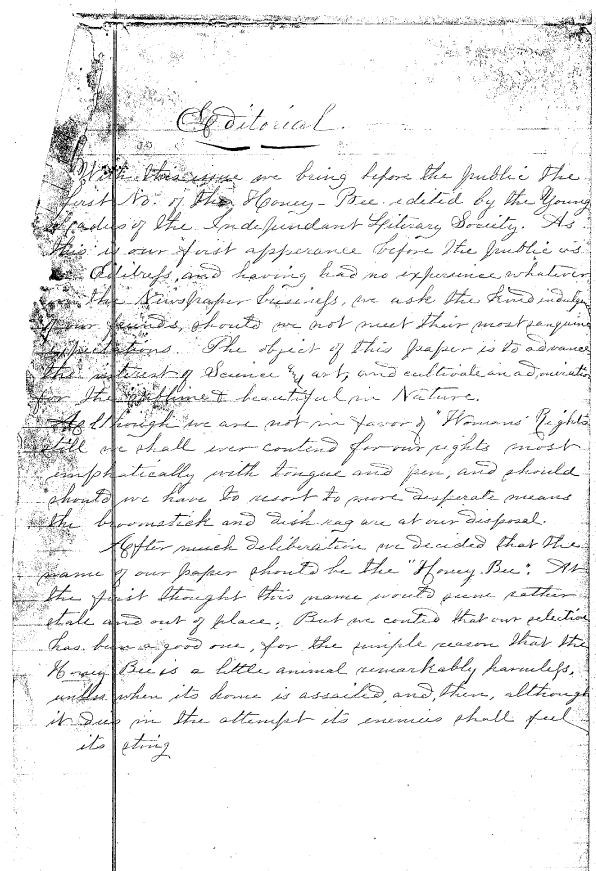
From the “Editorial” on page 2 (see image below): “With this issue we  bring before the public the first No. of the Honey-Bee, edited by the Young Ladies of the Independant (sic) Literary Society. ”  The editor continues, ” . . . having had no experience whatever in the Newspaper business, we ask the kind indulgence of our friends, should we not meet their most sanguine expectations.”

Honey Bee (OR, 1874)

Bibliography: None

Locations:  Special Collections, University of Oregon Library, Eugene, OR

Home Writer (UT, 1881-1883)

Leave a comment

Home Writer (UT, 1881-1883)

Publication History:

Place of Publication: Manti, Utah

Frequency:  Monthly

Volume and Issue Data:  13 numbers:  Vol. 1, No. 2 December 6, 1881, through Vol. 2, No.13 December 3, 1883.

Size and Format:  8”x12.5” ledger-size lined pages, written in ink

Editor/Publisher:  S.A. Parsons, Olive Lowry, Charles Tennant, Ettie C. Kyar, A.S. Squire, T. Parry, R.L. Byleu, Nephi Gledhill, Nancy Westenskow, J.J. Hansen

Title Changes and Continuation: None

General Description and Notes:

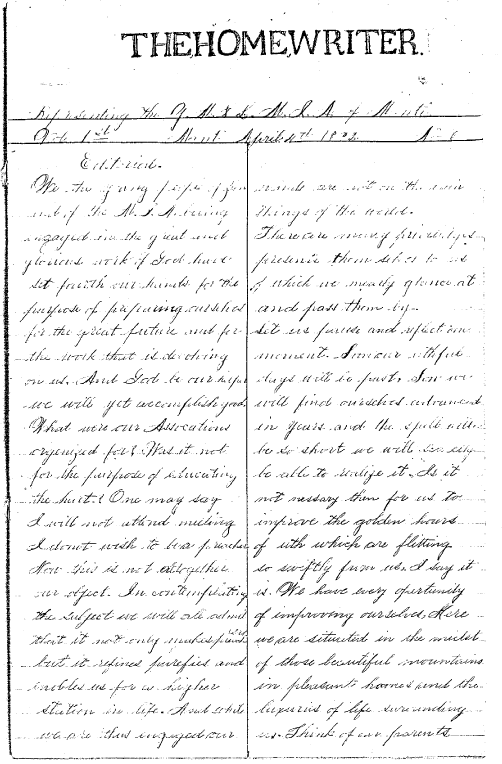
Motto:  Representing the Young Men and Young Ladies M.I. [Mutual Improvement] Association of Manti.

Includes editorials, hints on criticism, good thoughts, how to ? knowledge, wit and humor, mathematical problems, answers to problems, poetry, news, advertisements, births, deaths, marriages, etc.

Information Sources:

Home Writer (UT, 1881-1883)

Bibliography:  George T. Brooks Papers, Box 1 Fd. 2-4

Locations:  University Libraries, Manuscripts, University of Utah, Ms 368

The Hive (CT, 1828-1829)

Leave a comment

Publication History:

Place of Publication:  Torringford, Connecticut

Frequency:  Unknown

Volume and Issue Data:  7 issues extant, 1828-1829

Size and Format:  large size paper, 4 pages each

Editor/Publisher:  Unknown

Title Changes and Continuation: None

General Description and Notes:

None

Information Sources:

Bibliography:  None

Locations:  Salmon Brook Historical Society, Granby, CT

Hazelton Queek (BC, 1880-1881)

Leave a comment

Hazelton Queek (BC, 1881)

Publication History:

Place of Publication: Hazelton (Caledonia?), British Columbia, Canada

Frequency: Unknown

Volume and Issue Data:  1880-1881

Size and Format: Unknown (see image)

Editor/Publisher: Unknown

Title Changes and Continuation: Unknown

General Description and Notes:

A typewritten memo with the Queek in the BC Archives by Mrs. H.K. Andrews (or “Miss Woods”, whose name is scratched out) reads,

“In the year 1880, I went North with my brother to stay with our people the Tomlinsons. My brother to assist in farm and agricultural work which Mr. Tomlinson the missionary was starting, to help the Indians improve their mode of life. And had settled a little place called Ankihtlast–about 150 miles from the Coast and 20 miles from Hazelton, near the head of Navigation on the Skeena. I went to try and help my sister with the children (four in number). In the year of 80 & 81 Bp. and Mrs. Ridley having been sent by the C.F.S. to be head of the Missions were living at what we called ‘The Forks’ (the junction of the Bulkley and Skeena), now I believe called Old Hazelton. Wishing to do all possible to help the whites, Mrs. Ridley started what she called pleasant evenings on every Tuesday and her house was open house specially for the men who came out from Omineca. An evening of readings, music and general social intercourse.  This social evening developed into a desire for a weekly paper, both the Bp. and Mrs. R. were talented & had taken many sketches locally. Mrs. R. and I going out together, sketching up the Haguilket Valley. There was no news coming in for the winter months from the outside world, we were absolutely cut off till spring would come. So everyone was expected to help in gathering items of interest, a riddle, a story, anything. My brother sent weather readings from our mission station. I contributed a few sketches, for our paper was an illustrated one, and we looked forward to receiving it on Saturday. The Bp. wrote out and transferred it on a gelatine press, sufficient numbers for the regular customers–about 10 or 12 I suppose; the Hankins, ourselves, & the miners. “

Information Sources:

Bibliography:  None

Locations: British Columbia Archives and Records Services, Victoria, British Columbia, Canada

Hamiltonian (MA, 1840s)

Leave a comment

Publication History:

Place of Publication: Massachusetts?

Frequency: Unknown

Volume and Issue Data:  1840’s

Size and Format:  approx. 120 pp.

Editor/Publisher:  Hale family

Title Changes and Continuation:  “and other miscellaneous titles”

General Description and Notes:

Children’s projects.

Information Sources:

Bibliography:  None

Locations:  Hale Family Papers, Sophia Smith Collection, Archives, Smith College, Northampton, MA

Halaquah Times (OK, 1871-1875)

Leave a comment

Publication History:

Place of Publication: Wyandotte Mission School, Last Creek, Indian Territory (Oklahoma)

Volume and Issue Data:  Vol. 2, No. 3-Vol. 6, No. 6, ca. 1871-1875

Size and Format:  (check extant copies–at Kansas collection)

Editor/Publisher:  Ida Johnson and Julia Robitaille, editors; Halaquah, Literary Society of Wyandotte Mission School (1871-1875)

Title Changes and Continuations:  None

General Description and Notes:

According to Littlefield and Parins, the Halaquah Times was a manuscript magazine published by the students of the Wyandote Mission’s literary society.  It contained letters and essays on student and school activities.  Many of the essays focused on “social improvement.”  The magazine was edited by Ida Johnson and her associate July Robitaille.

According to Murphy and Murphy, the student editors made one copy and then had other students at the mission school make additional copies.

Information Sources:

Bibliography:  Carolyn Thomas Foreman, Oklahoma Imprints, 1835-1907 (Norman:  University of Oklahoma Press, 1936); Grace Ernestine Ray, Early Oklahoma Newspapers (Norman:  University of Oklahoma Press, 1928); James E. Murphy and Sharon M. Murphy, Let My People Know:  American Indian Journalism, 1828-1978 (Norman:  University, 1981); David F. Littlefield, Jr. and James W. Parins,  American Indian and Alaska Native Newspapers and Periodicals, 1826-1924 (Westport, Conn.:  Greenwood Press, 1984), 143-144.

Locations:  “Miscellaneous–Halaquah,” Manuscripts, Kansas State Historical Society, contains two undated issues, written in copybooks

The Grindstone Bee (SD, 1906)

Leave a comment

Grindstone Bee (SD, 1906)

Publication History:

Place of Publication:  Grindstone, South Dakota

Volume and Issue Data:  Vol. 1, No. 1, April 1, 1906; “whenever we feel like it”

Size and Format:  11 x 14 in.; 4 pp.

Editor/Publisher:  Wm. Henry Bruno

Title Changes and Continuations:  NA

General Description and Notes:

Grindstone Bee (SD, 1906)

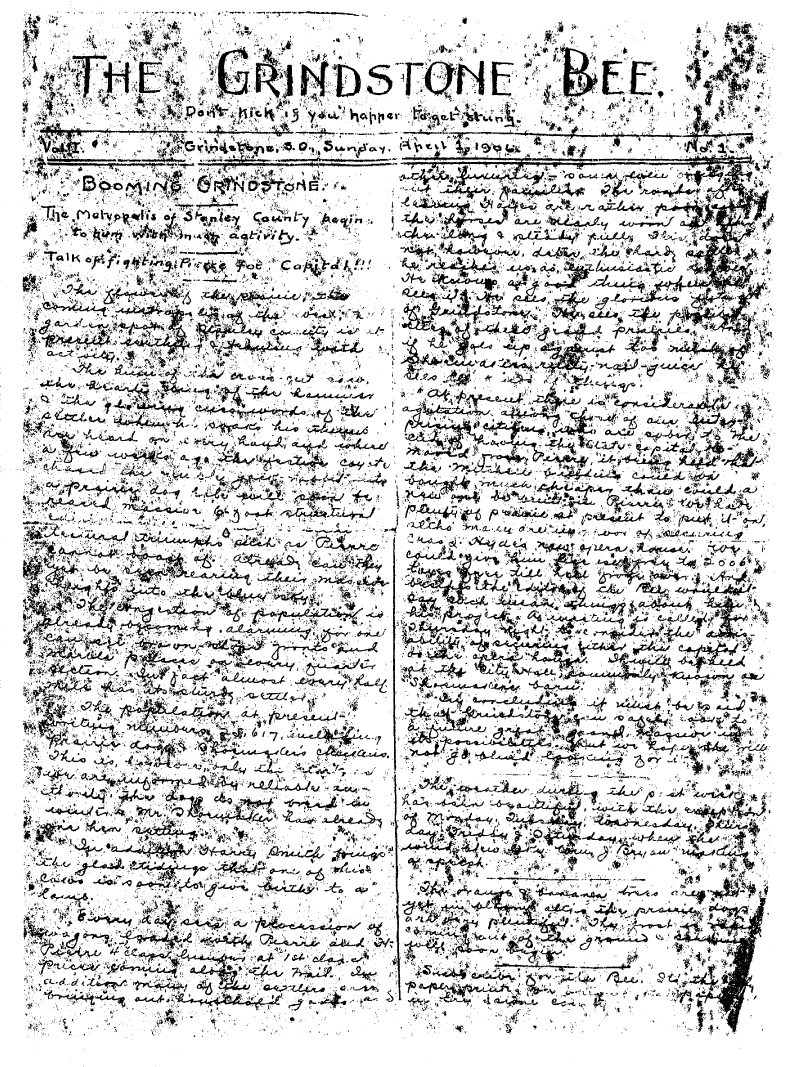
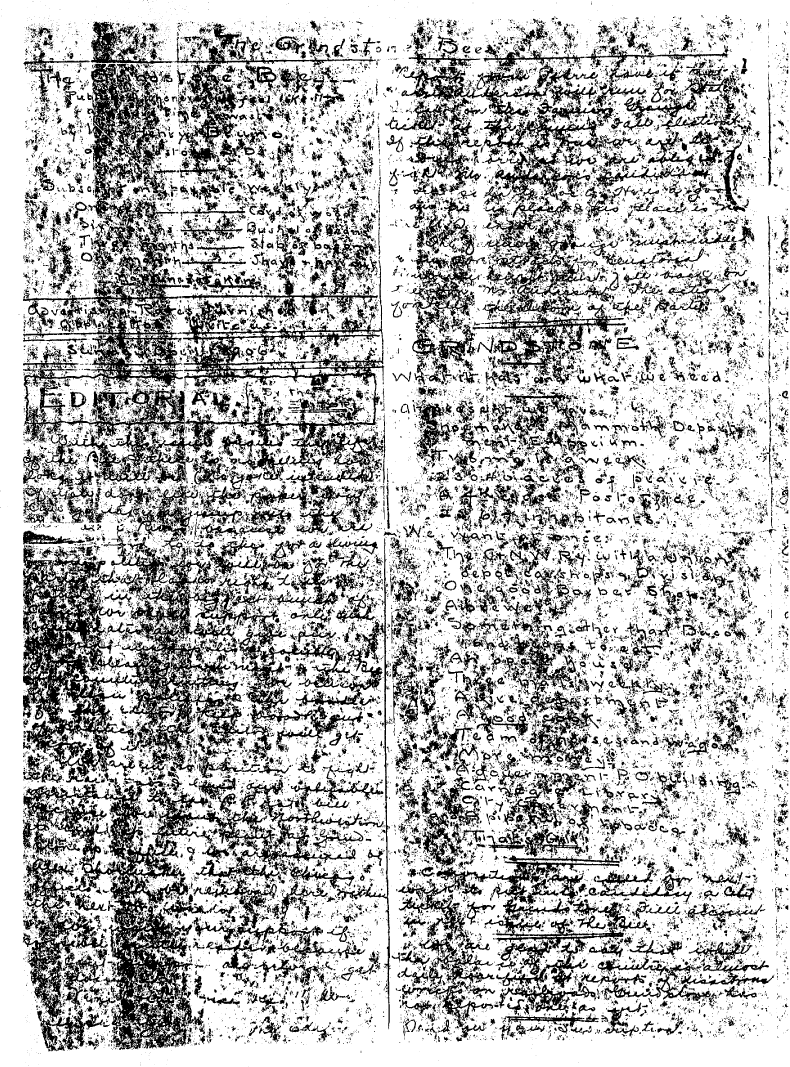
The date hints that it may be a spoof. Other indicators, such as the subscription rates on page 3 (“One year: cord of wood; six months: bushel of beans; three months: slab of bacon; one month: shave & hair cut”) and the motto,” Don’t kick if you happen to get stung,” also point toward an “April Fool’s” edition paper.

Information Sources:

Bibliography: None

Grindstone Bee (SD, 1906)

Locations: South Dakota Historical Society

Green Mountain Miscellany or Huntington Magazine (VT, 1834)

Leave a comment

Publication History:

Place of Publication: Huntington, Vermont

Frequency: Unknown

Volume and Issue Data: October 10, 1834

Size and Format: Unknown

Editor/Publisher:  James Johns

Title Changes and Continuation: Huntington Magazine

General Description and Notes:

The earliest extant issue of a pen-printed amateur newspaper.

Information Sources:

Bibliography: None

Locations:  American Antiquarian Society, Worcester, MA

The Grasshopper (TX, 1866-1869)

Leave a comment

Publication History:

Place of Publication:  Fort Buffalo Springs, Texas

Frequency:  Unknown

Volume and Issue Data:  Published sometime between 1866 and 1869.

Size and Format:  Unknown

Editor/Publisher:  H.H. McConnell

Title Changes and Continuation:  Same editor/publisher produced LITTLE JOKER at Jacksboro, Texas and the BIG INJUN at Fort Belknap, Texas.

General Description and Notes:

According to Whisenhunt, the Jacksboro area had no fewer than four newspapers between 1866 and 1869, although only one was printed.  The editor of all four was H.H. McConnell, a soldier first assigned to Jacksboro, Texas in 1866.  McConnell recounts his journalistic efforts and military experience on the Texas frontier in the Reconstruction period in his autobiography, Five Years a Cavalryman.

Shortly after he arrived in Jacksboro, McConnell and other soldiers published a weekly newspaper, LITTLE JOKER, on foolscap.  The paper circulated among the soldiers at Jacksboro.  The Jacksboro post was temporarily abandoned by the military, and the LITTLE JOKER “was ignominiously packed on a Quartermaster’s hourse and moved to Fort Belknap.”

At Fort Belknap soon issued another handwritten paper, BIG INJUN, intended for a military audience.  According to McConnell, “Here the genius of the editor again broke forth, and the ‘Big Injun’ for a time shed an undying lustre on the literature of the nineteenth century.”  The paper was short-lived:  “Like a meteor flashing along the midnight sky–brilliant for a moment, then rendering the darkness more intense–so the ‘Big Injun’ ran its course.”

McConnell’s transfer to nearby Fort Buffalo Springs marked the publication of his third handwritten, THE GRASSHOPPER.  Like its predecessors, THE GRASSHOPPER was short-lived.  Fort Buffalo Springs was soon abandoned for the more strategic Jacksboro post.

McConnell was finally reassigned to Fort Richardson where he contracted with a Weatherford, Tex. printer to publish The Flea.  This, his first printed newspaper, appeared Feb. 1, 1869, but lasted only six issues, until June 15, 1869.

According the Whisenut, McConnell’s handwritten papers did little more than provide diversion for the soldiers at their respective military posts, but “this was important.  Their very existence also implies that the life of the frontier soldier was mostly a monotonous existence despite the legend and aura of romance that surrounds the United States Cavalry.”

Information Sources:

Bibliography:  H.H. McConnell, Five Years a Cavalryman (Jacksboro, Texas:  J.N. Rogers and Co., 1889), p. 174; Donald W. Whisenhunt, “The Frontier Newspaper:  A Guide to Society and Culture,” Journalism Quarterly, 45:4 (Winter 1968), 727; see also Theronne Thompson, “Fort Buffalo Springs, Texas, Border Post,” West Texas Historical Association Yearbook, 36:168 (October 1960).

Location:  None

Granite Times (NV, 1908)

Leave a comment

Granite Times (NV, 1908)

Place of Publication:  Granite (seven miles west of Schurz in present-day Mineral County), Nevada

Frequency:  Weekly?

Volume and Issue Data:  March 20, 1908-May 1, 1908

Size and Format:  Two-page, three columns; graphite pencil and blue pencil headlines, or black ink in longhand, with occasional shading and coloring with crayon

Editor/Publisher:  Frank Eugene Bugbee (elected to Nevada Assembly 1931, 1933, and 1937) (1908)

Title Changes and Continuation:  Richard E. Lingenfelter, The Newspapers of Nevada (San Francisco:  John Howell-Books, 1964), 131, identifies paper as the Granite News.

General Description & Notes:

The Granite Times, according to its 1908 Easter edition, was “Devoted to the Mining and Material Interests of Granite and the Mountain View District.”  According to Highton, the paper was regularly sold for $1, while the special the Easter edition was $5.  The paper included general local news, editorials and poetry.  Stories addressed such events as the completion of an automobile road between Granite and Schurz.  The Rawhide Rustler, April 18, 1908, reproduced a portion of the Granite Times:  “We reproduce . . . a section of the Times, a paper printed in lead pencil in the new town of Granite . . . .  It shows the usual progressiveness of new mining camps in Nevada.”  Lingenfelter and Gash speculate that the Times suspended publication with its seventh number on May 1, 1908.

Earl and Moody report that editor Bugbee was an Ohio native who taught school in Kansas before arriving in Nevada at the turn of the century.  He visited several mining towns before joining the rush to Granite and starting the Times.  Bugbee reported in one issue that he had ordered a carload of type to print his paper, but through an error he received a mess of tripe.  He offered “a bar of soap and a pound of tripe” to those who solicited others for new subscriptions to the Times.  Noted the editor, “Do not get discouraged because have not the tools and equipment you should have to run your lease.  The editor has only three lead pencils, but he gets out a paper every week.”

The two extant issue of the Granite Times at the Nevada Historical Society were donated by Bugbee in 1909.

Information Sources:

Bibliography:  Phillip I. Earl and Eric Moody, “Type, Tripe and the Granite Times,” Nevada Magazine, (May-June 1982), 17-18; Jake Highton, Nevada Newspaper Days:  A History of Journalism in the Silver State (Stockton, Calif.:  Heritage West Books, 1990), pp. 97;  Richard E. Lingenfelter, The Newspapers of Nevada (San Francisco:  John Howell-Books, 1964), 131 (identifies paper as the Granite News); Richard E. Lingenfelter and Karen R. Gash, The Newspapers of Nevada (Reno:  University of Nevada Press, 1984), 110.

Locations:  April 17, May 1, 1908:  NvHi (also on microfilm)

The Grafton News (MA, no date)

Leave a comment

Publication History:

Place of Publication: Grafton, Massachusetts

Frequency: Unknown

Volume and Issue Data: Unknown

Size and Format:  Unknown

Editor/Publisher:  Unknown

Title Changes and Continuation: Unknown

General Description and Notes:

None

Information Sources:

Bibliography:  None

Link: The American Antiquarian Society, Amateur Newspapers Collection

Locations:  American Antiquarian Society, Worcester, MA

The Gold Coast Gazette & Commercial Intelligencer (GHA, 1822-1825)

Leave a comment

Publication History:

Place of Publication:  Ghana, West Africa

Frequency: Unknown

Volume and Issue Data: April 21, 1822-1825

Size and Format: “handwritten;” semi-official organ of the colonial government

Editor/Publisher: Sir Charles MacCarthy, governor of the British Gold Coast settlements

Title Changes and Continuation: Unknown

General Description and Notes:

According to Jennifer Hasty’s history of the press in Ghana,

The first newspaper, The Gold Coast Gazette and Commercial Intelligencer, was published from 1822-25 by Sir Charles MacCarthy, governor of the British Gold Coast settlements. As a semi-official organ of the colonial government, the central goal of this Cape Coast newspaper was to provide information to European merchants and civil servants in the colony. Recognizing the growing number of mission-educated Africans in the Gold Coast, the paper also aimed at promoting literacy, encouraging rural development, and quelling the political aspirations of this class of native elites by securing their loyalty and conformity with the colonial system.

The appropriation of print media by local African elites began in mid-century with the publication of The Accra Herald by Charles Bannerman, son of a British lieutenant governor and a princess from the Asante royal family. Handwritten like MacCarthy’s former colonial paper, The Accra Herald was circulated to some 300 subscribers, two-thirds of them African. Enduring for 16 years, the success of Bannerman’s paper stimulated a proliferation of African-owned newspapers in the late nineteenth century . . . (emphasis added)

Governor MacCarthy was later killed in the First Ashanti war. His death and the claim that the victorious natives used his skull as a drinking cup did nothing to improve relations between the British and the coastal tribes. At least two other Ashanti Wars were fought in the 19th century.

Information Sources:

Bibliography:  John D. Chick, “The Asanti Times: A Footnote in Ghanaian Press History,” African Affairs, 76:302 (1977), p. 80 (fn.3); “The Story of Africa: African History from the Dawn of Time,” BBC World Service, accessed August 18, 2011; Jennifer Hasty, “Ghana,” World Press Encyclopedia (2003);  JenniferHasty,  Big Language and Brown Envelopes: The Press and Political Culture in Ghana,  Ph.D. Dissertation, Duke University, 1999

Locations:  Unknown

The Gold Canon Switch (NV, 1854)

Leave a comment

Publication History:

Place of Publication:  Johntown, Utah Territory (four miles from what became Virginia City, Nevada)

Frequency:  Frequency disputed:  weekly, monthly or irregular

Volume and Issue Data:  Ca. 1854

Size and Format:  “Often several sheets

Editor/Publisher:  Joseph Webb (1854)

Title Changes and Continuations:  Unknown

General Description & Notes:

According to De Quille and Highton, the Switch was “a spicy, handwritten weekly, ‘often several sheets,’ and passed from hand to hand.”  Lingenfelter and Gash say the paper was “probably issued monthly on letter paper and in a very small edition.”  De Quille claims the paper was widely circulated and read in Johntown when it was a major mining center.  The editor, Joe Webb, was a partner of “Old Virginy” Fenimore, for whom Virginia City was later named, according to Lingenfelter.

Information Sources:

Bibliography:  Bob Karolevitz, “Pen and Ink Newspapers of the Old West,” Frontier Times, 44:2 (Feb.-Mar., 1970), 31; Robert F. Karolevitz, Newspapering in the Old West:  A Pictorial History of Journalism and Printing on the Frontier (New York:  Bonanza Books, 1969), p. 114; Jake Highton, Nevada Newspaper Days:  A History of Journalism in the Silver State (Stockton, Calif.:  Heritage West Books, 1990), pp. 2; Dan De Quille, History of The Big Bonanza (New York:  Alfred A. Knopf, 1947), p. 11.

Index Sources:  Richard E. Lingenfelter, The Newspapers of Nevada (San Francisco:  John Howell-Books, 1964), 61; Richard E. Lingenfelter and Karen R. Gash, The Newspapers of Nevada (Reno:  University of Nevada Press, 1984).

Locations:  None

Older Entries