Chinese News (NY, 1894-?)

Leave a comment

Publication History:

Place of Publication:  New York, NY

Frequency: Unknown, but multiple copies produced

Volume and Issue Data:  1894, perhaps longer

Size and Format:  Pen and ink, hand lettered Chinese characters

Editor/Publisher:  William J. Hanley & Steve Linguard

Title Changes and Continuation: Unknown

General Description and Notes:

According to the Library of  Congress, the description based on: No. 8 (Aug. 10, 1894). Red background with hand lettered in Chinese

Information Sources:

Bibliography: None

Links: http://chroniclingamerica.loc.gov/lccn/sn2004060426/

Locations:  New York State Rgn, Albany, NY

Bum Hill Gazette (CA, 1906)

Leave a comment

Publication History:

Place of Publication:  San Francisco, California

Frequency:  Two issues

Volume and Issue Data:  May [no day], and May 23, both 1906

Size and Format:  56-60 x 42 cm.; May (no date) May 23 issue is 2 pp.; “three folio leaves”; pen and ink; illustrated with watercolor

Editor/Publisher:  Published by “Prowlers of Ashbarrel Street, New San Francisco;” compiled, written and illustrated by Hazel Snell; also edited by “U.R.A. Bum, I.B.A. Tramp”

Title Changes and Continuation:  None

General Description & Notes:

Two issues of a newspaper edited by Hazel Snell (Holmes), San Francisco, were donated to the Bancroft Library by the editor.  In her own undated description of the Gazette, which accompanied the donation, Ms. Holmes writes:

“Three folio leaves compiled, written and illustrated by Snell as a neighborhood paper, residing with her parents on Ashbury Street between Hayes and Fell near the pan-handle of Golden Gate Park.  Some of the humorous jibes were contributed by William Jones Hanlon, now a retired Colonel of the U.S. Air Force.  As far as known, first amateur paper issued after earthquake and fire in San Francisco on April 18, 1906.”

The first number which was dated “May, 1906,” contained sections on business, society, poetry, and local news, and includes want ads and advertisements.  The two-page second number, dated “May 23, 1906,” noted:

“Editors:  U.R.A. Bum, I.B.A. Tramp.  Published any old time.  Sub. Price–six doughnut holes on a toothpick.  When your subscription expires–call an undertaker.  Price per copy–a can of corn bread.”

The motto of the paper, as indicated in the second issue was, “To see ourselves as others saw us.”  The second issue also announced on page one:

“The editors wish to inform the general public that a third and last Edition of the B.H.G. will be published and for the suckers of the same they will depend on the reports of the citizens of this street.  The names of reporters will not be mentioned.

“Kindly place reports in hands of Editors.

“The painting at head of the edition is the reproduction of the famous masterpiece rescued from Hopkins Art Institute during the ‘grate’ fire.”

The editor also claimed, “The first edition of the B.H.G. was probably the most elaborate publication since the earthquake.  It was encased in a beautiful gold and silver frame and given a warm reception in St. Nick’s Kitchen, evidently keeping its circulation in a good condition.”

Information Sources:

Bibliography:  None

Locations:  University of California, Berkeley Bancroft Library manuscripts collection, C-II 81.

Big Elk Budget (MT, 1890)

Leave a comment

Publication History:

Place of Publication:  Big Elk (Wheatland), Montana

Frequency:  Unknown

Volume and Issue Data:  Vol.  1, No. 1,  January 30, 1890 (1890-189?)

Size and Format:  Unknown

Editor/Publisher:  J.A. Crouse

Title Changes and Continuation: None

General Description and Notes:

Available on microfilm from Montana Historical Society. Hand-written.

Information Sources:

Bibliography: None

Links: http://chroniclingamerica.loc.gov/lccn/sn84036020/

Locations: Montana Historical Society Library, Helena, MT

The Bark Shanty Times (MI, ca. 1857)

Leave a comment

Publication History:

Place of Publication:  Bark Shanty or Port Sanilac, Michigan

Frequency:  Unknown

Volume and Issue Data: In the papers of Uri Urich Raymond, 1857-1883

Size and Format:  “Foolscap size and numbers about 200 pages”

Editor/Publisher:  Multiple, Uri Urich Raymond was a contributor

Title Changes and Continuation:  Port Sanilac Times

General Description & Notes:

According to a transcription produced by Cathi B. Campbell in 2005, Oliver Raymond (relative of Uri Urich Raymond) give a brief history of the town, key settlers and the paper: “Bark Shanty was the original name for Port Sanilac, and the Times was the first institution for the public weal. No types or presses were needed to conduct this enterprise; it was self executing and the editor was not howling continually for the subscribers to pay up. The community in general took a hand in editing the paper but Mr. U. Raymond acted as janitor and property man, though he disclaims any responsibility for its publications. He simply allowed blank writing paper to remain on the counter of his store and any and all were at liberty to write anything they chose and the public were at equal liberty to go and read without money and without price. As the pages were written they were sewed together. It is of foolscap size and numbers about 200 pages.”[emphasis added]

The book, Michigan: A Guide to the Wolverine State (1941), has a description of the paper and explanation of its role in the community (available through Google Books)

Information Sources:

Bibliography: Michigan: A Guide to the Wolverine State (Michigan Administrative Board, 1941), p. 458.

Locations:  Manuscript Holdings, Bentley Historical Library, The University of Michigan, Ann Arbor, MI; Library of Congress entry: http://chroniclingamerica.loc.gov/lccn/sn97070569/

Auburn Reporter (AR, 1881)

Leave a comment

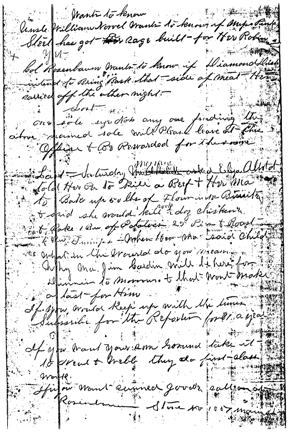
Auburn Reporter, AR, 1881, p. 1

Publication History:

Place of Publication:  Town now defunct.  Sebastian County near Ft. Smith, Arkansas

Frequency: Unknown

Volume and Issue Data:  extant copy: Vol. 1, No. 1, Dec. 30, 1881

Size and Format: 10.5 x 7 inches

Editor/Publisher: Unknown “editress”

Title Changes and Continuation: Unknown

General Description & Notes:

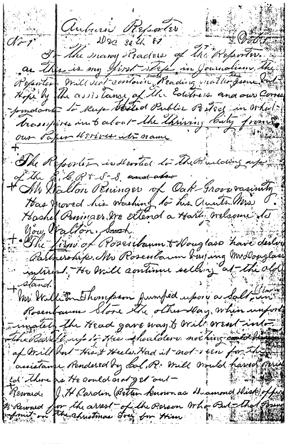
See attached images. One irony in the introductory statement of No. 1, the editor indicates that the paper will keep the “public posted in what transpires in & about the Thriving City from our Paper derives its name” (sic). The town Auburn is now defunct.

Auburn Reporter, AR, 1881, p. 2

The first page includes briefs on the activities of several individuals. The second page’s top story is about a “bad accident on Christmas eve.” The bottom of the page two and all of page three contain more brief anecdotes about individuals. The fourth and last page invites subscribers:

“If you would keep up with the times, Subscribe for the Reporter for $1 a year.”

Information Sources:

Bibliography: None

Auburn Reporter, AR, 1881, p. 4

Locations:  Arkansas Newspaper Project.  Extant copy at Arkansas Historical Commission, Little Rock, AK

Auburn Reporter, AR, 1881, p. 3

Acta Diurna (IT, 59 B.C.-ca. A.D. 222)

Leave a comment

Publication History:

Place of Publication: Rome, Italy (capital of the Roman Empire until its move to Constantinople)

Frequency: Possibly daily

Volume and Issue Data: Beginning 59 B.C. to circa A.D. 222

Size and Format: Variable; handwritten on stone tablets, metal (lead plates), papyrus and/or vellum/parchment, or early bulletin boards

Editor/Publisher:  Unknown, variable

Title Changes and Continuation: None

General Description and Notes:

These are among the earliest examples of a regularly published proto-newspaper.

According to media historian Mitch Stephens, the Acta were one of several early forms of news publication:

Rome had a particularly sophisticated system for circulating written news, centered on the acta — daily handwritten news sheets, which were posted by the government in the Roman Forum from the year 59 B.C. to at least A.D. 222 and which were filled with news of such subjects as political happenings, trials, scandals, military campaigns and executions. China, too, had early government-produced news sheets, called the tipao, which were first circulated among officials during the Han dynasty (202 B.C. to A.D. 221) and were printed at some point during the T’ang dynasty (618 to 906). (Stephens, “History of Newspapers,” for Collier’s Encyclopedia)

Acta Diurna (Latin: Daily Acts sometimes translated as Daily Public Records) were daily Roman official notices, a sort of daily gazette. They were carved on stone or metal and presented in message boards in public places like the Forum of Rome. They were also called simply Acta or Diurna or sometimes Acta Popidi or Acta Publica.

The first form of Acta appeared around 131 B.C. during the Roman Republic. Their original content included results of legal proceedings and outcomes of trials. Later the content was expanded to public notices and announcements and other noteworthy information such as prominent births, marriages and deaths. After a couple of days the notices were taken down and archived (though no intact copy has survived to the present day).

Sometimes scribes made copies of the Acta and sent them to provincial governors for information. Later emperors used them to announce royal or senatorial decrees and events of the court. Tacitus and Suetonius apparently used these Acta as sources of information about the empire’s early emperors in their histories of Rome.

Other forms of Acta were legal, municipal and military notices. Acta Senatus were originally kept secret, until then-consul Julius Caesar made them public in 59 B.C. Later rulers, however, often censored them.

Publication of the Acta Diurna stopped when the seat of the emperor was moved to Constantinople. (From Wikipedia)

Acta Diurna’s state-appointed reporters, called “actuarii,” gathered information on events ranging from wars and legal decisions to births, deaths, and marriages. (From the World Association of Newspapers)

Information Sources:

Bibliography: Leclerc, Des journaux chez les Romains (1838); Renssen, De Diurnis aliisque Romanorum Actis (1857); Hubner, De Senatus Populique Romani Actis (1860); Gaston Boissier, Tacitus and other Roman Studies (Eng. trans., W. G. Hutchison, 1906), pp. 197-229  (From Classic Encyclopedia [11th ed.,  Encyclopedia Britannica, 1911]); C.T. Cruttwell, A History of Roman Literature (1877), pp. 206-207; Mitch Stephens, A History of News (1996); Mitch Stephens, “History of Newspapers,” for Collier’s Encyclopedia.

Locations:  No known genuine extant fragments

Newer Entries