The Chugg Water Journal (WY, 1849)

Leave a comment

Chugg Water Journal (WY, 1849)

[Post updated August 17, 2011; thanks to Andrew Tucker for information about Fort Laramie’s Commanding Officer William Scott Ketchum]

Publication History:

Place of Publication:  Fort Laramie, Wyoming; “office under the hill, but still within hearing of the Juvenile Infirmary, when the wind is favorable” (November 1849, Vol. 1, No. 4)

Volume and Issue Data:  October-December, 1849; “will appear occasionally, and sometimes oftener, if not sooner” (Oct. 1849, Vol. 1, No. 2)

Size and Format:  7.75 x 11.5 inches, two columns, with cursive writing and ink illustration with captions

Editor/Publisher:  “The Quartette”

Title Changes and Continuations:  None

General Description and Notes:

The editors describe the paper as “the largest paper printed at Fort Laramie.” .

According to Andrew Tucker (see bibliography below), William Scott Ketchum, one of the names mentioned in the Journal, was an officer of the 6th Infantry stationed at Fort Gibson and later Fort Laramie. He was the commander at Fort Laramie when the Journal was published.

In the October 1849 issue (Vol. 1, No. 2), a joke mentions Ketchum: “Why is the Commander of the Infantry Company at this Post a terror to evil-doers? ‘Cause he Ketch-um.”

Chugg Water Journal (WY, 1849)

Tucker reports that Ketchum was a West Point grad and served as an Army officer in the Second Seminole War, and had frontier duty at Fort Gibson and Fort Laramie. He went on to become a brigadier general by the end of the Civil War. After he retired, he was allegedly poisoned by Elizabeth Wharton, the widow of one his fellow officers. The trial afterward gained international attention. Wharton was apparently acquitted.

Information Sources:

Bibliography: Michael L. Tate, The Frontier Army in the Settlement of the West (Norman: University of Oklahoma Press, 2001), pp. 264-265; thanks to Andrew Tucker, a relative of William Scott Ketchum, for the citation of the Tate book and the background information about Ketchum (via email exchanges with the HNP editor, August 16-17, 2011)

Links:  Michael L. Tate, The Frontier Army in the Settlement of the West (Norman: University of Oklahoma Press, 2001)pp. 264-265; Library of Congress, Chronicling America: Historic American Newspapers

Locations:  Wyoming Department of Commerce, Division of Parks and Cultural Resources, Historical Research and Publications Unit, Cheyenne, WY (microfilmed)
Charivari (Eng-Aus, 1854)

Leave a comment

Charivari (Eng-Aus, 1854)

Publication History:

Place of Publication:  Shipboard, aboard the Queen of the South, sailing from England to Australia

Frequency:  Unknown

Volume and Issue Data:   Two issues and the beginnings of a third. The first issue is dated 15 April 1854.

Size and Format:  Unknown (see image)

Editor/Publisher:  Charles Lyall (d. 1910?)

Title Changes and Continuation:  None

General Description and Notes:

Charivari (Eng-Aus, 1854)

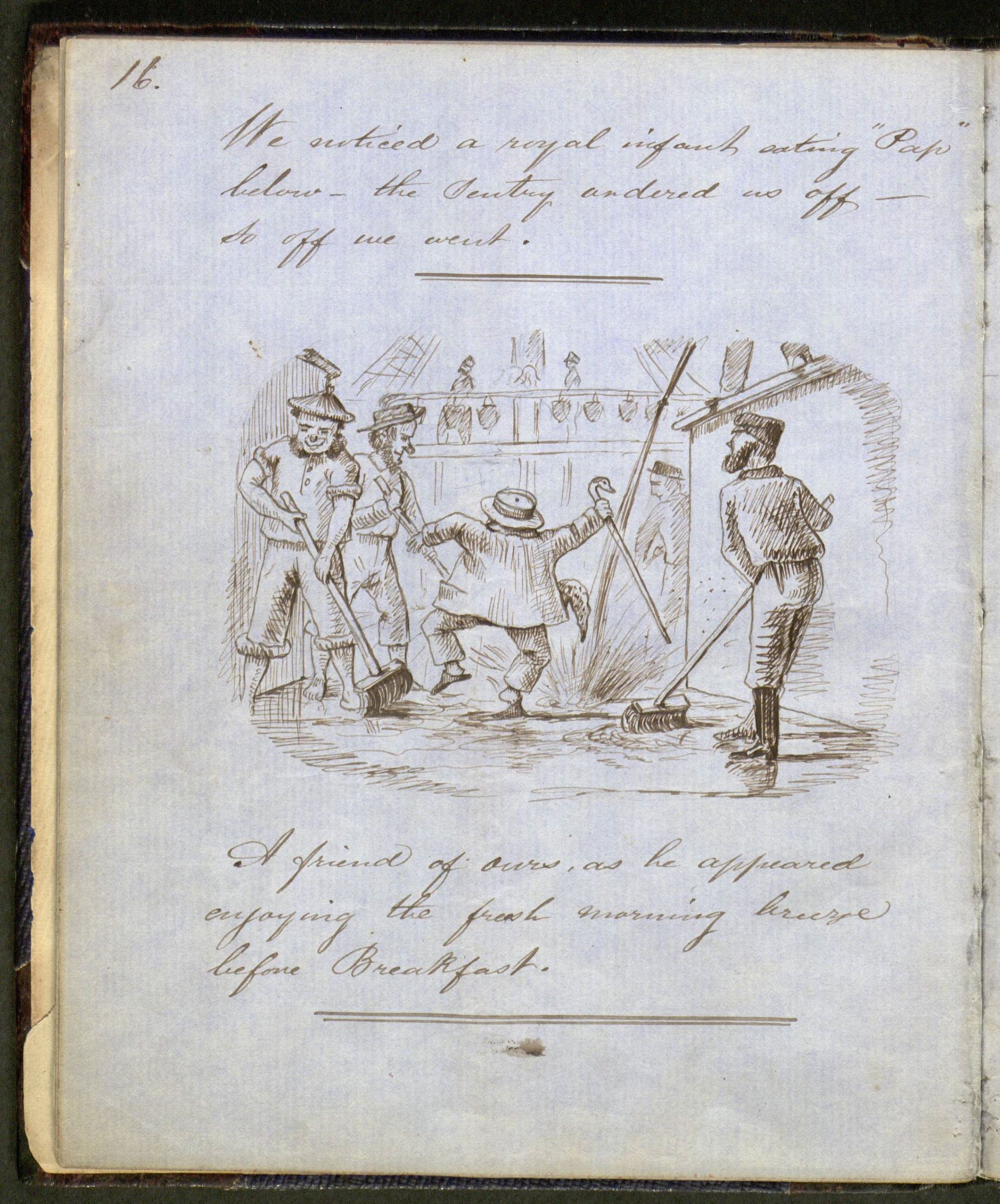
From the State Library of Victoria website: “Shipboard newspaper, written in the style of Punch (the London Charivari) , on board the Queen of the South on a voyage from England to Australia in 1854. Includes a description of the ship’s brief stopover at St. Vincent in the Windward Islands.”

Information Sources:                            

Bibliography:  None?

Locations: State Library of Victoria, accession no(s) MS 12221; MS 9100; accessible, but microfilm (MS 9100, MSM 39) issued instead of the original.

The Casket (NE, 1875)

Leave a comment

The Casket (NE, 1875)

Publication History:

Place of Publication:  Prospect Hill School (District 75), Waverly, Lancaster County, Nebraska

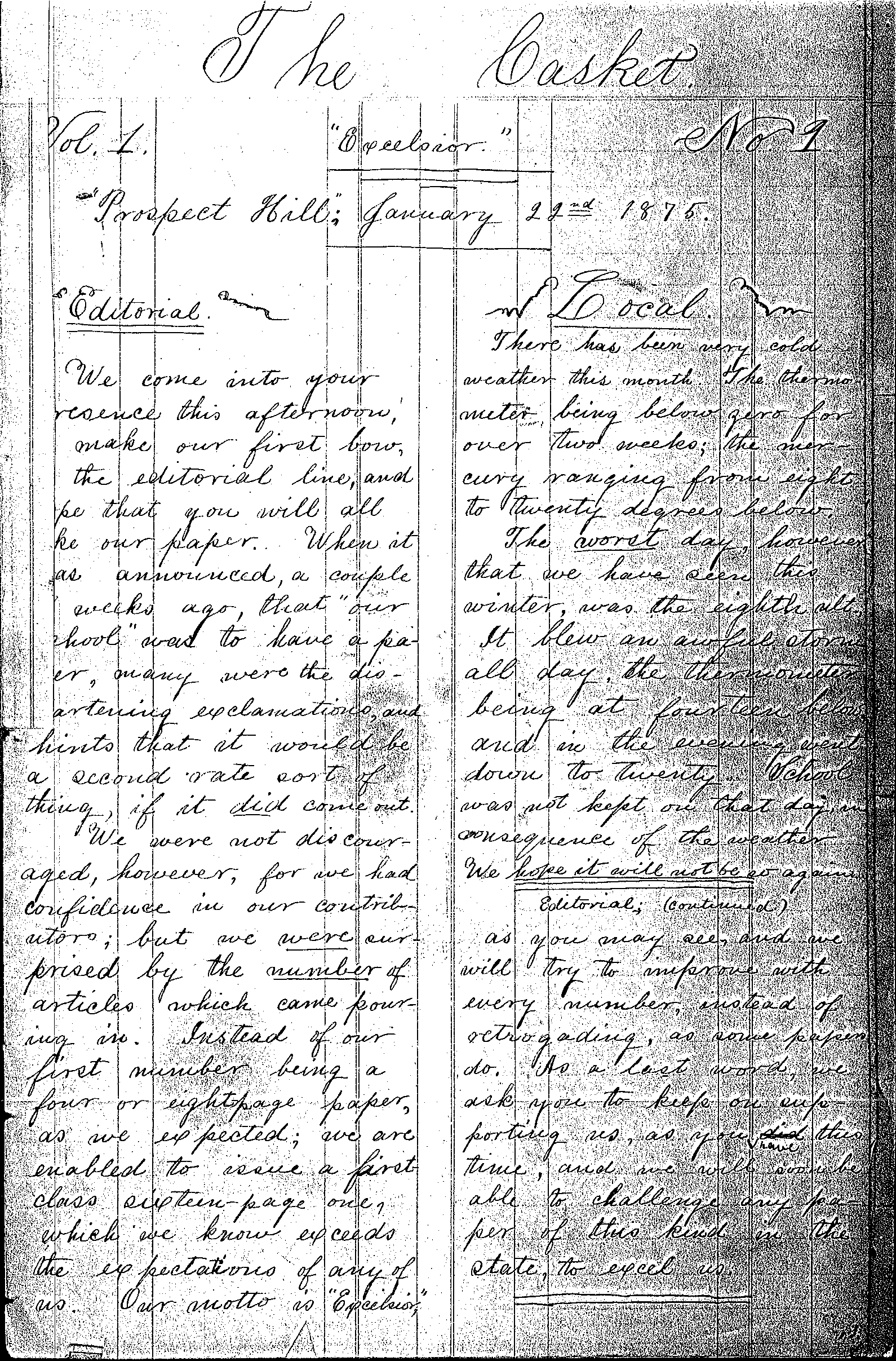
Volume and Issue Data:  Vol.1, No. 1, Jan. 22, 1875

Vol. 1, No. 2, Feb. 19, 1875

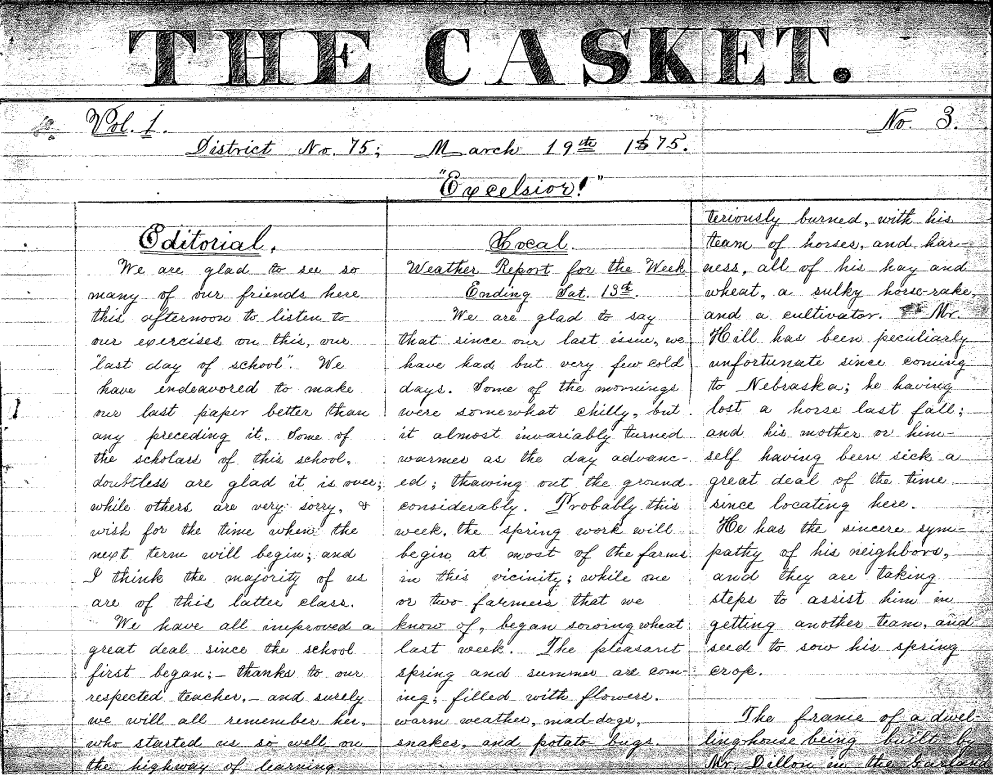
Vol. 1, No. 3, March 19, 1875

Size and Format:  Ledger paper, 7.75 x 12 inches; pen and ink; 2 cols.

Editor/Publisher:  Students, including Charles A. Pierce

Title Changes and Continuations:  See THE EXPERIMENT and WILLOW CREEK JOURNAL may have been precursors to The Casket

General Description & Notes:

The Casket contains short news items, editorials anecdotes and student “compositions.”  The weather apparently was of concern in all three extant numbers because of a bitter cold spell.

The editorial in the first number explains the circumstances of the new publication:

We come into your presence this afternoon, to make our first bow, in the editorial line, and hope that you will take our paper.  When it was announced, a couple of weeks ago, that “our school” was to have a paper, many were the disheartening exclamations, and hints that it would be a second rate sort of thing, if it did come out.

The Casket (NE, 1875)

We were not discouraged, however, for we had confidence in our contributors; but we were surprised by the number of articles which came pouring in.  Instead of our first number being a four or eight page paper, as we expected; we are enabled to issue a first class sixteen-page one, which we know exceeds the expectations of any of us.  Our motto is “Excelisor,” as you may see, and we will try to improve with every number, instead of retrograding, as some papers do.  As a last word, we ask you to keep on supporting use, as you did have this time, and we will soon be able to challenge any paper of this kind in the state, to excel us.

One of the student editors, Charles A. Pierce, was the son of Charles W. Pierce, a civil war veteran, who was transferred to Demopolis, Alabama in 1866 as a major with the Freedman’s Bureau and District commander of western Alabama.  The senior Pierce served one term in the 41st Congress from Alabama’s fourth district in 1867.  I was during this time that his son, Charles A., began his first handwritten newspaper, THE EXPERIMENT, at Oakland Hall, Chunchula, Alabama.  In 1872 the family moved to Waverly, Nebraska, where THE EXPERIMENT, and its successor, WILLOW CREEK JOURNAL were published by Charles A in 1873.  THE CASKET appeared in Nebraska in 1875 as a school effort, no doubt with the help of Charles A.

The Casket (NE, 1875)

Information Sources:

Bibliography:  None

Locations:  Nebraska State Historical Society, State Archives, Lincoln, NB, Charles Pierce papers, Ms. 554

The Camp Ford News (TX, 1865)

Leave a comment

Camp Ford News (TX, 1865)

Publication History:

Place of Publication:  Camp Ford (Confederate Prison Fort), Tyler, Texas

Frequency:  “Only one copy is known to have been printed, this being the issue of May 1, 1865”

Volume and Issue Data:  May 1, 1865 (one issue: Civil War ended the next week)

Size and Format:  One sheet broadside

Editor/Publisher:  Capt. Lewis Burger

Title Changes and Continuation:  None

General Description & Notes:

Like the OLD FLAG and RIGHT FLANKER, this was a paper created to relieve the monotony and trials of prison life during the Civil War.  Only one issue appeared apparently because May 13-17, 1865 marked the end of the Civil War and the abandonment of Camp Ford.

Camp Ford was part of a Confederate prison complex in Tyler and Hempstead, Texas.  The prison held officers and enlisted men from 1863 to the end of war and the prisoners had built their own shelters.  After 1864 and the Red River Campaign, prison crowding and sickness increased, and the general conditions of prison life declined.  It was during these latter days of the War that the paper was produced.

Information Sources:

Bibliography:  F. Lee Lawrence and Robert W. Glover, Camp Ford, C.S.A.:  The Story of Union Prisoners in Texas (Austin, Texas:  Texas Civil War Centennial Advisory Committee, 1964); Mark Boatner, III, The Civil War Dictionary (New York: Random House, 1991).

Locations:  Smith County Historical Society, Texas

The Bumble Bee (LA, 1864)

Leave a comment

Publication History:

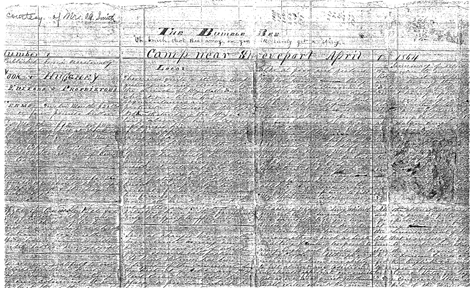
The Bumble Bee, LA, 1864

Place of Publication:  “Camp near Shreveport (LA);” “Office of Bumble Bee for the present will be under the board shelter of Co. ‘E’, which is a very airy and healthy location in dry weather.”

Frequency:  “Semi occasionally” (from No. 1)

Volume and Issue Data: April 1, 1864

Size and Format:  13+ x ? inches

Editor/Publisher:  “Cook & Hu(?)ghey, Editors & Proprietors”

Title Changes and Continuation:  Unknown

General Description & Notes:

This is a handwritten Confederate Army paper published near Shreveport, Louisiana, in 1864. Its motto on first number: “Oh brush that Bee away or you will surely get a sting.” The extant copy (see above) includes “Local” news, anecdotes, and appeals for subscriptions.

Information Sources:

Bibliography: None

Locations: Arkansas History Commission, Little Rock, AR (according to John L. Ferguson, State Historian [letter to HNP editor, June 21, 1993], “I think that we have a few similar little CSA papers on microfilm”).

The Boston News-Letter (MA, 1700-1704)

Leave a comment

Publication History:

Place of Publication:  Boston, Massachusetts

Frequency: Weekly

Volume and Issue Data:  1700-1704; after 1704, the paper was printed

Size and Format: Approximately 6.25 x 10.5 inches

Editor/Publisher: John Campbell, Boston postmaster

Title Changes and Continuation: Boston News-Letter (printed edition beginning 1704)

Boston News-Letter (printed edition, 1704)

General Description & Notes:

The Boston News-Letter is generally regarded as the first “successful” newspaper in the American colonies. From 1704 to 1722, the last date being three years after he retired as postmaster, editor John Campbell produced a printed newsletter. However, for the first four years of the News-Letters’ existence, it was published in handwritten form.

Benjamin Harris’s Publick Occurrences preceded the News-Letter by at least 10 years, but Day’s paper lasted only one issue and was shut down by authorities. As the Campbell’s first printed issue of the News-Letter boldly states, the paper was “Published by Authority.”

Postmaster Campbell used his postal role as to gather information which he published “in the form of a newsletter–the primitive, handwritten report that had been the common medium of communication in Europe before the invention of printing. Most of the information sent out by Campbell was concerned with commercial and governmental matters.”

According to one historian, “There was such a demand for his news letter that Campbell began to look around for some way of relieving the pressure upon his time and energy. He got his brother, Duncan, to help, but even together they could not supply the demand for news. The just couldn’t write longhand fast enough.”

The first printed edition, replacing the handwritten version, appeared on April 24, 1704. “It was called the Boston News-Letter, an appropriate title, since it was merely a continuation of the publication the Campbells had been producing since 1700.”

Source: http://blog.genealogybank.com/a-mystery-from-the-first-handwritten-newspaper-published-in-america.html

Boston News-Letter (Boston, Mass.), 18-25 November 1706, p. 4

Information Sources:

Bibliography: Proceedings of the Massachusetts Historical Society, First Series, March 1867, Volume 9, pp. 485-501 (Nine issues of the News-Letter from 1703 are presented in this collection); Frank Luther Mott, American Journalism: A History of Newspapers in the United States Through 250 Years (New York, 1941); Willard G. Bleyer, Main Currents in the History of American Journalism (New York, 1973); Edwin Emery and Michael Emery,  The Press and America,  Fifth ed.  (Englewood Cliffs, 1984); Wm. David Sloan and Julie Hedgepath Williams, The Early American Press, 1690-1783 (Westport, CT: Greenwood Press, 1994), p.  18; Wm. David Sloan, “John Campbell and the Boston News-Letter,” AEJMC website (2004); Tom Kemp, “A Mystery from the First Handwritten Newspaper in America,” http://blog.genealogybank.com/a-mystery-from-the-first-handwritten-newspaper-published-in-america.html, posted Nov. 20, 2012, accessed Feb. 7, 2013.

Locations:  American Antiquarian Society, Worcester, MA; State Historical Society of Wisconsin, Madison, WI

The Blister (PA, 1921-1927)

Leave a comment

Publication History:

Place of Publication: Gettysburg, PA

Frequency: “Created almost every day when school was in session”

Volume and Issue Data: November 5, 1921-March 29, 1927

Size and Format: Single typewritten and hand-illustrated page

Editor/Publisher: Variable

Title Changes and Continuation: Unknown

The Blister, PA, 1922

General Description & Notes:

Note from Gettysburg College Special Collections Librarian David Hedrick (to HNP editor, June 22, 1993):

The Blister was created almost every day when school was in session. The Blister consisted of a single typewritten page usually containing an ‘Editorial’, some campus news, a couple of jokes, and a hand-drawn cartoon. It seems that only a limited number of copies of each issue were created and at least one copy was always posted on a campus bulletin-board. An almost complete run is maintained in our collections . . . . This publication has been microfilmed, and can be acquired via interlibrary loan.

Information Sources:

Bibliography: Charles Glatfelter, A Salutary Influence: Gettysburg College, 1832-1985 (Gettysburg, 1987).

Locations: Musselman Library, Special Collections, Gettysburg College, Gettysburg, PA

Black Republican and Office-Holder’s Journal (NY, 1865)

Leave a comment

Publication History:

Place of Publication:  New York, New York

Frequency:  Unknown

Volume and Issue Data:  August, 1865

Size and Format:  Last issue 4 pages

Editor/Publisher:  Pluto Jumbo

Title Changes and Continuation: Unknown

General Description and Notes:

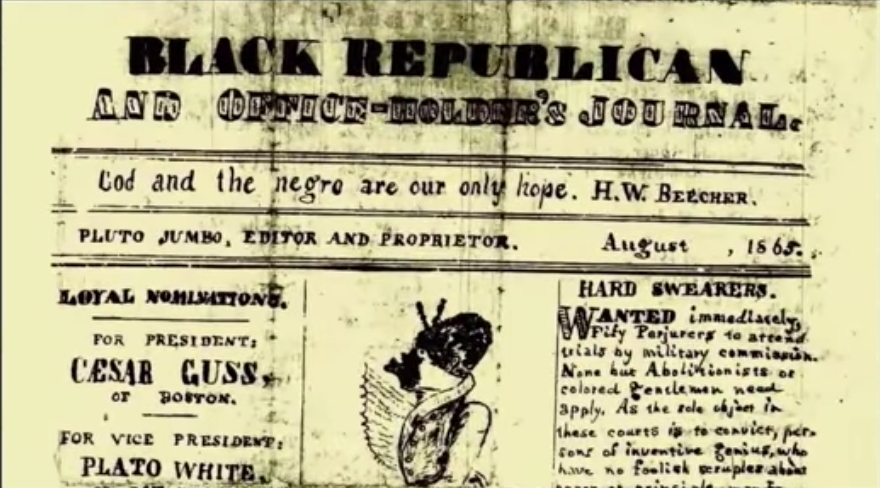
The Library of Congress identifies the handwritten paper as a parody publication. 

  •  “…an entry for the Black Republican and Office-Holder’s Journal, which turns out to be a single-issue parody of black newspapers.”–African American Review.
  • Microfilmed by the Library of Congress for the Committee on Negro Studies of the American Council of Learned Studies.
  • Description based on: Aug. 10, 1865; title from title page.
  • Latest issue consulted: Number 4 (September, 1865); American History, 1493-1945 (online) (viewed February 16, 2018).”

Includes line drawings.

Information Sources:

Bibliography: None

Locations:  Available in microform from DLC (1865). LC card no. sn85-42252.  OCLC no. 12006614, 2611164.  Subject focus and/or Features:  Newspaper.

On microfilm at The State Historical Society of Wisconsin, Madison, WI.

See https://www.loc.gov/item/sn85042252/.

Images of the paper are included in a video on 19th century American journalism.

The Belmont Star (AB, 1889-1890)

Leave a comment

Belmont AB Star (AB, 1889)

Publication History:

Place of Publication: Belmont School, Belmont, AB Canada

Frequency:  Unknown

Volume and Issue Data:  Issues published in February 1889 to May 1890

Size and Format:  Variable

Editor/Publisher:  Albert Fraser, Simon Borwick, et al.

Title Changes and Continuation:  The Star

General Description and Notes:

According to an Edmonton city website, The Star was a handwritten newspaper put together by students of the Belmont School and teacher, James Bond Steele.  The Edmonton Archives have three editions of the newspaper, February 1889, March 1889 and May 1890.  Here is a scan and transcription of the introduction of the first edition:

StarIntroductionv3

The Belmont Star (AB, 1889)

The Belmont Star
Albert Fraser – Editor-in-Chief
Belmont, Alta., Feb’y, 1889

The Star

We present to-day the first number of the Belmont Star. It is started for the instruction [and]amusement of the pupils of Belmont[School]. All the news and other matter in the Star will be made up by the scholars. The school-house was put up in 1882, and the first teacher was Mr. Murphy. The old pupils generally leave in the spring, or at hay-making time, because there is more work then than any other time. Some of them stop a week or two in the autumn. New scholars generally begin in spring or summer. There were a few of the scholars sick for a while. Some didn’t go to school for two weeks; some for about a week. There were five examinations, one in 1885, one in 1886, one in 1887, and two in 1888.

And a transcription of the local news (pictured above):

Local News
Simon Borwick – – Editor

Robins were singing in town on March 2nd.

Henry J. Fraser saw a band of ducks on March 1st.

Rain fell on the 27th of February.

Eggs are 33 1/3 c a dozen, and butter is 40 c a pound.

The weather was fine all the month, with the exception of one week.

There are cracks in the ground 4 5/8 inches wide, and three feet deep.

Prairie fires are raging and have done some damage. Mr. Stedman had his house burnt, and others have lost a good deal of hay.

This has been a very open winter. The coldest day was Friday, Feb’y 22nd. It was 28 degrees below zero.

Some of the pupils were sick in school lately. Others were forced to make some sudden trips outside on account of their noses bleeding.

The ice is melting on the lakes.

Mr. William Rowland’s team ran away on the 26th.

The air has been very smoky lately.

Harry Fulton left scho[ol] on the 1st instant.

The Ducks

The ducks come early in the spring to lay their eggs. They lay them in a bush or by a lake. After she hatches her eggs she loses her feathers and can’t fly till in September. Then all the ducks begin to fly around the country. In the fall they go home to another country and stay till the next spring.

___ Henry J. Fraser

(City of Edmonton Archives volunteer Kathryn Merrett transcribed the Belmont Star stories above.)

Information Sources:

Bibliography: None

Link: http://www.transformingedmonton.ca/index.php/2011/04/20/belmont-school-newspaper-the-star-part-i/

Locations:  Edmonton Archives, Edmonton, AB, Canada

Belgravian Weekly Journal (ENG-AUS, 1866)

Leave a comment

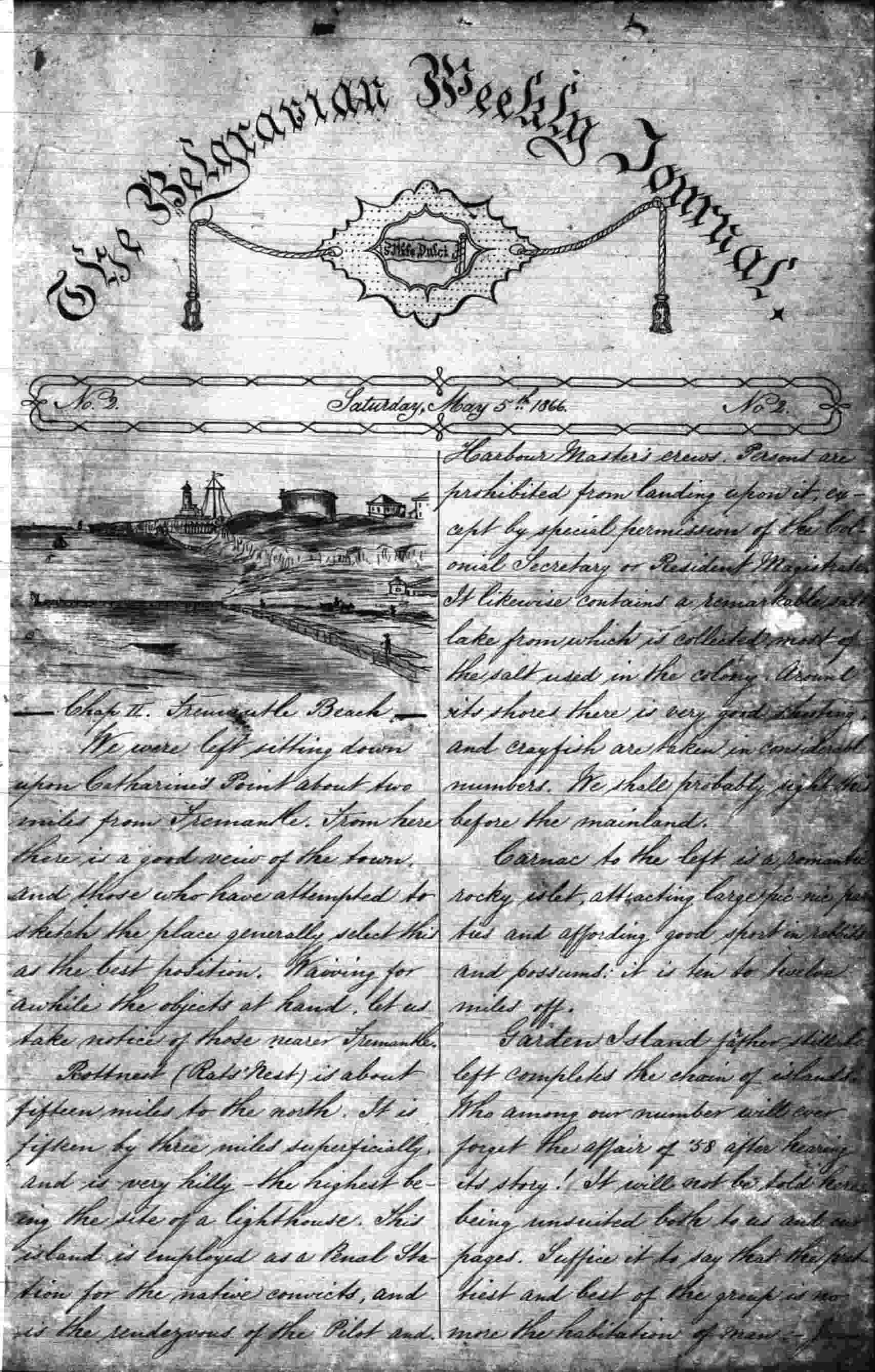
The Belgravian Weekly Journal (Eng-Aus, 1866)

The Belgravian Weekly Journal (Eng-Aus, 1866)

Publication History:

Place of Publication: Aboard the ship Belgravia on its journey from England to Fremantle, Western Australia, with convicts, 28 April 1866-23 June, 1866

Frequency:  Unknown

Volume and Issue Data:  1866

Size and Format:  See image of the front page of No. 2, May 5, 1866

Editor/Publisher:  Unknown

Title Changes and Continuation:  None

General Description and Notes:

Convict shipboard paper en route from England to Western Australia.

Information Sources:                            

Bibliography: William Irvin, Journals on board the convict ships Palmerston, 1861, Belgravia, 28th Apr. 1866-23rd June, 1866 and Norwood, 27th Apr.-6th July, 1867 [microform], reproduction of typescript.

Locations:  State Library of Western Australia; thanks to Annette Delbianco of the SLWA.

The Beehive (UT, 1887-1889)

Leave a comment

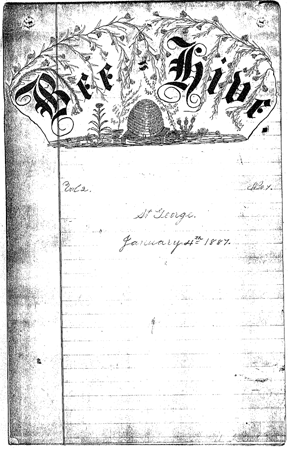
The Beehive, UT, 1887

Publication History:

Place of Publication:  St. George, UT

Frequency:  Unknown

Volume and Issue Data:  Vol. 1, No. 5 and No.8; Vol. 2, No. 1, January 4, 1887; Vol. 2, No.2,  January 15, 1887; Vol. 2,  No. 3; Vol.2, No. 4,  December 20, 1887; Vol. 4, No. 2,  Feb 15, 1887; Vol. 4, No. 5, April 10,1888; Vol. 5, No. 12,  March 12,1889; Vol 7, No.2; Vol.? No.8

Size and Format:  Legal/ledger size lined pages, one column

Editor/Publisher:  Belle McArthur (March 12, 1889), Julie Macdonald (Vol. 2, No. 4, 1887), Miss F. DeFriez (Vol. 4, No. 5, April 10, 1888)

Title Changes and Continuation: None

The Beehive, UT, 1887

General Description & Notes:

This was a Mormon Ladies Improvement Society publication. Multiple extant copies of The Beehive are in various states of readability. Most issues have an illustrated masthead, but otherwise blank title page. The stories are in neat cursive writing on lined ledger paper

Information Sources:

Bibliography: None

Locations:  Utah State Historical Society, Mss A 1053

The Beehive, UT, Vol. 2, No. 3, N.D.

Auburn Reporter (AR, 1881)

Leave a comment

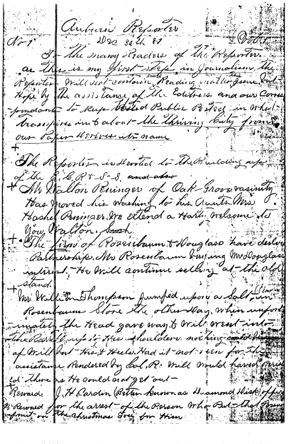
Auburn Reporter, AR, 1881, p. 1

Publication History:

Place of Publication:  Town now defunct.  Sebastian County near Ft. Smith, Arkansas

Frequency: Unknown

Volume and Issue Data:  extant copy: Vol. 1, No. 1, Dec. 30, 1881

Size and Format: 10.5 x 7 inches

Editor/Publisher: Unknown “editress”

Title Changes and Continuation: Unknown

General Description & Notes:

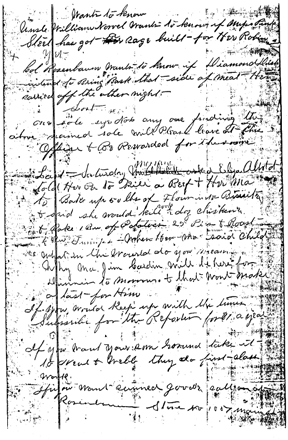
See attached images. One irony in the introductory statement of No. 1, the editor indicates that the paper will keep the “public posted in what transpires in & about the Thriving City from our Paper derives its name” (sic). The town Auburn is now defunct.

Auburn Reporter, AR, 1881, p. 2

The first page includes briefs on the activities of several individuals. The second page’s top story is about a “bad accident on Christmas eve.” The bottom of the page two and all of page three contain more brief anecdotes about individuals. The fourth and last page invites subscribers:

“If you would keep up with the times, Subscribe for the Reporter for $1 a year.”

Information Sources:

Bibliography: None

Auburn Reporter, AR, 1881, p. 4

Locations:  Arkansas Newspaper Project.  Extant copy at Arkansas Historical Commission, Little Rock, AK

Auburn Reporter, AR, 1881, p. 3

The Algona Bee (IA, 1857-1858)

Leave a comment

The Algona Bee (IA, 1858)

Publication History:

Place of Publication:  Algona (Kossuth County), Iowa (ca. 1857-1858)

Frequency:  Weekly; irregular

Volume and Issue Data:  Vol. 1, No. 1, Dec. 21, 1857 (note:  another date, Jan. 8th, 1858 is marked out above the Dec. 21 entry)

Size and Format:  8 1/2 x 11 inches; two columns

Editor/Publisher:  Franklin McCoy; Algona Reading Club (et al.?)

Title Changes and Continuation:  Unknown

General Description & Notes:

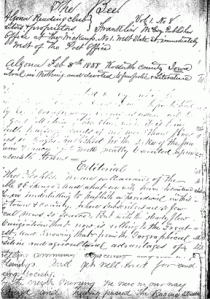
The Bee was apparently produced by the Algona Reading Club, identified as editors and proprietors (see Vol. 1, No. 8, Feb. 8, 1858).  This number lists the paper’s office at “the wickeup No. 1 West State St. immediately West of the Post Office,” and identifies Franklin McCoy as “publisher.”  However, other pages (many of which are almost illegible) mention an “editress.”

The paper contains poetry, anecdotes, editorials and short story items.  The clear difference in handwriting style and script size between the numbers suggests at least two different writers were responsible for the paper’s production.  The first issue opens with the following introductory editorial:

“We are happy to present to our friends this first number of ‘The Bee’ as the first paper published in this ‘little world of Algona,’ and tho [sic] now small and may-be insignificant in the eyes of many–still we have sanguine hopes that it will thrive–and before many years stand the first and oldest among our village papers.  A person when first starting in an enterprise like this feels rather delicately.  Many fears arise wether [sic] the paper will suit the readers.  Knowing there are as many minds as persons and also knowing, that unless all these minds are satisfied, we are the losers, we feel still more anxiety than we would otherwise.

“The Bee is intended to be strictly a neutral paper.  We shall strive to please all by offending none.  It will abound in wit and humor–be graced with sound intellectual studies and pleasing stories–have all the news of the day–we hope none of the gossip [original emphasis].  We have able correspondents for the Bee who will favour it with their productions from time to time.  A few advertisements will be inserted just to help pay expenses.  We have tried to tell you imperfectly however what we shall strive to make the Bee, and we humbly beg our friends to stand by us and not allow it to sink into obscurity as the paper in our neighboring community has done.”

The Feb. 8, 1858 issue says, “The Bee is published weekly, but if the stories do not improve soon it will be published only Semi Occasionally.”  The editor also notes that “Business cards of not more than five lines in length published for the sake of the fun, flair and fancy.  Job work neatly executed upon reasonable terms.”

Information Sources:

Bibliography:  None

Locations:  Harvey Ingham Papers, Vol. 2, Box 2, Iowa State Historical Society, Des Moines, IA

————————————————————

The Advocate (ID, 1879)

Leave a comment

The Advocate (ID, 1879)

Publication History:

Place of Publication:  Placerville, Granite Creek, Boise City, Baker City and Idaho City, Idaho

Frequency:   Unknown

Volume and Issue Data:  May 16, 1879

Size and Format:  8 x 13 inches; one column

Editor/Publisher:  Thomas Haney, editor and manager; other editors listed on title page from respective towns (see below); P.D. Rothwell, teacher

Title Changes and Continuation:  Unknown

General Description & Notes:

This school newspaper consisted of a series of student essays.  It is unclear how the paper was organized or produced, but several student editors from various towns in southern Idaho apparently contributed materials of their own or from students residing in these locales.

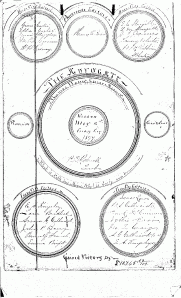
The title page-cover is illustrated with a series of nine circles, each filled with the names of the editors/authors, or place names.  The motto of the paper reads, “What is Noble in Man, What is Lovely in Woman.”

The editors from the different schools represented are identified on the title-front page inside circles drawings:

Boise City Editors: Carrie Cartio, Ella Cartio, James Allington, M.B. Givinns(?), A.H. Redway
Placerville Editors: H(?) O’Brien
Baker City Editors: E.L. Sturjill, L.M. Sturjill, J.F. James, Fanny White, M.M. Robbins, A.B. Carter
Idaho City Editors (L): E.A. Kingsley, Lena Broadbeck, Anna G. Galbraith, John P. Barry, Peniel French, Emma Bright
Idaho City Editors (R): Gage Lewis, W.S. Galbraith, Frank McGuinness, Nellie Davis, Jn. E. Craig, A.G. Galbraith (2nd), E.A. Kingsley (2nd).

In one extant essay, “Our School,” a student author notes that the school had desks for 13 students.  The building is described as “very old” and “very dirty.”  “This school house is a very dirty one, the more you scrub it the dirtier it looks.” Even the stove was deemed “very old.”  Despite that, Hannora Halley, the author of the essay, writes “I would rather go to school than to stay home.” She does not identify the locations of her school or home.

Information Sources:

Bibliography:  None

Locations:  Library and Archives, Idaho State Historical Society, Boise, ID

————————————————————

Newer Entries