See The Rebel
The (Carolina) Rebel (SC, 1863)
June 20, 2011
1863, Alphabetical Order, C, South Carolina, United States, US Civil War-Era Papers Leave a comment
The Camp Ford News (TX, 1865)
June 20, 2011
1865, Alphabetical Order, C, Images, Prison Papers, Texas, United States, US Civil War-Era Papers Leave a comment

Camp Ford News (TX, 1865)
Publication History:
Place of Publication: Camp Ford (Confederate Prison Fort), Tyler, Texas
Frequency: “Only one copy is known to have been printed, this being the issue of May 1, 1865”
Volume and Issue Data: May 1, 1865 (one issue: Civil War ended the next week)
Size and Format: One sheet broadside
Editor/Publisher: Capt. Lewis Burger
Title Changes and Continuation: None
General Description & Notes:
Like the OLD FLAG and RIGHT FLANKER, this was a paper created to relieve the monotony and trials of prison life during the Civil War. Only one issue appeared apparently because May 13-17, 1865 marked the end of the Civil War and the abandonment of Camp Ford.
Camp Ford was part of a Confederate prison complex in Tyler and Hempstead, Texas. The prison held officers and enlisted men from 1863 to the end of war and the prisoners had built their own shelters. After 1864 and the Red River Campaign, prison crowding and sickness increased, and the general conditions of prison life declined. It was during these latter days of the War that the paper was produced.
Information Sources:
Bibliography: F. Lee Lawrence and Robert W. Glover, Camp Ford, C.S.A.: The Story of Union Prisoners in Texas (Austin, Texas: Texas Civil War Centennial Advisory Committee, 1964); Mark Boatner, III, The Civil War Dictionary (New York: Random House, 1991).
Locations: Smith County Historical Society, Texas
The Cactus (UT, 1878?-1884)
June 20, 2011
1878, Alphabetical Order, C, Frontier Papers, Humor Papers, United States, Utah Leave a comment
Publication History:
Place of Publication: Panguitch, Garfield County, Utah (1878? 1880?-1884)
Frequency: Irregular, “when the spirit moved”
Volume and Issue Data: Started 1878 or 1879 and published until about 1884
Size and Format: 8 x 10 inches, four pages
Editor/Publisher: John M. Dunning, editor and publisher; James T. Daly, Sr., correspondent or writer
Title Changes and Continuation: Garfield County News, The Recorder, The Register
General Description & Notes:
The paper was first called the Cactus, but the name was changed, possibly, to the Garfield County News, The Recorder, and/or The Register. The paper was not issued regularly but “when the spirit moved.”
According to Alter, editor Dunning was said to have been a humorist and prepared his own jokes for fillers. Many of his poems and other writings also appeared in the Cactus. Says Alter, “It may have been a manuscript, pen-and-ink newspaper.”
Alter notes that “the Manti Home Sentinel mentions March 26, 1886 as being: ‘among our latest exchanges:’ though the echang practice was so universal it is more than likely the Register was just beginning when it received this notice.”
According Lucy Hatch, a member of the Panguitch Daughters of the Utah Pioneers, Dunning published the first newspaper in the town “from about 1880 to 1884” and that Daly was a correspondent or writer.
Information Sources:
Bibliography: J. Cecil Alter, Early Utah Journalism (Salt Lake City: Utah Historical Society, 1938), p. 180
Locations: No issues located
See also the Panguitch Register
The Butterfly (IL, early 20th century)
June 20, 2011
Alphabetical Order, B, Illinois, No Date, Organization Newspapers, United States Leave a comment
Publication History:
Place of Publication: Chicago(?), Illinois
Frequency: “Several volumes”
Volume and Issue Data: Early 20th century
Size and Format: Unknown
Editor/Publisher: Members of the Butterfly Society
Title Changes and Continuation: Unknown
General Description and Notes:
The Butterfly is an aesthetic journal published by the Butterfly Society in the early part of this century. The first two volumes are completely handwritten as well as illustrated. Later issues were hand typed.
Information Sources:
Bibliography: None
Locations: The Chicago Public Library, Special Collections, Harold Washington Library Center, Chicago, IL
The Bumble Bee (LA, 1864)
June 20, 2011
1864, Alphabetical Order, B, Images, Louisiana, Military Papers, United States, US Civil War-Era Papers Leave a comment
Publication History:
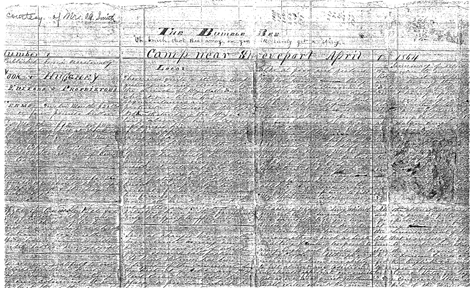
The Bumble Bee, LA, 1864
Place of Publication: “Camp near Shreveport (LA);” “Office of Bumble Bee for the present will be under the board shelter of Co. ‘E’, which is a very airy and healthy location in dry weather.”
Frequency: “Semi occasionally” (from No. 1)
Volume and Issue Data: April 1, 1864
Size and Format: 13+ x ? inches
Editor/Publisher: “Cook & Hu(?)ghey, Editors & Proprietors”
Title Changes and Continuation: Unknown
General Description & Notes:
This is a handwritten Confederate Army paper published near Shreveport, Louisiana, in 1864. Its motto on first number: “Oh brush that Bee away or you will surely get a sting.” The extant copy (see above) includes “Local” news, anecdotes, and appeals for subscriptions.
Information Sources:
Bibliography: None
Locations: Arkansas History Commission, Little Rock, AR (according to John L. Ferguson, State Historian [letter to HNP editor, June 21, 1993], “I think that we have a few similar little CSA papers on microfilm”).
Bum Hill Gazette (CA, 1906)
June 20, 2011
1906, Alphabetical Order, B, California, Children Papers, Community Papers, Emergency-Disaster Response Papers, United States Leave a comment
Publication History:
Place of Publication: San Francisco, California
Frequency: Two issues
Volume and Issue Data: May [no day], and May 23, both 1906
Size and Format: 56-60 x 42 cm.; May (no date) May 23 issue is 2 pp.; “three folio leaves”; pen and ink; illustrated with watercolor
Editor/Publisher: Published by “Prowlers of Ashbarrel Street, New San Francisco;” compiled, written and illustrated by Hazel Snell; also edited by “U.R.A. Bum, I.B.A. Tramp”
Title Changes and Continuation: None
General Description & Notes:
Two issues of a newspaper edited by Hazel Snell (Holmes), San Francisco, were donated to the Bancroft Library by the editor. In her own undated description of the Gazette, which accompanied the donation, Ms. Holmes writes:
“Three folio leaves compiled, written and illustrated by Snell as a neighborhood paper, residing with her parents on Ashbury Street between Hayes and Fell near the pan-handle of Golden Gate Park. Some of the humorous jibes were contributed by William Jones Hanlon, now a retired Colonel of the U.S. Air Force. As far as known, first amateur paper issued after earthquake and fire in San Francisco on April 18, 1906.”
The first number which was dated “May, 1906,” contained sections on business, society, poetry, and local news, and includes want ads and advertisements. The two-page second number, dated “May 23, 1906,” noted:
“Editors: U.R.A. Bum, I.B.A. Tramp. Published any old time. Sub. Price–six doughnut holes on a toothpick. When your subscription expires–call an undertaker. Price per copy–a can of corn bread.”
The motto of the paper, as indicated in the second issue was, “To see ourselves as others saw us.” The second issue also announced on page one:
“The editors wish to inform the general public that a third and last Edition of the B.H.G. will be published and for the suckers of the same they will depend on the reports of the citizens of this street. The names of reporters will not be mentioned.
“Kindly place reports in hands of Editors.
“The painting at head of the edition is the reproduction of the famous masterpiece rescued from Hopkins Art Institute during the ‘grate’ fire.”
The editor also claimed, “The first edition of the B.H.G. was probably the most elaborate publication since the earthquake. It was encased in a beautiful gold and silver frame and given a warm reception in St. Nick’s Kitchen, evidently keeping its circulation in a good condition.”
Information Sources:
Bibliography: None
Locations: University of California, Berkeley Bancroft Library manuscripts collection, C-II 81.
Bugle (NV, 1880)
June 20, 2011
1880, Alphabetical Order, B, Children Papers, Frontier Papers, Nevada, United States Leave a comment
Publication History:
Place of Publication: Junctionville (also known as Bonelli’s Ferry), Nevada
Frequency: Weekly
Volume and Issue Data: c. Feb. 1880-c. 1880
Size and Format: Written on letter sheets
Editor/Publisher: Leonard Bonelli, Bugle Publishing Co.
Title Changes and Continuation: None
General Description & Notes:
The Pioche Record, Feb. 28, 1880, reports that the Bugle was a weekly written on letter sheets by the ferryman’s son, Leonard Bonelli, who lists himself as the editor and the Bugle Publishing Co. as publisher.
Information Sources:
Bibliography: Pioche Record, Feb. 28, 1880; Lingenfelter and Gash, The Newspapers of Nevada (Reno: University of Nevada Press, 1984), p. 123.
Locations: No extant issues located
Bow and Arrow (MI, 1833)
June 20, 2011
1833, Alphabetical Order, B, Frontier Papers, Michigan, United States Leave a comment
Publication History:
Place of Publication: Michilimackinac, Michigan (1833)
Frequency: Unknown
Volume and Issue Data: No. 2, Oct. 1, 1833
Size and Format: Unknown
Editor/Publisher: Henry Rowe Schoolcraft (1833)
Title Changes and Continuations: None
General Description & Notes:
According to Littlefield and Parins, The Bow and Arrow was a manuscript magazine devoted to Indian life, history, opinion, and names. This was editor Schoolcraft’s third handwritten publication, the first being a literary magaznie published from 1809 to 1818 and the second being The Muzzinyegun or Literary Voyager (1826-1827) published in Sault Ste. Marie, Mich. The Oct. 1, 1833 issue of the Bow and Arrow contained an article entitled “The Indian” dealing with stereotypes and characteristics of the American Indian.
Information Sources:
Bibliography: Vernon Kinietz, “Schoolcraft’s Manuscript Magazines,” Bibliographical Society of America Papers, 35 (April-June, 1941), 151-154. Indexed in David F. Littlefield, Jr. and James W. Parins, American Indian and Alaska Native Newspapers and Periodicals, 1826-1924 (Westport, Conn.: Greenwood Press, 1984), 44.
Locations: DLC
The Boston News-Letter (MA, 1700-1704)
June 20, 2011
1700, Alphabetical Order, B, Colonial Papers, Images, Massachusetts, United States Leave a comment
Publication History:
Place of Publication: Boston, Massachusetts
Frequency: Weekly
Volume and Issue Data: 1700-1704; after 1704, the paper was printed
Size and Format: Approximately 6.25 x 10.5 inches
Editor/Publisher: John Campbell, Boston postmaster
Title Changes and Continuation: Boston News-Letter (printed edition beginning 1704)

Boston News-Letter (printed edition, 1704)
General Description & Notes:
The Boston News-Letter is generally regarded as the first “successful” newspaper in the American colonies. From 1704 to 1722, the last date being three years after he retired as postmaster, editor John Campbell produced a printed newsletter. However, for the first four years of the News-Letters’ existence, it was published in handwritten form.
Benjamin Harris’s Publick Occurrences preceded the News-Letter by at least 10 years, but Day’s paper lasted only one issue and was shut down by authorities. As the Campbell’s first printed issue of the News-Letter boldly states, the paper was “Published by Authority.”
Postmaster Campbell used his postal role as to gather information which he published “in the form of a newsletter–the primitive, handwritten report that had been the common medium of communication in Europe before the invention of printing. Most of the information sent out by Campbell was concerned with commercial and governmental matters.”
According to one historian, “There was such a demand for his news letter that Campbell began to look around for some way of relieving the pressure upon his time and energy. He got his brother, Duncan, to help, but even together they could not supply the demand for news. The just couldn’t write longhand fast enough.”
The first printed edition, replacing the handwritten version, appeared on April 24, 1704. “It was called the Boston News-Letter, an appropriate title, since it was merely a continuation of the publication the Campbells had been producing since 1700.”

Boston News-Letter (Boston, Mass.), 18-25 November 1706, p. 4
Information Sources:
Bibliography: Proceedings of the Massachusetts Historical Society, First Series, March 1867, Volume 9, pp. 485-501 (Nine issues of the News-Letter from 1703 are presented in this collection); Frank Luther Mott, American Journalism: A History of Newspapers in the United States Through 250 Years (New York, 1941); Willard G. Bleyer, Main Currents in the History of American Journalism (New York, 1973); Edwin Emery and Michael Emery, The Press and America, Fifth ed. (Englewood Cliffs, 1984); Wm. David Sloan and Julie Hedgepath Williams, The Early American Press, 1690-1783 (Westport, CT: Greenwood Press, 1994), p. 18; Wm. David Sloan, “John Campbell and the Boston News-Letter,” AEJMC website (2004); Tom Kemp, “A Mystery from the First Handwritten Newspaper in America,” http://blog.genealogybank.com/a-mystery-from-the-first-handwritten-newspaper-published-in-america.html, posted Nov. 20, 2012, accessed Feb. 7, 2013.
Locations: American Antiquarian Society, Worcester, MA; State Historical Society of Wisconsin, Madison, WI
The Bomb Shell (MN, 1854)
June 20, 2011
1854, Alphabetical Order, B, Minnesota, Uncategorized, United States Leave a comment
Publication History:
Place of Publication: Fort Ripley(?), Minnesota
Frequency: Unknown
Volume and Issue Data: 1854
Size and Format: Unknown; may be printed “from type carved by hand.”
Editor/Publisher: Unknown
Title Changes and Continuation: Unknown
General Description & Notes:
“The paper is pictured on the end papers as well as contained in the unpaginated illustrations portion.” (quote from Danky letter to HNP editor, June 21, 1993). This could refer to the book by George S. Hage, Newspapers on the Minnesota Frontier, 1849-1860.
Information Sources:
Bibliography: Referred to in George S. Hage’s book Newspapers on the Minnesota Frontier, 1849-1860, and presumably copies were used inside the cover.
Locations: Information came from James Danky, Newspapers and Periodicals Librarian at the State Historical Society of Wisconsin, Madison, WI.
The Blister (PA, 1921-1927)
June 20, 2011
1921, Alphabetical Order, B, Images, Pennsylvania, School Newspapers, United States Leave a comment
Publication History:
Place of Publication: Gettysburg, PA
Frequency: “Created almost every day when school was in session”
Volume and Issue Data: November 5, 1921-March 29, 1927
Size and Format: Single typewritten and hand-illustrated page
Editor/Publisher: Variable
Title Changes and Continuation: Unknown

The Blister, PA, 1922
General Description & Notes:
Note from Gettysburg College Special Collections Librarian David Hedrick (to HNP editor, June 22, 1993):
The Blister was created almost every day when school was in session. The Blister consisted of a single typewritten page usually containing an ‘Editorial’, some campus news, a couple of jokes, and a hand-drawn cartoon. It seems that only a limited number of copies of each issue were created and at least one copy was always posted on a campus bulletin-board. An almost complete run is maintained in our collections . . . . This publication has been microfilmed, and can be acquired via interlibrary loan.
Information Sources:
Bibliography: Charles Glatfelter, A Salutary Influence: Gettysburg College, 1832-1985 (Gettysburg, 1987).
Locations: Musselman Library, Special Collections, Gettysburg College, Gettysburg, PA
Black Republican and Office-Holder’s Journal (NY, 1865)
June 20, 2011
1865, Alphabetical Order, B, Humor Papers, Images, Louisiana, New York, Organization Newspapers, Political Papers, Satire Papers, United States, US Civil War-Era Papers Leave a comment
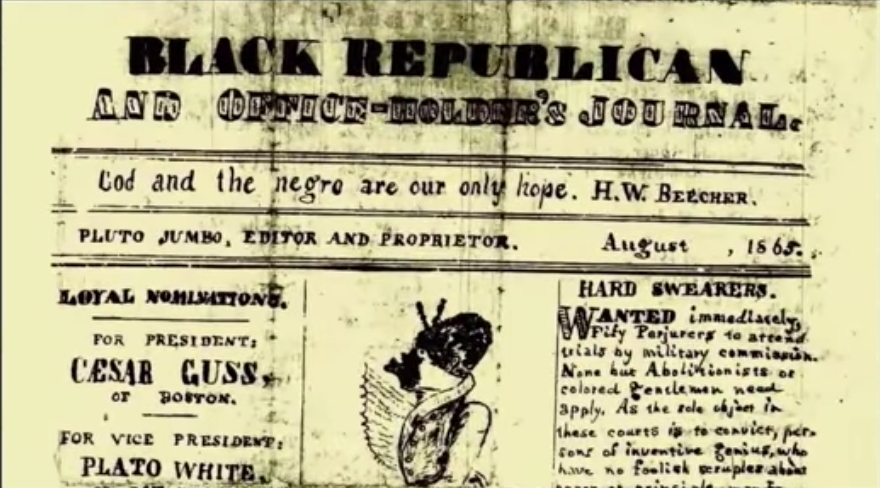
Publication History:
Place of Publication: New York, New York
Frequency: Unknown
Volume and Issue Data: August, 1865
Size and Format: Last issue 4 pages
Editor/Publisher: Pluto Jumbo
Title Changes and Continuation: Unknown
General Description and Notes:
The Library of Congress identifies the handwritten paper as a parody publication.
- “…an entry for the Black Republican and Office-Holder’s Journal, which turns out to be a single-issue parody of black newspapers.”–African American Review.
- Microfilmed by the Library of Congress for the Committee on Negro Studies of the American Council of Learned Studies.
- Description based on: Aug. 10, 1865; title from title page.
- Latest issue consulted: Number 4 (September, 1865); American History, 1493-1945 (online) (viewed February 16, 2018).”
Includes line drawings.
Information Sources:
Bibliography: None
Locations: Available in microform from DLC (1865). LC card no. sn85-42252. OCLC no. 12006614, 2611164. Subject focus and/or Features: Newspaper.
On microfilm at The State Historical Society of Wisconsin, Madison, WI.
See https://www.loc.gov/item/sn85042252/.
Images of the paper are included in a video on 19th century American journalism.
The Black Fly (MI, 1913-1915)
June 20, 2011
1913, Alphabetical Order, B, Michigan, School Newspapers, United States Leave a comment
Publication History:
Place of Publication: Douglas Lake, Michigan
Frequency: Irregular
Volume and Issue Data: July and August, 1913-1915
Size and Format: Unknown
Editor/Publisher: Student surveyors at surveying camp, Douglas Lake, Michigan
Title Changes and Continuation: Unknown
General Description & Notes:
This paper is listed as a “printed holding”, but may still be relevant–perhaps it is partial manuscript.
Information Sources:
Bibliography: Floyd Streeter, Michigan Bibliography (Michigan Historical Commission, 1921), p. 42 (entry 380):
“The black fly, v. 2-4. Camp Davis, Mich., 1913-1915. U.
Published irregularly during July and August at the University of Michigan surveying camp at Douglas Lake, Mich.”
Locations: Bentley Historical Library, University of Michigan, Ann Arbor, MI
Big Injun (TX, 1866, 1869)
June 20, 2011
1866, 1869, Alphabetical Order, B, Frontier Papers, Military Papers, Texas, United States Leave a comment
Publication History:
Place of Publication: Fort Belknap, Texas
Frequency: Unknown
Volume and Issue Data: Published sometime between 1866 and 1869.
Size and Format: Unknown
Editor/Publisher: H.H. McConnell
Title Changes and Continuation: Same editor/publisher produced LITTLE JOKER at Jacksboro, Texas, prior to his transfer to Fort Belknap. After creating BIG INJUN, he was transfered again a short distance to Fort Buffalo and “again broke forth” with THE GRASSHOPPER.
General Description & Notes:
According to Whisenhunt, the Jacksboro area had no fewer than four newspapers between 1866 and 1869, although only one was printed. The editor of all four was H.H. McConnell, a soldier first assigned to Jacksboro, Texas in 1866. McConnell recounts his journalistic efforts and military experience on the Texas frontier in the Reconstruction period in his autobiography, Five Years a Cavalryman.
Shortly after he arrived in Jacksboro, McConnell and other soldiers published a weekly newspaper, LITTLE JOKER, on foolscap. The paper circulated among the soldiers at Jacksboro. The Jacksboro post was temporarily abandoned by the military, and the LITTLE JOKER “was ignominiously packed on a Quartermaster’s hourse and moved to Fort Belknap.”
At Fort Belknap soon issued another handwritten paper, BIG INJUN, intended for a military audience. According to McConnell, “Here the genius of the editor again broke forth, and the ‘Big Injun’ for a time shed an undying lustre on the literature of the nineteenth century.” The paper was short-lived: “Like a meteor flashing along the midnight sky–brilliant for a moment, then rendering the darkness more intense–so the ‘Big Injun’ ran its course.”
McConnell’s transfer to nearby Fort Buffalo Springs marked the publication of his third handwritten, THE GRASSHOPPER. Like its predecessors, THE GRASSHOPPER was short-lived. Fort Buffalo Springs was soon abandoned for the more strategic Jacksboro post.
McConnell was finally reassigned to Fort Richardson where he contracted with a Weatherford, Tex. printer to publish The Flea. This, his first printed newspaper, appeared Feb. 1, 1869, but lasted only six issues, until June 15, 1869.
According the Whisenut, McConnell’s handwritten papers did little more than provide diversion for the soldiers at their respective military posts, but “this was important. Their very existence also impolies that the life of the frontier soldier was mostly a monotonous existence despite the legend and aura of romance that surrounds the United States Cavalry.”
Information Sources:
Bibliography: H.H. McConnell, Five Years a Cavalryman (Jacksboro, Texas: J.N. Rogers and Co., 1889), p. 174; Donald W. Whisenhunt, “The Frontier Newspaper: A Guide to Society and Culture,” Journalism Quarterly, 45:4 (Winter 1968), 727; see also Theronne Thompson, “Fort Buffalo Springs, Texas, Border Post,” West Texas Historical Association Yearbook, 36:168 (October 1960).
Locations: None
Big Elk Budget (MT, 1890)
June 20, 2011
1890, Alphabetical Order, B, Community Papers, Montana, United States Leave a comment
Publication History:
Place of Publication: Big Elk (Wheatland), Montana
Frequency: Unknown
Volume and Issue Data: Vol. 1, No. 1, January 30, 1890 (1890-189?)
Size and Format: Unknown
Editor/Publisher: J.A. Crouse
Title Changes and Continuation: None
General Description and Notes:
Available on microfilm from Montana Historical Society. Hand-written.
Information Sources:
Bibliography: None
Links: http://chroniclingamerica.loc.gov/lccn/sn84036020/
Locations: Montana Historical Society Library, Helena, MT
Beltionian Review (IL, 1857-?)
June 20, 2011
1857, Alphabetical Order, B, Illinois, Organization Newspapers, United States Leave a comment
Publication History:
Place of Publication: Wheaton College, Wheaton, Illinois
Frequency: Unknown
Volume and Issue Data: 4 years of copies (no dates given)
Size and Format: Unknown
Editor/Publisher: Beltionian Literary Society
Title Changes and Continuation: “Sister” publication The Evening Star (produced by the Student Lyceum League, Wheaton College); extant copy: Vol. 1, No. 3.
General Description & Notes:
The Beltionian Literary Society located at Wheaton College, was preceded by the Student Lyceum League. The Society was established in 1857 and functioned until 1958.
Information Sources:
Bibliography: None
Locations: http://a2z.my.wheaton.edu/literary-societies/beltionian-literary-society; Special Collections, Wheaton College Archives, Wheaton, IL
The Beehive (UT, 1887-1889)
June 20, 2011
1887, 1888, Alphabetical Order, B, Images, United States, Utah Leave a comment

The Beehive, UT, 1887
Publication History:
Place of Publication: St. George, UT
Frequency: Unknown
Volume and Issue Data: Vol. 1, No. 5 and No.8; Vol. 2, No. 1, January 4, 1887; Vol. 2, No.2, January 15, 1887; Vol. 2, No. 3; Vol.2, No. 4, December 20, 1887; Vol. 4, No. 2, Feb 15, 1887; Vol. 4, No. 5, April 10,1888; Vol. 5, No. 12, March 12,1889; Vol 7, No.2; Vol.? No.8
Size and Format: Legal/ledger size lined pages, one column
Editor/Publisher: Belle McArthur (March 12, 1889), Julie Macdonald (Vol. 2, No. 4, 1887), Miss F. DeFriez (Vol. 4, No. 5, April 10, 1888)
Title Changes and Continuation: None
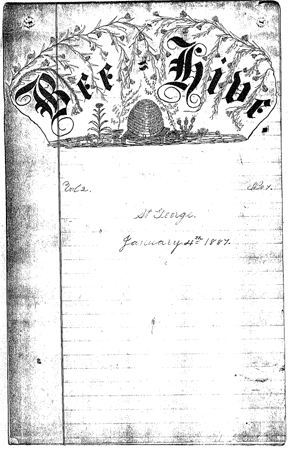
The Beehive, UT, 1887
General Description & Notes:
This was a Mormon Ladies Improvement Society publication. Multiple extant copies of The Beehive are in various states of readability. Most issues have an illustrated masthead, but otherwise blank title page. The stories are in neat cursive writing on lined ledger paper
Information Sources:
Bibliography: None
Locations: Utah State Historical Society, Mss A 1053

The Beehive, UT, Vol. 2, No. 3, N.D.
Barometer (MA-CA, 1849)
June 20, 2011
1849, Alphabetical Order, B, California Gold Rush Papers, Massachusetts, Shipboard Papers, United States Leave a comment
Publication History:
Place of Publication: Shipboard Edward Everett (1849)
Frequency: Weekly, every Saturday
Volume and Issue Data: The Edward Everett departed Boston Jan. 13, 1849
Size and Format: Four pages, handwritten
Editor/Publisher: “A board of five editors was responsible for the journal” (Lewis); members of the Boston and California Joint Mining and Trading Company en route to the California gold fields
Title Changes and Continuation: None
General Description & Notes:
According to Lewis, the first organized contingent to leave Boston for the California gold fields was the Boston and California Joint Mining and Trading Company. The group sailed from Boston aboard the Edward Everett, a 700-ton “fast-ship,” on January 13, 1849. The company of 150 men, included eight sea captains, four doctors, a clergyman, a mineralogist, a geologist, merchants, manufacturers, farmers, artisans and medical and divinity students.
The Edward Everett was a relatively new ship (approximately six years old) and well equipped. The bunks below deck were named after Boston localities. To combat boredom at sea, numerous regularly scheduled activities were organized, including a musical band, a weekly newspaper, Sunday and mid-week church services, and lectures.
The ship’s newspaper Barometer was intended to circulate the ship’s news among the passengers and the crew, and to publish “original contributions in prose and verse.” Lewis calls the Barometer, “probably the earliest of the gold-ship ‘newspapers'” (p. 89). According to Lewis, the Barometer was
a four-page hand-written sheet issued every Saturday during the voyage of the Edward Everett. A board of five editors was responsible for the journal, the columns of which were filled with daily happenings on the ship, together with a record of her position and speed, and a leavening of lighter fare in the form of “original prose and poetical matter.”
Lewis notes that this and other shipboard newspapers (see, e.g., EMIGRANT, THE PETREL, and SHARK) “lacked the formality of print but more nearly approached conventional journalism” than the various travel journals and diaries kept during the voyages.
Information Sources:
Bibliography: Oscar Lewis, Sea Routes to the Gold Fields: The Migration by Water to California in 1849-1852 (New York: A.A. Knopf, 1949), pp. 89-92; Roy Atwood, “Shipboard News: Nineteenth Century Handwritten Periodicals at Sea,” Paper Presentation to the History Division of the Association for Education in Journalism and Mass Communication Annual Convention, Chicago, IL, 1997.
Locations: Bancroft Library, CA?
————————————————————
The Bark Shanty Times (MI, ca. 1857)
June 20, 2011
1857, Alphabetical Order, B, Community Papers, Michigan, United States Leave a comment
Publication History:
Place of Publication: Bark Shanty or Port Sanilac, Michigan
Frequency: Unknown
Volume and Issue Data: In the papers of Uri Urich Raymond, 1857-1883
Size and Format: “Foolscap size and numbers about 200 pages”
Editor/Publisher: Multiple, Uri Urich Raymond was a contributor
Title Changes and Continuation: Port Sanilac Times
General Description & Notes:
According to a transcription produced by Cathi B. Campbell in 2005, Oliver Raymond (relative of Uri Urich Raymond) give a brief history of the town, key settlers and the paper: “Bark Shanty was the original name for Port Sanilac, and the Times was the first institution for the public weal. No types or presses were needed to conduct this enterprise; it was self executing and the editor was not howling continually for the subscribers to pay up. The community in general took a hand in editing the paper but Mr. U. Raymond acted as janitor and property man, though he disclaims any responsibility for its publications. He simply allowed blank writing paper to remain on the counter of his store and any and all were at liberty to write anything they chose and the public were at equal liberty to go and read without money and without price. As the pages were written they were sewed together. It is of foolscap size and numbers about 200 pages.”[emphasis added]
The book, Michigan: A Guide to the Wolverine State (1941), has a description of the paper and explanation of its role in the community (available through Google Books)
Information Sources:
Bibliography: Michigan: A Guide to the Wolverine State (Michigan Administrative Board, 1941), p. 458.
Locations: Manuscript Holdings, Bentley Historical Library, The University of Michigan, Ann Arbor, MI; Library of Congress entry: http://chroniclingamerica.loc.gov/lccn/sn97070569/
Auburn Reporter (AR, 1881)
June 20, 2011
1881, A, Alphabetical Order, Arkansas, Community Papers, Images, United States Leave a comment
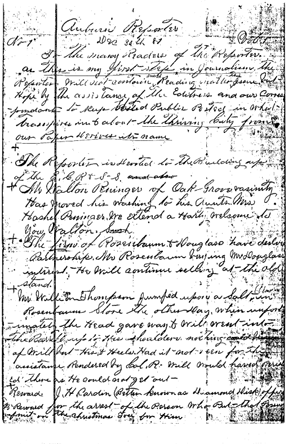
Auburn Reporter, AR, 1881, p. 1
Publication History:
Place of Publication: Town now defunct. Sebastian County near Ft. Smith, Arkansas
Frequency: Unknown
Volume and Issue Data: extant copy: Vol. 1, No. 1, Dec. 30, 1881
Size and Format: 10.5 x 7 inches
Editor/Publisher: Unknown “editress”
Title Changes and Continuation: Unknown
General Description & Notes:
See attached images. One irony in the introductory statement of No. 1, the editor indicates that the paper will keep the “public posted in what transpires in & about the Thriving City from our Paper derives its name” (sic). The town Auburn is now defunct.

Auburn Reporter, AR, 1881, p. 2
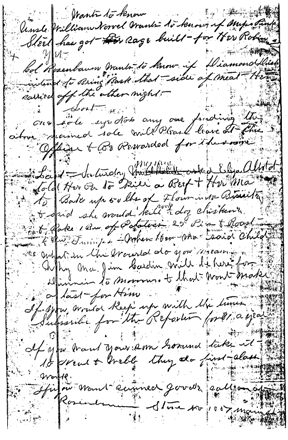
The first page includes briefs on the activities of several individuals. The second page’s top story is about a “bad accident on Christmas eve.” The bottom of the page two and all of page three contain more brief anecdotes about individuals. The fourth and last page invites subscribers:
“If you would keep up with the times, Subscribe for the Reporter for $1 a year.”
Information Sources:
Bibliography: None
Auburn Reporter, AR, 1881, p. 4
Locations: Arkansas Newspaper Project. Extant copy at Arkansas Historical Commission, Little Rock, AK

Auburn Reporter, AR, 1881, p. 3


 The Handwritten Newspapers Project