The Redwing Carrier-Pigeon (KS, 1886)

Leave a comment

Redwing Carrier-Pigeon (KS, 1886)

Publication History:

Place of Publication: Barton County, Kansas

Frequency:  Weekly

Volume and Issue Data:  Vol. 1, No. 2, Dec. 2, 1886

Size and Format:  Single column; masthead includes motto: “Justice and Impartiality”

Editor/Publisher:  H.C. Banke (1886); Dec. 2, 1886 paper identifies two women and one man as part of the “editorial staff,” and refers to the Redwing Literary Society, as if it were a primary sponsor and/or publisher

Title Changes and Continuation:  Unknown

General Description and Notes:

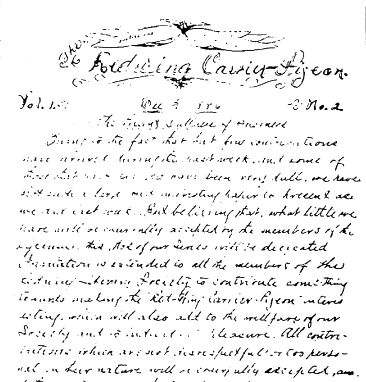
The second number of this paper, signed by H.C. Banke, complains about the lack of news around town and urges contributions.  The editor writes:

“Owing to the fact that but few contributions have arrived during the past week, and some of those that have arrived have been very dull, we have not such a large and interesting paper to present as we did last week.  But believing that, what little we have will be cheerfully accepted by the members of the lyceum, this, No. 2 of our Lines, will be dedicated.  Invitation is extended to all the members of the Redwing Literary Society to contribute something towards making the Red-wing (sic) Carrier-Pigeon interesting, which will also add to the well fare of our Society and to individual pleasure.  All contributions which are not disrespectful or too personal in their nature will be cheerfully excepted (sic), and if they arrive before Wednesday will be published in the current issue of the paper.  However, everything of a personal or disrespectful nature will be avoided from obvious reasons.

“The editorial staff is now composed of Mrs. H.E. Smith, Mr. B.C. Cofer and Mrs. L.J. Gifford.  Contributions sent to either of the before mentioned ladies will reach the editor-in-chief safely.  Contributors are requested to send their contributions and to them will be most convenient.”

Information Sources:

Bibliography:  Robert F. Karolevitz, Newspapering in the Old West:  A Pictorial History of Journalism and Printing on the Frontier (New York:  Bonanza Books, 1969), p. 87; Bob Karolevitz, “Pen and Ink Newspapers of the Old West,” Frontier Times, 44:2 (Feb.-March 1970), 30, 62

Locations:  KSHi-Topeka; front page, Vol. 1, No. 1, Dec. 3, 1886, reproduced in Karolevitz (1969), p. 87, and Karolevitz (1970), p. 30.
The (Carolina) Rebel (SC, 1863)

Leave a comment

The (Carolina) Rebel (SC, 1863)

Publication History:

Place of Publication: Columbia, SC

Frequency:  Unknown (monthly?)

Volume and Issue Data:  Two extant copies: Vol. 1, No. 1, January 28, 1863; Vol. 1, No. 4, April 23, 1863

Size and Format:  Four pages

Editor/Publisher:  “Liliput”

Title Changes and Continuation:  No. 1 is titled The Rebel; No. 4 is titled The Carolina Rebel (though the first column says, “The Rebel, published at Columbia, So Ca, Whenever the Editor is in the right mood by Liliput, Editor and Proprietor.”

The (Carolina) Rebel (SC, 1863)

General Description and Notes:

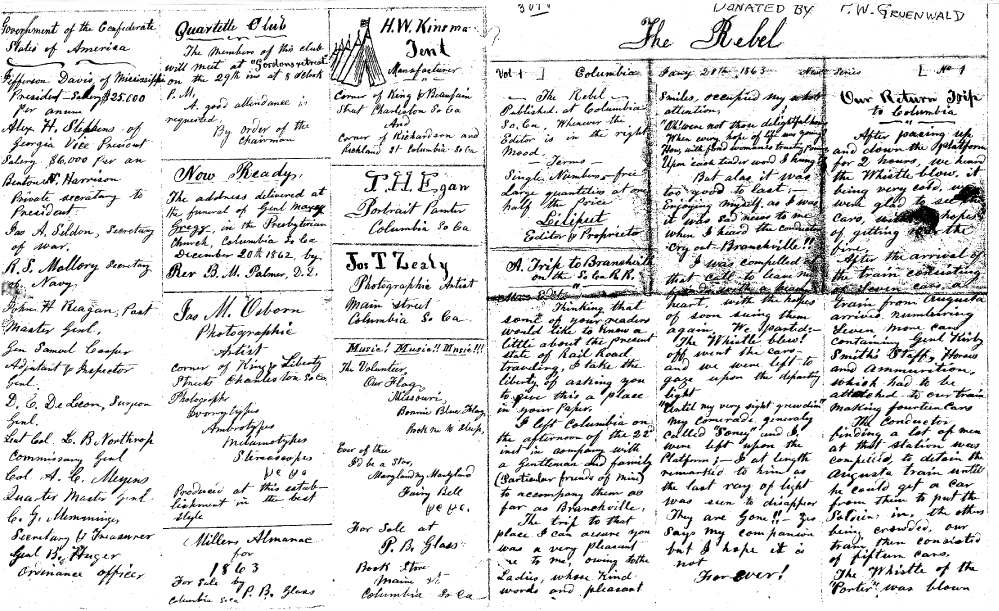
Although The Rebel was produced during the middle of the Civil War (No. 4 was written four months after the Emancipation Proclamation and just days before the Southern Army’s victory at Chancellorsville), the editor makes only minimal references to the conflict. Page four of the April issue has a brief report on the war gathered during the editor’s trip to Charleston. Most of the stories deal with domestic matters (teaching children, food prices, first year of marriage, etc.). This suggests that the paper was most likely the editorial work of a young woman.

According to the South Carolina Historical Society catalog, the Rebel is a “Handwritten newspaper (4 p.). ‘Vol. 1, No.1, published at Columbia, So. Ca., whenever the Editor is in the right mood.’ Includes humorous articles, letters to the editor, articles concerning Confederate officers and officials, and advertisements for ‘T.H. Egan, Portrait Painter’ and others.”

Information Sources:

Bibliography:  Short article in The South Carolina Historical Magazine (1963), page unknown; “The Rebel: A Handwritten 1863 Columbia Newspaper,” Carologue: A Publication of the South Carolina Historical Society, 9:1 (Spring 1993 ), pp. 14-18.

Locations:  Both extant copies are held by the South Carolina Historical Society, Charleston, SC: Vol. 1, No. 1, is part of the manuscript collection donated by P.W. Gruenwald: The Rebel, 1863 Jan. 28. (43/435) ; No. 4 is in the Balzano Collection.

Rattlesnake Blizzard (OR, 1885)

Leave a comment

Rattlesnake Blizzard (OR, 1885)

Publication History:

Place of Publication: Pleasant Hill, Oregon

Frequency:  One issue

Volume and Issue Data: Tuesday, Dec. 30, 1885

Size and Format:  Ledger sheets, 13 pp.

Editor/Publisher:  Anonymous (Pleasant Hill Literary Society?)

Title Changes and Continuation:  Succeeded by the Pleasant Hill Popgun (See Pleasant Hill Popgun)

General Description and Notes:

A handwritten newspaper on old ledger sheets, Dec. 30, 1885; succeeded by the Pleasant Hill Popgun, Dec. 13, 1901, in the same ledger.  Edited anonymously.  Contains brief news items, jokes and anecdotes.

The opening story-editorial states:

 “From the ranks of this society your humble servants have been given the unpleasant and difficult task of editing this paper which we shall call the Rattlesnake Blizzard.

“As this office was forced upon the editors and items are hard to get, and when obtained it takes all the constructive power, and a little more than the writer has, to put them together, the members need not be astonished at the end of this term to see two shattered invalids, or raving maniacs roaming about the country in wild despair [sic], seeking lost health and long forgotten happiness.  Of course those whose sterling worth, honesty, mental and other qualities exceeds those of others are called upon to fill the honorable, now paying position of editors . . . .”

The paper contains sections labeled “Conundrums,” “Stuff & Nonsense,” and “Advertisements.”

Information Sources:

Bibliography:  Martin SchmidtCatalogues and Manuscripts, University of Oregon Library,  Special Collections, Vol. I, 1971, item 888.

Locations:  Special Collections, Knight Library, University of Oregon, Eugene, Oregon

Rapidann (VA, 1864)

Leave a comment

Publication History:

Place of Publication:  Somewhere in Virginia

Frequency: One known extant copy

Volume and Issue Data:  January 1, 1864

Size and Format:  1 sheet

Editor/Publisher:  Unknown

Title Changes and Continuation: Unknown

General Description and Notes:

Handwritten newspaper (1 sheet) created by a Confederate soldier (probably from South Carolina) serving in Virginia. Newspaper contains articles about army life, Virginia, furloughs, and other topics as well as jokes, poems, and illustrations (from SC Hist Soc catalog)

Information Sources:

Bibliography: None

Locations:   Teague, Benjamin H. (Benjamin Hammet), 1846-1921. B.H. Teague family and collected papers, 1770-1899, Manuscript, 1105.07.09, South Carolina Historical Society, Charleston, SC

Quarterly Visitor (IA, 1844)

Leave a comment

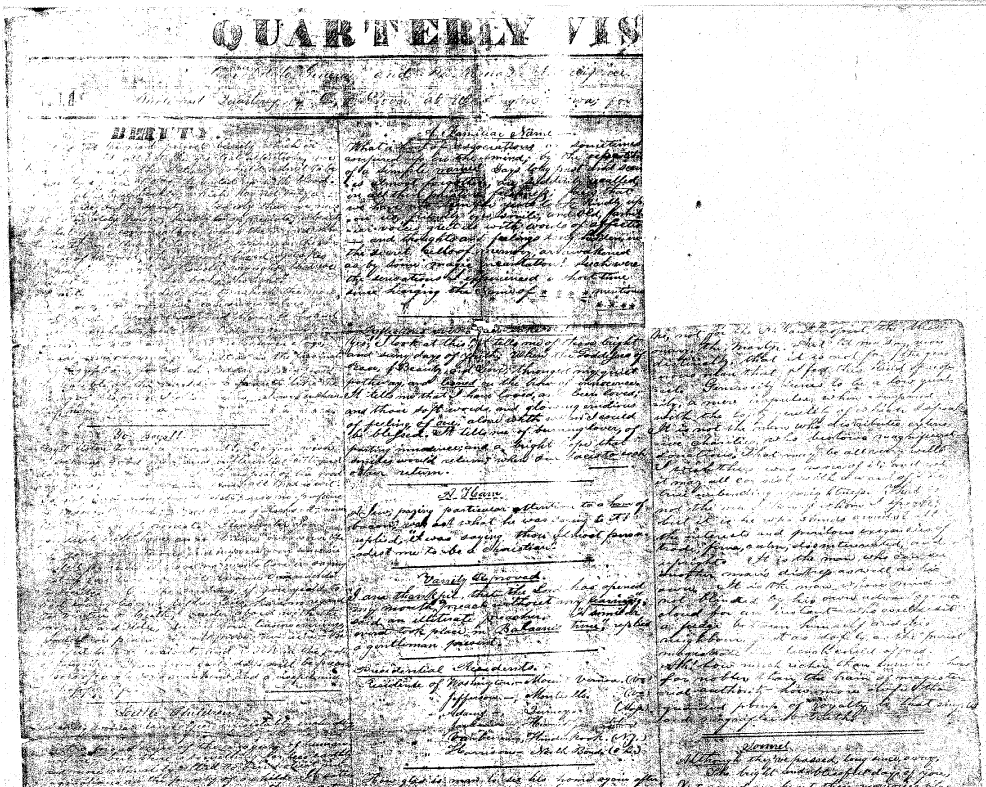
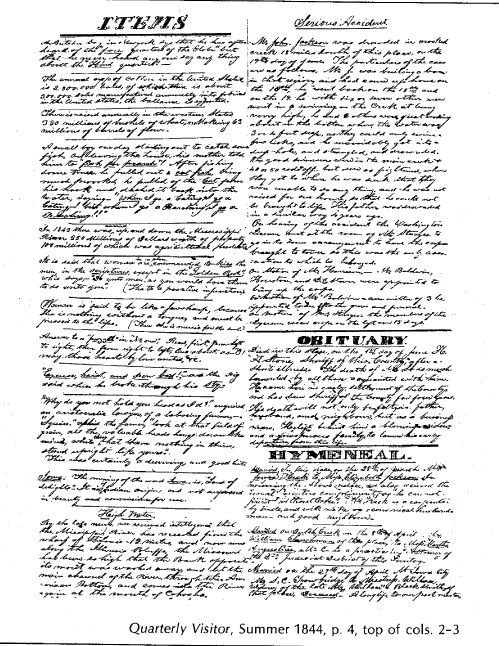
Quarterly Visitor (IA, 1844); upper right corner of front page missing from extant copy

Publication History:

Place of Publication: Washington, Iowa

Frequency:  Quarterly

Volume and Issue Data:  Extant issue, June 1844

Size and Format:  13 x 20 inches; three columns; four pages; ink

Editor/Publisher:  Daniel C. Stover

Title Changes and Continuation:  None

General Description and Notes:

The extant copy of the Quarterly Visitor, June, 1844, contained three basic types of material:  news, features and editorials.  The front page contained mostly poems and short moralisms.  The second page carried three editorials (one which attacked the political neutrality of the Domestic Quarterly Review, another local handwritten paper), a report on an extra session of the Iowa legislature, three news items about rain, wheat and wind, a humor piece about someone’s misfortunes while seeking a claim, a biographical sketch of Henry Clay and two brief news stories.  The third page continued the biographical descriptions of “the most distinguished statesmen now living” (Clay, Martin Van Buren, John C. Calhoun, Richard M. Johnson, James Buchanan and John Tyler).  The rest of the page had an article about the organization of neighboring Keokuk County, a letter to the editor (dated Washington, June 25, 1844) and five short news items.  Included on the third page was a map of Keokuk County showing rivers, townships and sections.  The last page was one-third poetry and two-thirds news items.  Included in the news items were an accidental drowning story and an obituary.

Quarterly Visitor (IA, 1844)

Several references in the extant issue to previous issues provide evidence that at least one previous issue of the paper was written.

Daniel C. Stover, the editor, was a lawyer and had started a law practice in the county seat town of Washington with his brother sometime in 1840, a year after their arrival in Iowa City from Indiana.  In 1844 Stover served as the secretary of the Democratic Convention held in Washington, and was nominated as the Democratic candidate for the Washington County Commissioner’s Clerk.  During the period Stover edited the Visitor, his brother was the district court clerk in Washington.

Information Sources:

Bibliography:  Roy Alden Atwood, “Handwritten Newspapers on the Iowa Frontier, 1844-1854,” Journalism History, 7:2 (Summer 1980), 56-59, 66-67; Nathan Littler, History of Washington County, 1835-1875, ed. by Edna Jones (Washington, Iowa:  Jonathan C. Clark, 1977) pp. 29, 126, 221-222; Kathy Fisher, In the Beginning There Was Land:  A History of Washington County, Iowa (Washington, Iowa:  Washington Historical Society, 1978), pp. 107, 190-191.

Locations:  State Historical Society of Iowa, Archives, Iowa City, Iowa

The Prisoner Vidette (IL, 1864)

Leave a comment

Publication History:

Place of Publication:  Camp Douglas (Prisoner of War Camp), Cook County, IL

Frequency:  Unknown

Volume and Issue Data:  Vol. 1, No. 1, after January 1864

Size and Format:  Four pages

Editor/Publisher:  Confederate Prisoners of War

Title Changes and Continuation:  None

General Description and Notes:

Camp Douglas, named after Stephen Douglas who owned the property, was located on the west side of Cottage Grove Avenue between 31st and 33rd streets in Chicago. In 1861, it was designed for recruiting and training Union soldiers, but after the capture of Fort Donelson in 1862, it became a prison camp for approximately 7,000 Confederate prisoners. The manuscript paper contains camp gossip, editorials, news from home, poetry, and advertisements. The “Prospectus” (page 1) states, “Feeling the want of a literary sheet of some discription [sic], in our midst, we have at length concluded to place before the public of Camp Douglas a spicy little paper, The Prisoner Vidette.”

The extant manuscript the Chicago Public Library Collection was restored at the Document Conservation Center, Atlanta, in 1976.

Information Sources:

Bibliography:  Mabel McIlvaine, ed., “History of Camp Douglas” in Reminiscenes of Chicago During the Civil War (Chicago, 1914), pp. 161-194; Thomas A. Orlando and Marie Gecik, compilers, Treasures of the Chicago Public Library (Chicago, 1977), Item 154, pp. 77-78

Locations: Grand Army Hall and Memorial Association Collection, Chicago Public Library.

The Prison Times (DE, 1865)

Leave a comment

Prison Times, DE, 1865; Image Source: Library of Congress; images of four pages at the New York Historical Society website

Place of Publication:  Fort Delaware, a Union prison camp holding Confederate officer prisoners, located on Pea Patch Island where the Delaware River merges into Delaware Bay, just south of New Castle, DE

Frequency:  Four extant copies (according to the NY Historical Society [with thanks to Joseph Ditta; see comments below; updated 9-24-12)

Volume and Issue Data:  Vol.  1, No. 1, April  8, 1865

Size and Format:  See image below

Editor/Publisher:  J.W. Hibbs, Capt. 13th Va. Inf.was the publisher.  Proprietors and editors were George S. Thomas, Capt. 6thGa., Div. 24; W.H. Bennett, Capt. & A.C.S., Div. 24; and A. Harris, Lt. 3rdFla., Div. 28.

Title Changes and Continuation:  See The Stonewall Register

General Description and Notes:

Evidently there are three extant copies of the same issue, one in Savannah, Georgia, Charleston, South Carolina, and the other in Buffalo, NY.  The paper contains editorials, announcements, advertisements, poetry, barracks directory, Christian Association Directory, notices of clubs, and prison news notes.  The NY letter says, “As General Lee surrendered to General Grant on the 9th, this [April 8] issue may well have been the sole issue.”

In a letter from William H. Loos, Curator, Rare Book Room, Buffalo and Erie County Public Library, Buffalo, NY, dated July 14, 1993, Loos states that he found an extant copy of The Prison Times in “an old portfolio of loose single issues of early American newspapers that we have had for many years and which I had not had occasion to consult in nearly twenty years.” Two representatives from the New York State Library, who were working on the state’s portion of the national newspaper project, came to the Buffalo library to research their collection. “When I reviewed this portfolio before one of the researchers recorded its contents,” Loos wrote, “I was surprised to find a handwritten newspaper.”

According to Loos,

“The newspaper is vol. 1, no. 1 of the Prison Times issued at Fort Delaware in 1865. On page two, the date April 8th appears. As General Lee surrendered to General Grant on the 9th, this may well have been the sole issue. Fort Delaware was a prison camp for Confederate officers. The fort was located on Pea Patch Island where the Delaware River merges into Delaware Bay, just south of New Castle, Delaware.”

According to the South Carolina Historical Society records, P.A. McMichael raised a Confederate volunteer company that became Company G of the Twentieth South Carolina Infantry. He served in the Charleston, South Carolina area (1861-1863) mainly around Sullivan’s Island, and in Virginia, where he participated in the battle of Cold Harbor and was promoted to Lt. Col of the 20th Regiment. He was captured at Cedar Creek and taken to Fort Delaware.  His collection includes the handwritten newspaper, Prison Times (vol. 1, no. 1) for prisoners at Fort Delaware, Del. The South Carolina Historical Society catalog says the paper contains “advertisements for tailoring, barbering, music, religious assistance, debate and chess clubs with poetry, barracks directory, and descriptions and comments on prison life.”

Information Sources:

Bibliography:

Links: New York Historical SocetyGeorgia Historical Society catalog entry for The Prison Times;  South Carolina Historical Society, Paul A. McMichael holdings; see also  http://chroniclingamerica.loc.gov/lccn/sn93063825/

Locations:  Prison Times, Misc. Fort Delaware: NYUGB12021269-A, New York Historical Society, with images of four pages; Prison Times, MS 638, Georgia Historical Society, Savannah, Georgia; and Buffalo and Erie County Public Library, Buffalo, NY; and Prison Times in Paul Agalus McMichael (1820-1869),  correspondence and diary, 1861-1865 (1073.00),  South Carolina Historical Society, Charleston, SC.

The Potters Wheel (MO, 1904-1907)

Leave a comment

Publication History:

Place of Publication: St. Louis, MO

Frequency:  Monthly

Volume and Issue Data:  15 issues, 1904-1907

Size and Format: Unknown

Editor/Publisher:  The Potters, a group of St. Louis women artists and writers who issued this monthly magazine

Title Changes and Continuation: Unknown

General Description and Notes:

“A single copy of the magazine was hand-lettered and hand-illustrated by the Potters. It contained a variety of artistic output, including poetry and prose, photographs, calligraphy artwork, and needlework.  Comprised of young women in their late teens and early twenties, the Potters included poet Sara Teasdale, artists Caroline Risque and Petronelle Sombart, photographers Grace and Williamina Parrish, and writers Vine Colby, Inez Dutro, Celia Harris, Edna Wahlert and Guida Richey.  Their mentor, Lillie Rose Ernst, was a botany teacher at Central High School [and later an administrator with the St. Louis Public School System], and she alternately encouraged and challenged them.  The Potters went their various ways after 1907, some of them to marry, others for further study or to actively pursue careers in distant places.

The collection contains poems, short stories, watercolor prints, photographs–mostly portraits, various hand-painted designs, plays, fabric covered designs, and photographs of sculptures.

Information Sources:                   

Bibliography: None

Locations:  The Potters Wheel Collection, Missouri Historical Society Archives, St. Louis, MO; three issues  in the Yale University Collection of American Literature, Beinecke Rare Book and Manuscript Library, New Haven,CT

Potosi Nix Cum Rouscht (NV, 1861)

Leave a comment

Publication History:

Place of Publication: Potosi, Nevada (then in northwest New Mexico Territory)

Frequency:  Not more than one or two issues

Volume and Issue Data:  Late Feb. 1861

Size and Format:  Unknown

Editor/Publisher:  Capt. J.E. Stevens, aka “Man about the Mill”

Title Changes and Continuation:  None

General Description and Notes:

According to Lingenfelter and Gash, editor Stevens started this manuscript paper in late Feb. 1861 so as “not to be outdone by Talbott’s Miner’s Voice.”  Stevens was the president of the Colorado Mining Company and founder of Potosi.  The editor said the paper was “printed” at Las Vegas station and “published at Potosi.”  The paper probably did not last beyond the first issue.

Information Sources:

Bibliography:  Robert F. Karolevitz, Newspapering in the Old West:  A Pictorial History of Journalism and Printing on the Frontier (New York:  Bonanza Books, 1969), p. 119; Richard E. Lingenfelter, The Newspapers of Nevada (San Francisco:  John Howell-Books, 1964), 67; Richard E. Lingenfelter and Karen R. Gash, The Newspapers of Nevada (Reno:  University of Nevada Press, 1984), p. 171.

Locations:  No issues located, but Feb. 19, 1861 issue (Vol. 1, No. 1) quoted in Los Angeles Star, March 9, 1861.

Pony Gazette (MD, 1854-1856)

Leave a comment

PONY GAZETTE

Publication History:

Place of Publication:  Baltimore, Maryland

Frequency:   Unknown

Volume and Issue Data:  From 1854 (-56?)

Size and Format:  4-6 pages, roughly 8″ x 14″

Editor/Publisher:  Hook and Ladder Firemen’s Association

Title Changes and Continuation:

General Description and Notes:

The local organ of the Hook and Ladder volunteer fire company, handwritten on stock with a pre-printed masthead, in good condition and very legible. See also The Pickwickian, a New York Hook and Ladder Association’s handwritten paper.

Information Sources:

Bibliography: None

Locations:  The Hook and Ladder Company Collection (MS 662), Manuscripts, Maryland Historical Society,  Baltimore, MD

Politische Richter (WI, 1860)

Leave a comment

Publication History:

Place of Publication: Burlington, WI?

Frequency:  Likely weekly

Volume and Issue Data:  Feb.-Apr.? 1860

Size and Format:  two pages of foolscap

Editor/Publisher:  Mathias Bachmayer

Title Changes and Continuation:  The exact title is uncertain; “Political Judge” is the translation.

General Description and Notes:

In German.  The paper is known only from mentions in the Burlington Gazette of March 20, 1860, ” . . . the paper is hand copied.  It is free and devoted to calling out the Catholic church building committee and local news.” and Apr. 4, 1860, “number twelve is received.  It covers two pages of foolscap.”  The exact title is uncertain; that given above is a translation from the English given in the Gazette.

Information Sources:         

Bibliography:  Burlington Gazette, March 20, 1860 and April 4, 1860; information from James P. Danky, Newspapers and Periodicals Librarian, The State Historical Society of Wisconsin, Madison, WI

Locations:  No copies are known.

Pleasant Hill Popgun (OR, 1901)

Leave a comment

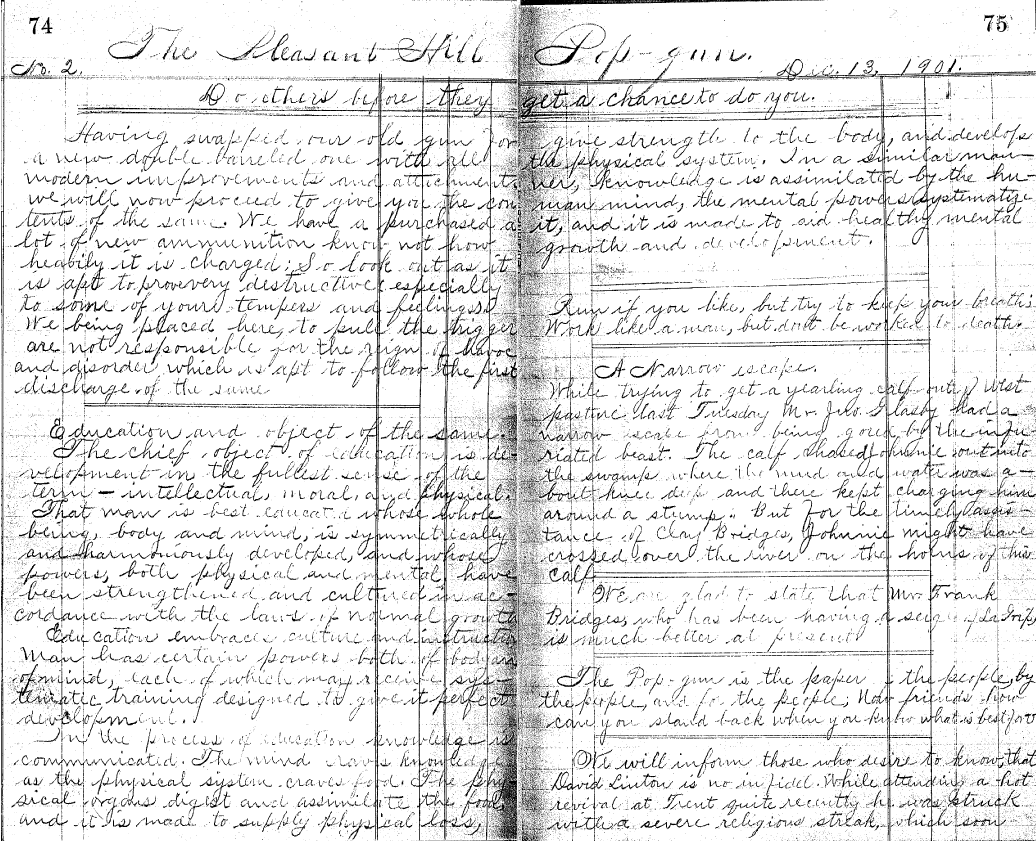
Pleasant Hill Popgun (OR, 1901)

Place of Publication: Pleasant Hill, Oregon

Frequency:  One issue?

Volume and Issue Data:  No. 2, Dec. 13, 1901

Size and Format:  Ledger sheets, 14 pp.

Editor/Publisher:  Anonymous (Pleasant Hill Literary Society?)

Title Changes and Continuation:  Succeeded Rattlesnake Blizzard

General Description and Notes:

A handwritten newspaper on old ledger sheets, Dec. 13, 1901, in the same ledger as the earlier, Rattlesnake Blizzard, Dec. 30, 1885.  Edited anonymously.  Contained brief news items, jokes and anecdotes.

Page two contains the following:

“The Pop-gun is the paper of the people, by the people, and for the people; Now friends how can you stand back when you know what is best for U [sic].”

 The paper ends with this statement:

 “We desire to thank those who have so cheerfully contributed to these columns.  Without the aid of all the members it would be impossible for one to produce a piece of work such as the society will expect of their servants.  We have consigned nothing to the waste basket and have carefully looked over the almanacs and magazines in securing our material for this issue of the paper.  Now as we are about to step out we [sic] our successors a successful term and have a liberal patronage.  The present editors will hereafter be seen wandering about seeking lost health and long forgotten happiness.  Thanking you for the patronage we have enjoyed we now retire with the greatest of pleasure.”

Information Sources:

Bibliography:  Martin Schmidt, Catalogues and Manuscripts, University of Oregon Library, Special Collections, Vol. I, 1971, item 888.

Locations:  Special Collections, Knight Library, University of Oregon, Eugene, Oregon

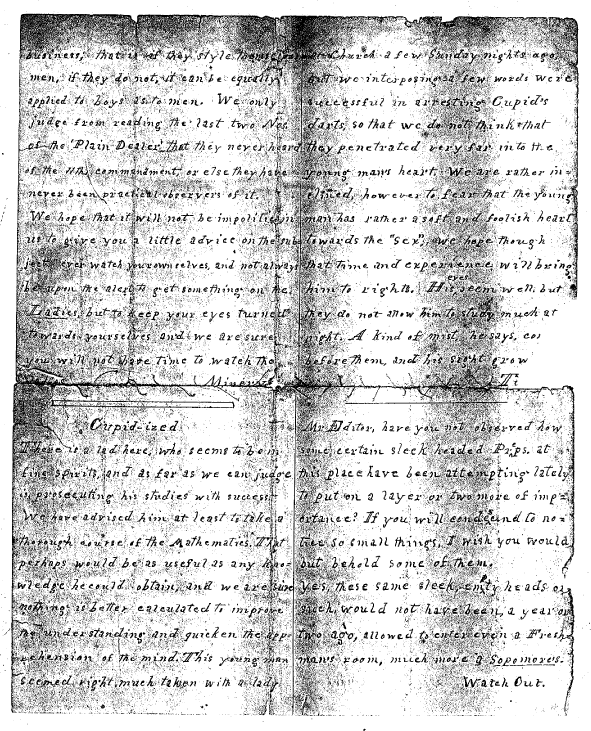
Plain Dealer (NJ, 1775-1776)

Leave a comment

Publication History:

Place of Publication: Potter’s Tavern, Bridgeton, Cumberland County, NJ

Frequency: Weekly, “every Tuesday morning”

Issue Data:  8 issues, December 21, 1775 through November 23, 1776.

Size and Format: Unknown

Editor/Publisher:  Ebenezer Elmer, 23, a native of Fairfield, NJ

Title Changes and Continuation: Unknown

General Description and Notes:

According to the Cumberland County, NJ, history webpage,

“The Plain Dealer, the first newspaper established in New Jersey expressly for the purpose of supporting the sometimes faltering drive for American liberty, is one of the literary-political landmarks of the American Revolutionary period. The distinguished historian, John T. Cunningham, said that the fact that the Plain Dealer appeared every Tuesday morning probably made it New Jersey’s first regular “Newspaper.”

Potter’s Tavern, where the Plain Dealer was published is one of New Jersey’s most significant historical shrines.

“The editor of the Plain Dealer was Ebenezer Elmer, age 23, a native of Fairfield, a tea burner and a young physician who later distinguished himself as a soldier, a statesman and a public benefactor. He was the last survivor of Washington’s officers of the Jersey Continental Line. He was also the last original member of the New Jersey Society of the Cincinnati and at his death was the president of that mutual aid organization formed by the officers of Washington’s army when his troops were disbanded.

“Containing clear and persuasive argument in favor of Liberty from British domination, the Plain Dealer successfully served to crystallize sentiment in Cumberland County in favor of armed resistance. This accomplished, the editor and the contributors went off to war.

“The tavern bore the name of its licensed keeper, Matthew Potter. He was a brother of David Potter, who was later a Colonel in the Militia. Matthew’s place of entertainment was a gathering spot for the local firebrands. The fact that he gave a home to the Plain Dealer placed him in personal danger in the Revolutionary period. The silhouette on the cover of this booklet is the only likeness of Ebenezer Elmer so far identified.

“The original manuscript of the Plain Dealer was in the hands of Bridgeton owners who held it by inheritance. In the 1930’s it found its way into the streams of trade finally coming to rest in the Rare Book Collection of Rutgers, The State University.”

Information Sources:

Bibliography: “The Plain Dealer,” Cumberland County, NJ, history webpage

Locations:  Special Collections and Archives, Rutgers University Libraries, New Brunswick, NJ

The Plain Dealer (NC, 1857 or 1858)

Leave a comment

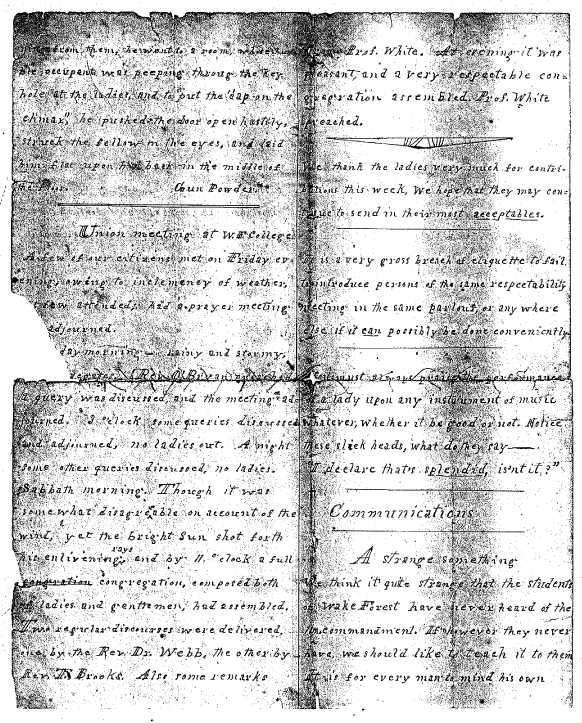
The Plain Dealer (NC, 1857 or 1858)

Publication History:

Place of Publication: Wake Forest College, Winston-Salem, NC

Frequency:  Unknown

Volume and Issue Data:  No dates, but from dates found, it is from an issue of about 1857 or 1858.

Size and Format:  Only 2 pages remain–no cover page.

Editor/Publisher: Unknown

Title Changes and Continuation:  The Student?

General Description and Notes:

The Plain Dealer” was the forerunner of the “Student“.  Printing was done with a pen, very neatly, and very readable.

Information Sources:

The Plain Dealer (NC, 1857 or 1858)

Bibliography:  “A Leaf from the “Plain Dealer.”  The Wake Forest Student, April 1905, XXIV No. 7, pp.483-485.

Locations:  University Archives, Z. Smith Reynolds Library, Wake Forest University, Winston-Salem, NC

The Pioneer Budget (MI, 1854)

Leave a comment

Publication History:

Place of Publication: Unknown

Frequency:  Unknown

Volume and Issue Data:  1854

Size and Format: Unknown

Editor/Publisher:  Comstock, J. (?)

Title Changes and Continuation: Unknown

General Description and Notes:

None

Information Sources:

Bibliography: None

Locations:  Manuscript Holdings, Bentley Historical Library, The University of Michigan, Ann Arbor, MI

Pioneer Banner (FL, no date, ca. 1860s)

Leave a comment

PIONEER BANNER

Publication History:

Place of Publication:  Fort Barrancas (near Pensacola, now part of the U.S. Naval Air Station), FL

Frequency:  “semi-occasionally”

Volume and Issue Data: Unknown

Size and Format:  Unknown

Editor/Publisher:  Young Confederates stationed at Fort Barrancas

Title Changes and Continuation: Unknown

General Description and Notes:

Civil war era.  Published for the young ladies of the Union Female College.

Information Sources:

Bibliography:  Bell Irvin Wiley, They Who Fought Here, NY:  Bonanza Books, 1959, p. 161.  See Secesh Eradicator also.

Links: Re. Fort Barrancas

Locations:  Unknown

The Pioneer (NE, 1872)

Leave a comment

Publication History:

Place of Publication: Norfolk, Nebraska

Frequency:  Issued “semi-occasionally”

Volume and Issue Data: Jan. 17, 1872

Size and Format:  Two columns

Editor/Publisher:  Unknown?

Title Changes and Continuation:  Unknown

General Description and Notes:

According to the Federal Writers’ Project guide to Nebraska, The Pioneer was not sold for money, but traded for wheat, potatoes, minkskins, and eggs.  The front page carried Norfolk business “card” advertisements and poetry, with at least one titled, “Women Rights.”

Information Sources:                              

Bibliography:  Federal Writers’ Project, compilers, Nebraska:  A Guide to the Cornhusker State (New York:  The Viking Press, 1939), 134-135; Robert F. Karolevitz, Newspapering in the Old West:  A Pictorial History of Journalism and Printing on the Frontier (New York:  Bonanza Books, 1969), 111

Locations:  NB?; Reprint:  Federal Writers’ Project, compilers, Nebraska:  A Guide to the Cornhusker State (New York:  The Viking Press, 1939),135.

Pioneer (CA, 1856)

Leave a comment

Publication History:

Place of Publication: North San Juan, California

Frequency:  Semi-monthly

Volume and Issue Data:  March-July 4, 1856; six issues

Size and Format:  “sheet of foolscap”

Editor/Publisher:  Unknown

Title Changes and Continuation:  None

General Description and Notes:

According to Kennedy, the only newspaper at North San Juanwas a manuscript sheet called the Pioneer, which appeared in 1856.  Kennedy speculates that the paper may have been a humorous publication.

Information Sources:

Bibliography: Chester P. Kennedy, “Newspapers of the California Northern Mines, 1850-1860–A Record of Life, Letters and Culture,” unpublished Ph.D. dissertation, Stanford University, 1949, pp. 24-25, 39, 132, 289, 508-509, 511-512, 609

Locations:  Cu-B?

Pine Grove and Rockland Star (NV, 1872)

Leave a comment

See Pine Grove Burlesque

Pine Grove Chronicle (NV, 1872)

Leave a comment

See Pine Grove Burlesque

Older Entries Newer Entries